
Why Jhajjar businesses are investing in multi-vendor marketplaces
Jhajjar is a commercial centre in Haryana, India home to about 89,000 people, and one of the places where we build multi-vendor marketplaces for local businesses.
Industrial and logistics belt — a business base that increasingly wants to sell online rather than through calls, messages and spreadsheets.
Across Haryana, the economy is shaped by automobiles, IT and corporate offices in Gurugram, agriculture, textiles and logistics around Delhi, with Chandigarh as the state capital.
India has more than 6 crore (60 million) MSMEs registered on the Udyam portal (Ministry of MSME). India has the world's largest real-time payments system in UPI and one of the fastest-growing online shopper bases, increasingly from tier-2 and tier-3 cities. Businesses that own their store — with UPI, COD, regional languages and WhatsApp updates — build loyal customers instead of renting them from marketplaces.
For a business in Jhajjar, the opportunity is to own the customer relationship: your own multi-vendor marketplace keeps your margin, your data and your brand, while marketplaces and social channels become additional sales routes instead of the only one.
Why going digital matters for a business in Jhajjar
In India, buying starts on a phone: shoppers search, compare on Amazon.in and Flipkart and pay with UPI (Google Pay, PhonePe, Paytm) and RuPay, Visa and Mastercard cards. Jhajjar alone has about 89,000 people, and a business without its own multi-vendor marketplace hands those orders to whoever is easier to buy from.
Orders taken by phone, WhatsApp or spreadsheet cost real money: stock goes wrong, payments are chased by hand and sales stop when the shop closes. Mobiles and electronics, fashion and ethnic wear and beauty and personal care are among the strongest online categories in India, so the demand is already there to capture.
It is also a compliance move. GST-ready invoices and records, and customer data handled under the Digital Personal Data Protection Act 2023 and the DPDP Rules 2025, are far easier to keep right in one system than across notebooks and chat threads.
| Area | Offline and chat orders | With your own multi-vendor marketplace in Jhajjar |
|---|---|---|
| Orders | Phone, WhatsApp, spreadsheets; open only in shop hours | Taken 24 hours a day, tracked end to end |
| Payments | Cash and manual follow-up | UPI (Google Pay, PhonePe, Paytm) and RuPay, Visa and Mastercard cards and other local methods at checkout |
| Reach | Walk-ins and word of mouth | Search, social, Amazon.in and Flipkart and a link anyone can share |
| Records | Paper and chat history | GST invoices, customer and stock data in one place |
Local details we build into every Jhajjar project
A store that works in Jhajjar respects local habits as well as local law. These are the details we configure first.
Currency and pricing
Everything a Jhajjar shopper sees — price, tax, delivery fee, refund — is in INR, written the local way.
Language and content
Storefront copy, product pages and emails can run in Hindi, Haryanvi and Punjabi, with local date and number formats.
Local trust signals
Trust is local: familiar names such as UPI (Google Pay, PhonePe, Paytm) and RuPay, Visa and Mastercard cards and Delhivery sit next to the buy button.
Domain, phone and contact
A .in domain (or your own) builds local trust and search relevance. Click-to-call and WhatsApp buttons use the +91 calling code so customers reach you without dialling errors.
Custom-built for how you sell in Jhajjar
We do not hand Jhajjar businesses a ready-made theme: we study how you sell, then build the online platform and Android/iOS app your customers and staff actually need.
Typical clients include regional seller networks, B2B supplier platforms, service-provider marketplaces and institutional procurement platforms. Categories that sell especially well online in India — mobiles and electronics, fashion and ethnic wear, beauty and personal care and groceries and FMCG — get catalogue structures and filters designed for them.
Before any commitment you get a free requirements meeting, a demo built on your use case and a proposal priced to your budget.
What a multi-vendor marketplace in Jhajjar should include first
For Jhajjar, we suggest this sequence, so the first release already takes orders and later releases add the rest:
- Pilot marketplace: Seller onboarding, catalogue, checkout, order routing and basic payouts. Set up for INR, UPI (Google Pay, PhonePe, Paytm) and Delhivery.
- Govern and grow: Moderation, commissions, promotions, reviews and dispute handling.
- Scale: Buyer and seller apps, new categories, cities and service areas.
What your multi-vendor marketplace includes
Each module below is configured — or custom-developed — to your requirements. You choose what launches first and what follows in later phases.
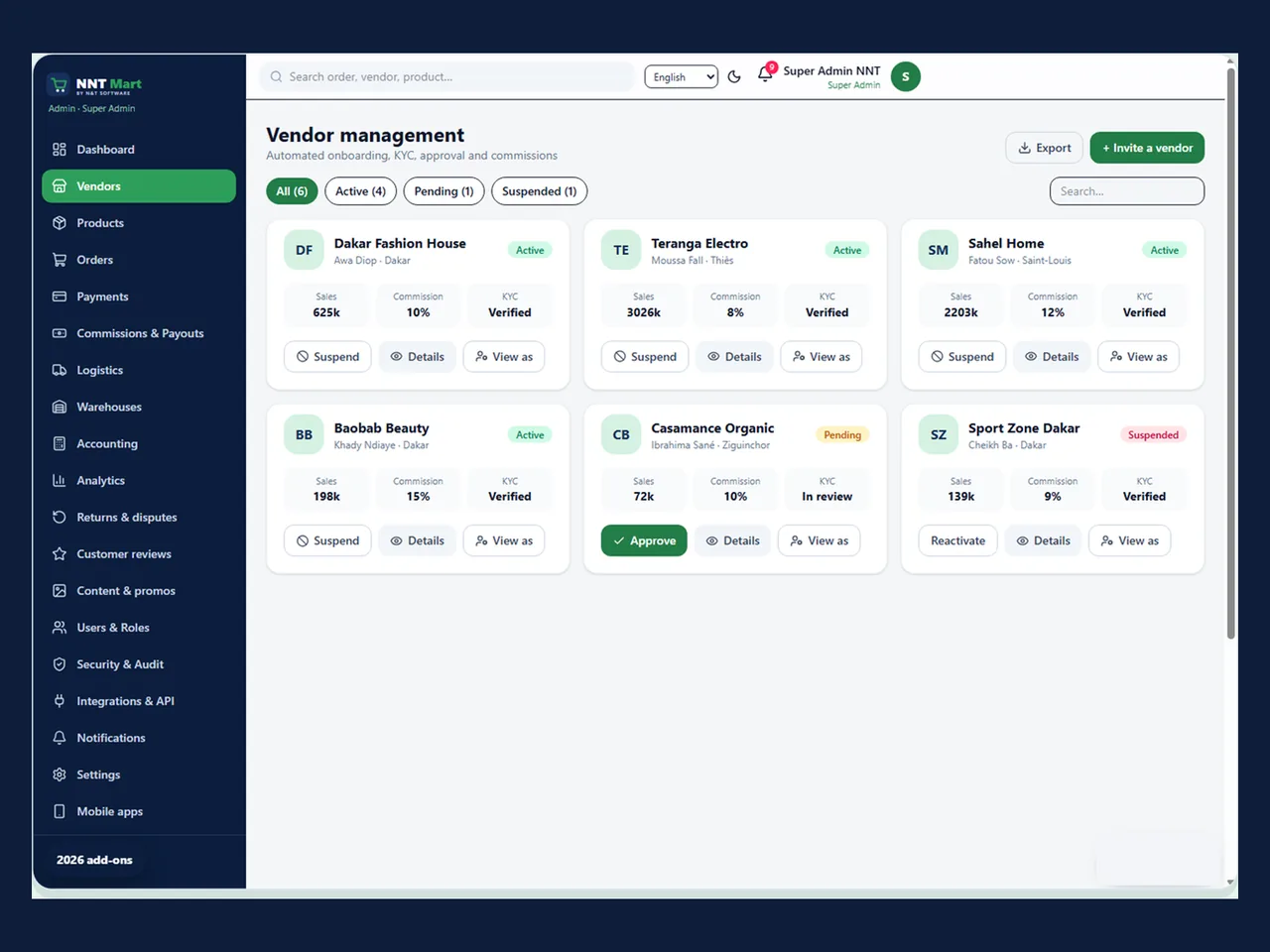
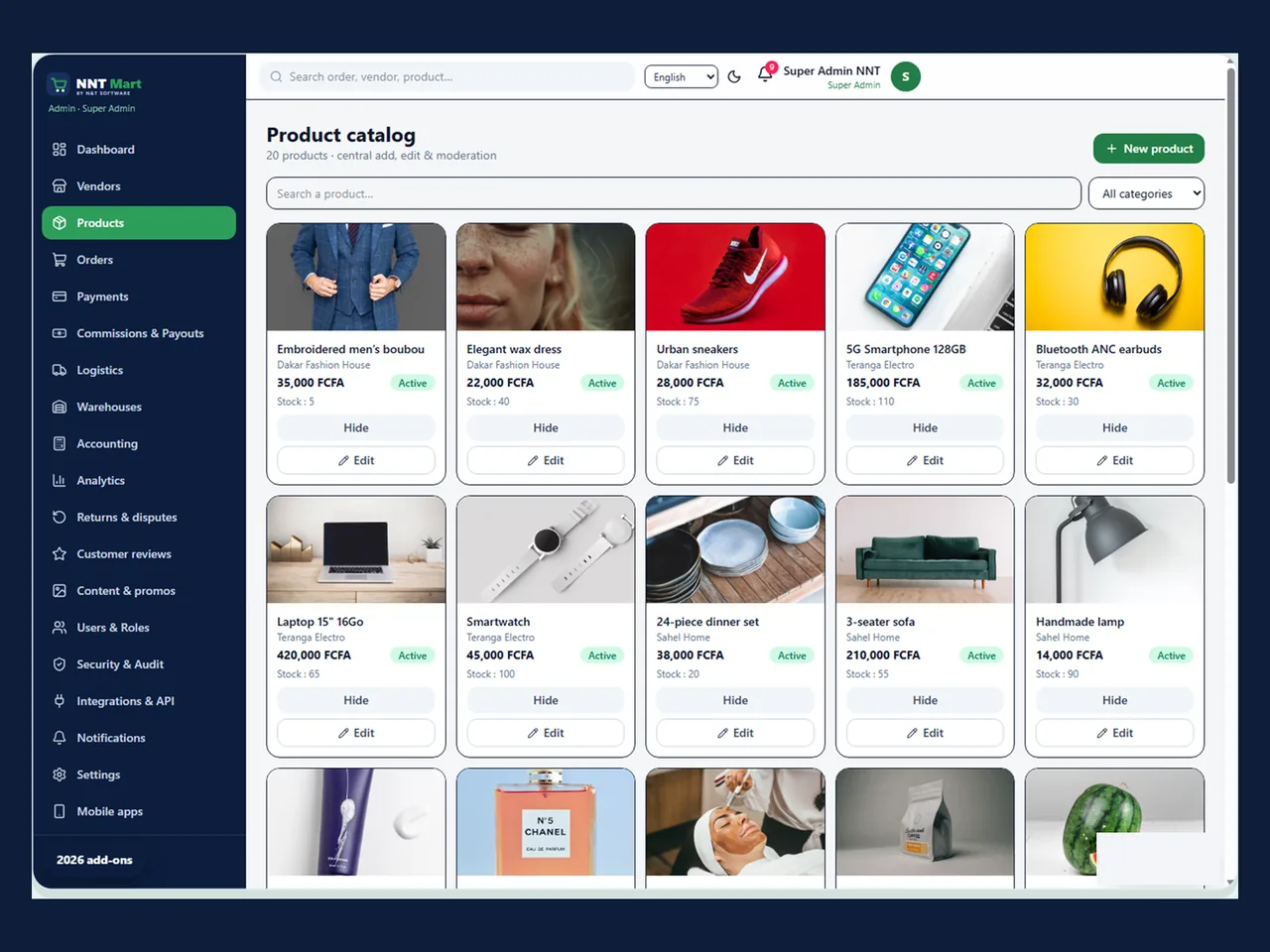
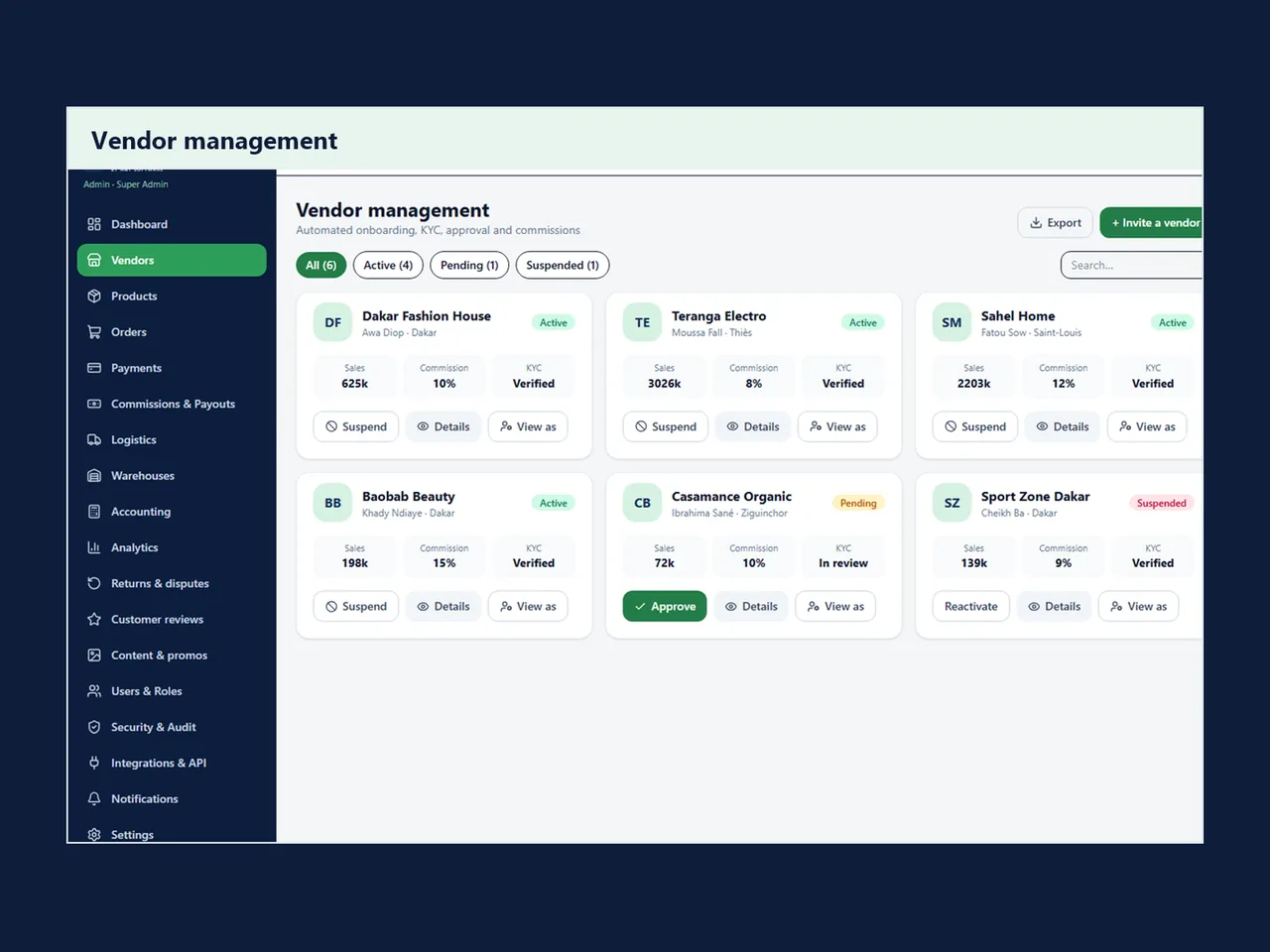
Vendor onboarding
Application, document verification, agreements, approval and seller dashboards with team access. Storefront language, imagery and navigation are set up for Jhajjar shoppers and available in Hindi and Haryanvi.
Catalogue governance
Listing templates, moderation queues, category rules, image standards and duplicate detection. Bulk import and sync tools mean the Jhajjar team never re-keys stock, prices or descriptions by hand.
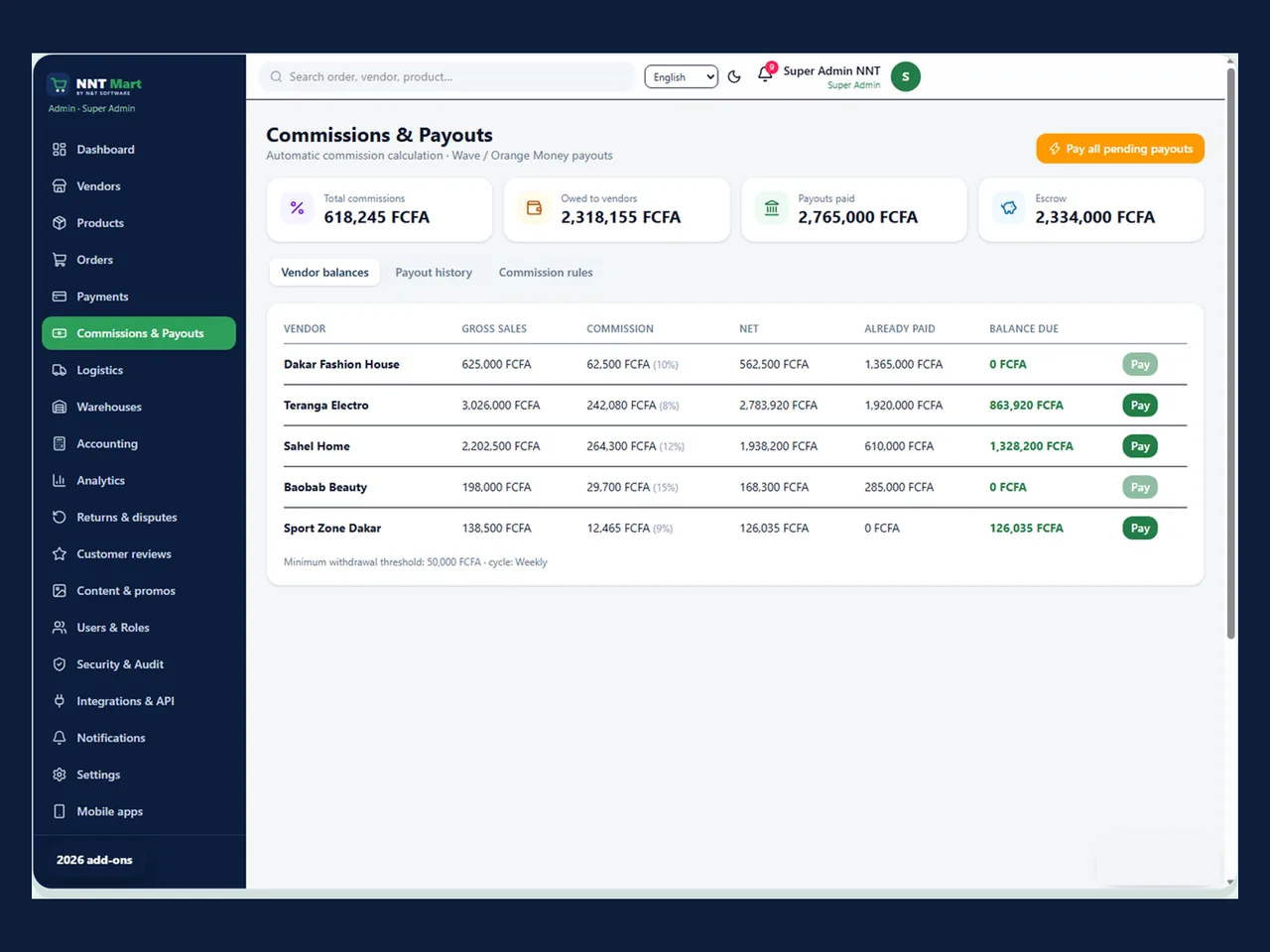
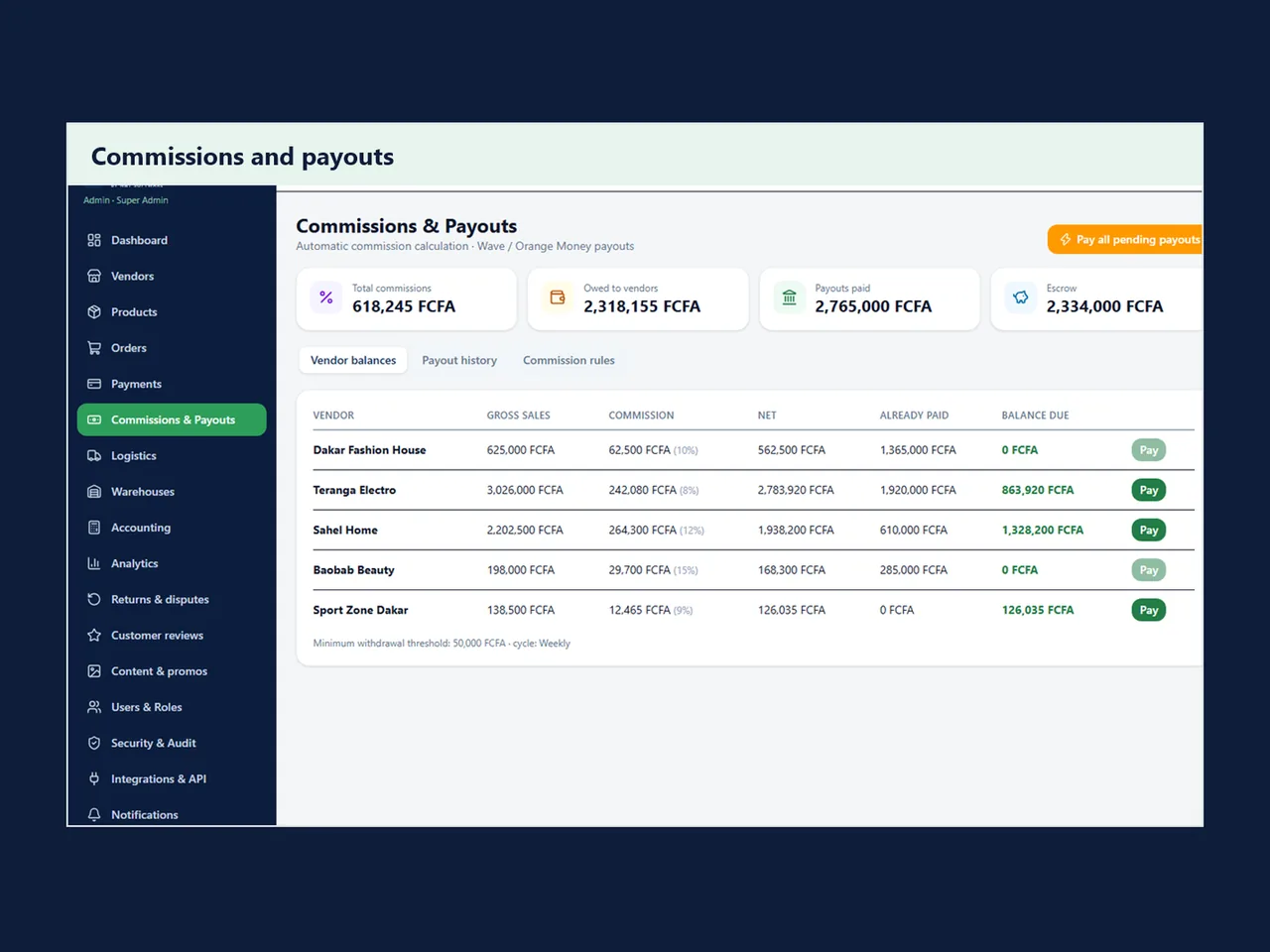
Commission engine
Commissions and fees by vendor, category, product or transaction, with promotions funded by either party. Payment steps are built around UPI (Google Pay, PhonePe, Paytm), RuPay, Visa and Mastercard cards and net banking, the options shoppers here already trust.
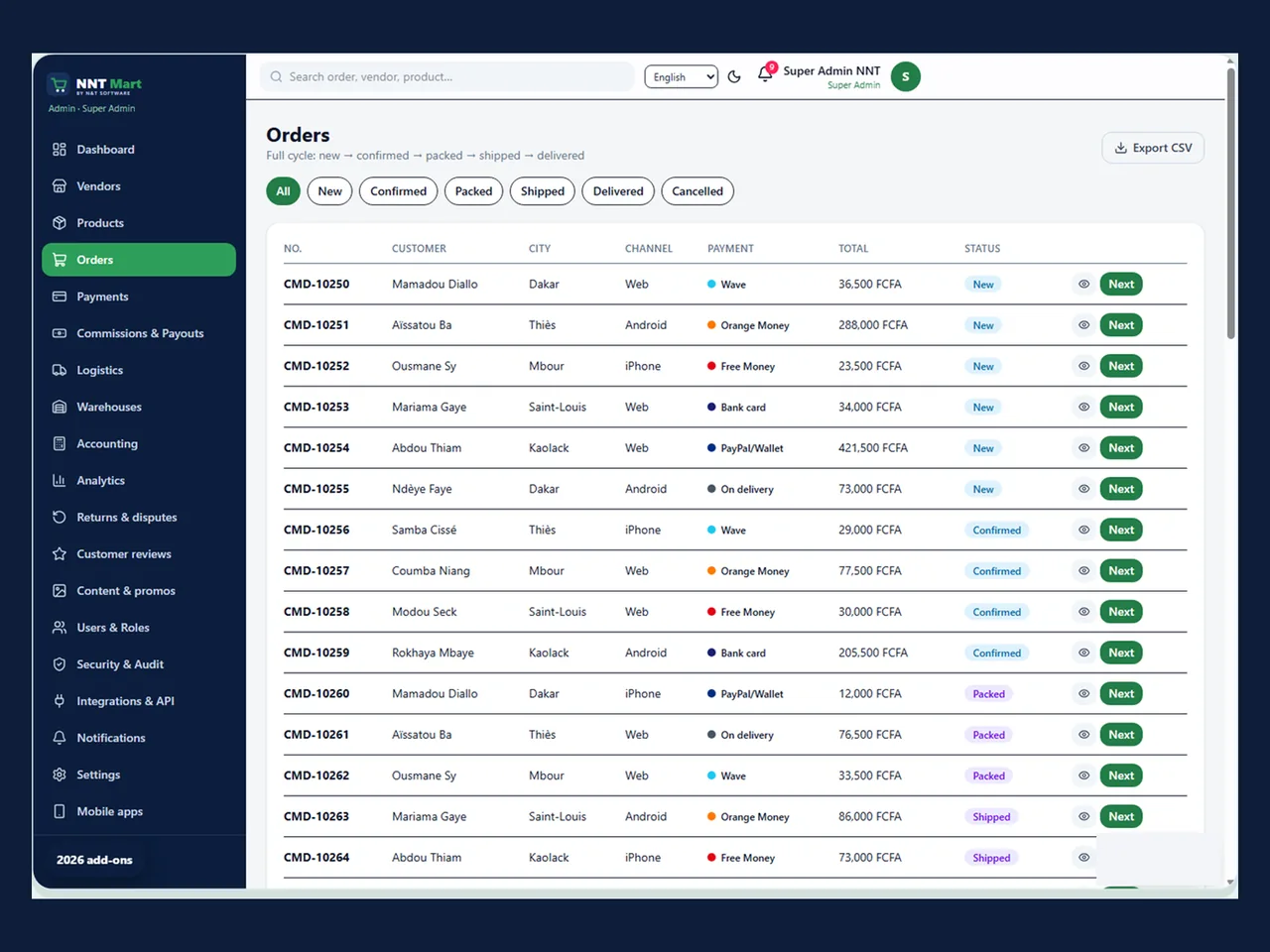
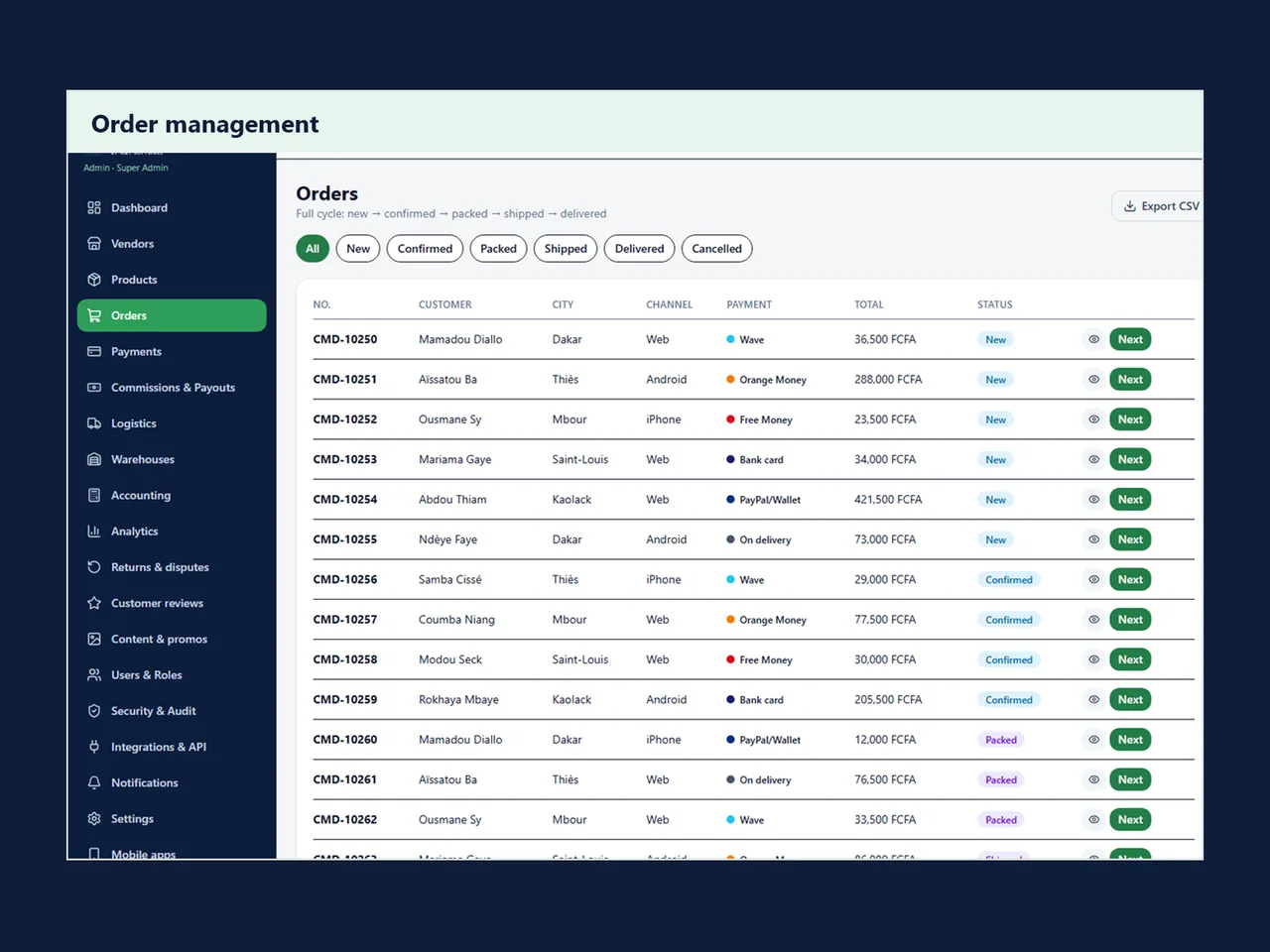
Order routing
Split carts, vendor-wise fulfilment, shipping rules, service areas and delivery tracking. Shipping rules can use Delhivery, Blue Dart and Shiprocket as well as your own delivery staff in Jhajjar.
Settlements
Payout calculations, reconciliation reports and integration with split-payment providers where permitted. Inventory can sit in Jhajjar, in a partner warehouse or across Haryana, with click-and-collect where customers want it.
Trust and support
Ratings, reviews, returns, disputes, seller performance scores and customer-support workflows. Revenue reports by product, repeat buyer and delivery area of Jhajjar guide stock and marketing decisions.
Multi-vendor marketplace development and more: what we build in Jhajjar
Businesses in Jhajjar search for these in different words. Each one is something NNT Mart designs, builds and supports:
Multi-vendor marketplace development in Jhajjar
Application, document verification, agreements, approval and seller dashboards with team access. For Jhajjar, prices, tax and invoices are in INR and GST-ready.
Marketplace website like Amazon in Jhajjar
Listing templates, moderation queues, category rules, image standards and duplicate detection. Built for Jhajjar: UPI and RuPay, Visa and Mastercard cards payments and Delhivery delivery.
Build an online marketplace in Jhajjar
Commissions and fees by vendor, category, product or transaction, with promotions funded by either party. In Jhajjar it takes UPI at checkout and ships through Delhivery.
Vendor marketplace platform in Jhajjar
Split carts, vendor-wise fulfilment, shipping rules, service areas and delivery tracking. For Jhajjar, prices, tax and invoices are in INR and GST-ready.
B2B marketplace development in Jhajjar
Payout calculations, reconciliation reports and integration with split-payment providers where permitted. Built for Jhajjar: UPI and RuPay, Visa and Mastercard cards payments and Delhivery delivery.
Local marketplace app in Jhajjar
Ratings, reviews, returns, disputes, seller performance scores and customer-support workflows. In Jhajjar it takes UPI at checkout and ships through Delhivery.
Marketplace commission software in Jhajjar
Application, document verification, agreements, approval and seller dashboards with team access. For Jhajjar, prices, tax and invoices are in INR and GST-ready.
Seller onboarding platform in Jhajjar
Listing templates, moderation queues, category rules, image standards and duplicate detection. Built for Jhajjar: UPI and RuPay, Visa and Mastercard cards payments and Delhivery delivery.
The benefits of a multi-vendor marketplace in Jhajjar
Here is what changes once the multi-vendor marketplace is live:
Keep the customer and the margin
Marketplaces such as Amazon.in and Flipkart bring reach but keep the buyer; your own multi-vendor marketplace brings repeat orders you do not pay a commission on.
Sell round the clock to Jhajjar
Customers order and pay at any hour, including evenings and weekends, with UPI (Google Pay, PhonePe, Paytm) and RuPay, Visa and Mastercard cards at checkout, so sales no longer depend on shop hours.
Run the business from one place
Vendor onboarding and catalogue governance sit in one admin, connected to split-payment and escrow providers, so the team stops re-typing orders and stock.
See what works
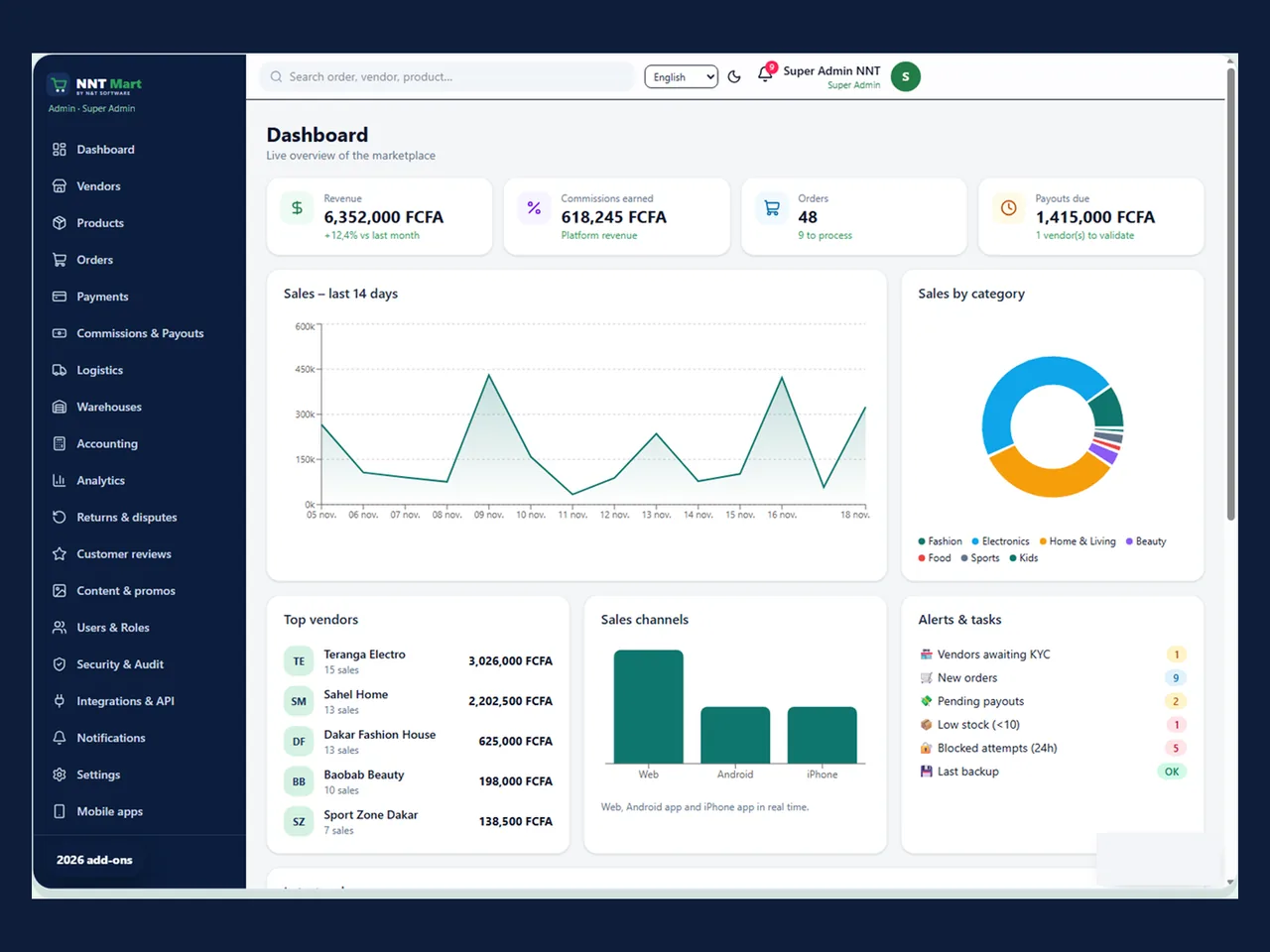
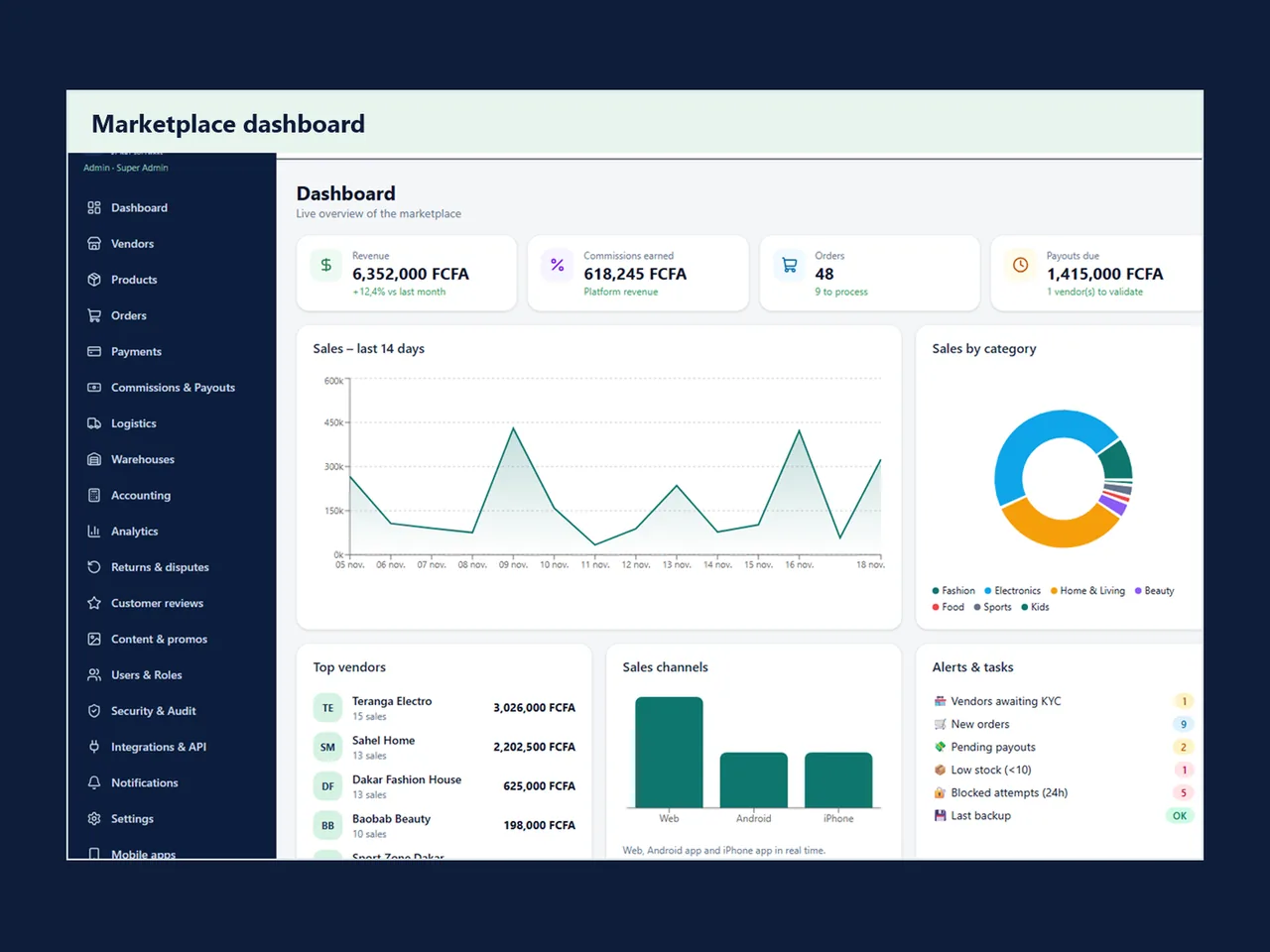
A live dashboard tracks active sellers, GMV and take rate and listing approval time, so Jhajjar decisions on stock, offers and spend come from numbers, not guesses.
Reach customers on their phones
An Android and iOS app on the same backend adds push alerts, saved details and one-tap reorder for repeat buyers in Jhajjar.
Be found by search and AI assistants
Fast pages, product and FAQ schema, a sitemap and direct-answer content let Google and AI assistants read, quote and recommend your multi-vendor marketplace when Jhajjar customers ask.
Take orders on WhatsApp and the app
Customers in Jhajjar can start an order from a link, WhatsApp or the mobile app and finish it in one checkout, so no enquiry is lost in a chat thread.
Own the technology
After final payment you receive 100% of the source code, design files and documentation, with a 90-day warranty, so growth never depends on a licence you cannot move.
Industries in Jhajjar we work with
Popular online categories in India include mobiles and electronics, fashion and ethnic wear, beauty and personal care, groceries and FMCG, home and kitchen and B2B industrial supplies. Industrial and logistics belt — which shapes what local businesses need online. In Jhajjar, we most often build multi-vendor marketplaces for:
Industry-specific marketplaces
For industry-specific marketplaces, we usually start with catalogue governance, then add split-payment and escrow providers once orders are flowing.
Regional seller networks
Catalogue, pricing and fulfilment rules designed for regional seller networks in Jhajjar, connected to the systems you already use.
B2B supplier platforms
B2B supplier platforms get commission engine plus settlements workflows tailored to their operations.
Service-provider marketplaces
We map how service-provider marketplaces sell today and digitise it end to end — from enquiry and order to payment, dispatch and repeat purchase.
Institutional procurement platforms
For institutional procurement platforms, we usually start with trust and support, then add search and recommendation engines once orders are flowing.
Artisan and curated brand marketplaces
Catalogue, pricing and fulfilment rules designed for artisan and curated brand marketplaces in Jhajjar, connected to the systems you already use.
How Jhajjar customers pay online
Checkout is where most online sales are won or lost. In India, customers expect to pay with UPI (Google Pay, PhonePe, Paytm), RuPay, Visa and Mastercard cards and net banking, and many also look for cash on delivery, EMI and cardless EMI and wallets and UPI AutoPay for subscriptions.
Provider approval, settlement time and fees differ by business type, so we shortlist gateways with you, then wire up status updates, refunds and reconciliation in INR with GST invoices — card details stay with the provider.
- Net banking
- UPI (Google Pay, PhonePe, Paytm)
- Wallets and UPI AutoPay for subscriptions
- Cash on delivery
- EMI and cardless EMI
- RuPay, Visa and Mastercard cards
Shipping, couriers and local delivery in Jhajjar
Your multi-vendor marketplace can book shipments and share tracking with Delhivery, Blue Dart, Shiprocket, DTDC, Xpressbees, Ecom Express and India Post, or route orders to your own riders and stores across Jhajjar.
Delivery rules can price by distance, weight, postcode or zone, offer same-day slots in dense areas, and switch on pickup points or click-and-collect where customers prefer them.
Marketplaces vs. your own multi-vendor marketplace in Jhajjar
For a Jhajjar business, Amazon.in, Flipkart, Meesho and Myntra are useful shop windows — but fees, ranking changes and shared customer data limit how far you can grow on them alone.
With your own multi-vendor marketplace you keep the customer data, set the offers and the packaging, and still push stock to marketplaces from a single admin.
Compliance built into your multi-vendor marketplace
On tax: India levies GST, rationalised in September 2025 into main slabs of 5% and 18% with a 40% rate for select goods; e-commerce operators collect TCS, and e-invoicing and e-way bills apply above set thresholds.
Businesses registered in Haryana carry GST state code 06 in their GSTIN, and intra-state sales are billed as CGST + SGST while sales to other states are billed as IGST.
Customer data is handled with the Digital Personal Data Protection Act 2023 and the DPDP Rules 2025, alongside the IT Act 2000 in mind, and the storefront follows the Consumer Protection (E-Commerce) Rules 2020, which require seller details, country of origin, grievance officers and clear return and refund policies, plus the Legal Metrology rules on product labelling.
We build the technical controls — tax-inclusive pricing, compliant invoices, consent banners, terms and return pages, data-access roles and audit logs. We are not a law firm, so final legal and tax positions should be confirmed with your own adviser in Haryana.
Add a mobile app for Jhajjar customers
Phones carry most traffic in India. Separate buyer and seller apps let customers shop and track orders while vendors manage listings, accept orders and see payouts from their phones.
For shopping app development company in Jhajjar: one team builds the Android and iOS shopping app and the store behind it, and the ecommerce mobile app cost depends on your screens, integrations and team size.
One backend serves the website and the apps, and the apps ship under your own Google Play and App Store accounts — so what you change once appears everywhere.
Push notifications can be timed to UTC+5:30 so offers reach Jhajjar customers when they are awake, and the interface can run in Hindi and Haryanvi.
- Tax and invoicing systems
- KYC and business verification
- Logistics aggregators
- Split-payment and escrow providers
- Analytics and BI
- Search and recommendation engines
- CRM and helpdesk
- WhatsApp and push notifications
Integrations above are examples; we connect any system that offers a suitable API, database access or approved import and export process.
A phased launch plan for Jhajjar
Value first, depth later. For a multi-vendor marketplace serving Jhajjar, the usual sequence looks like this:
| Phase | What goes live |
|---|---|
| Pilot marketplace | Seller onboarding, catalogue, checkout, order routing and basic payouts. Configured for INR, UPI (Google Pay, PhonePe, Paytm) and Delhivery from the start. |
| Govern and grow | Moderation, commissions, promotions, reviews and dispute handling. |
| Scale | Buyer and seller apps, new categories, cities and service areas. Reviewed against how Jhajjar customers actually buy. |
We track active sellers, GMV and take rate, listing approval time, order defect rate, seller payout accuracy and buyer repeat rate on a live dashboard from day one, so Jhajjar results are visible, not promised.
Working with our team from Jhajjar
Jhajjar runs on UTC+5:30, the same clock as our engineering team in India. With three 8-hour shifts we are available 24×7, so meetings, demos and urgent fixes happen in your working hours.
We work in English and can deliver storefront content in Hindi, Haryanvi and Punjabi. NDAs are signed on request, and you get a named project lead plus direct access to the engineers building your multi-vendor marketplace.
Our head office is in Chhapi, Gujarat, with an office in Hyderabad and representation in Nigeria, South Africa, Ethiopia and Zambia; Jhajjar clients are served remotely with on-site workshops when the project needs them.