
Why a multi-vendor marketplace makes sense for Silchar
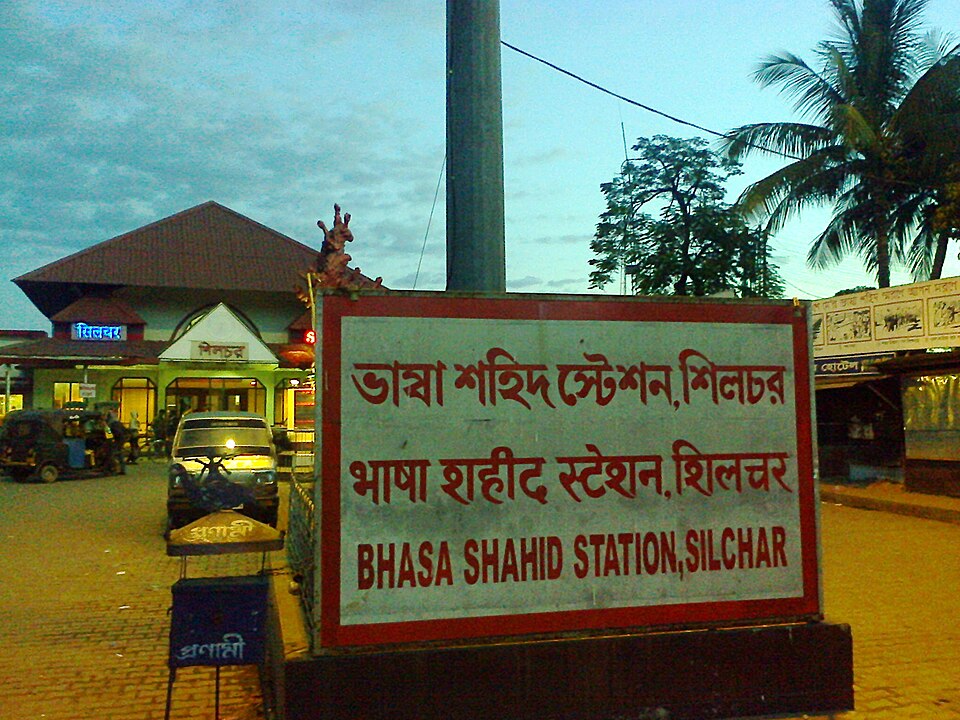
Silchar is a commercial centre in Assam, India home to about 229,000 people, and one of the places where we build multi-vendor marketplaces for local businesses.
Barak Valley trade centre — a business base that increasingly wants to sell online rather than through calls, messages and spreadsheets.
Across Assam, the economy is shaped by tea, oil and gas, silk (muga and eri), bamboo products and the gateway to North-East India, with Dispur as the state capital.
India has more than 6 crore (60 million) MSMEs registered on the Udyam portal (Ministry of MSME). India has the world's largest real-time payments system in UPI and one of the fastest-growing online shopper bases, increasingly from tier-2 and tier-3 cities. Businesses that own their store — with UPI, COD, regional languages and WhatsApp updates — build loyal customers instead of renting them from marketplaces.
For a business in Silchar, the opportunity is to own the customer relationship: your own multi-vendor marketplace keeps your margin, your data and your brand, while marketplaces and social channels become additional sales routes instead of the only one.
Why a business in Silchar cannot stay offline-only
Customers in India already pay with UPI (Google Pay, PhonePe, Paytm) and RuPay, Visa and Mastercard cards and compare prices on Amazon.in and Flipkart before they decide. Silchar alone has about 229,000 people, and a business that cannot be found, ordered from and paid online loses that buyer at the moment of choice.
Staying offline-only also hides your best data. A multi-vendor marketplace shows which products, areas and customers in Silchar earn money, which is how mobiles and electronics, fashion and ethnic wear and beauty and personal care sellers in India decide what to stock and promote.
It is also a compliance move. GST-ready invoices and records, and customer data handled under the Digital Personal Data Protection Act 2023 and the DPDP Rules 2025, are far easier to keep right in one system than across notebooks and chat threads.
| Area | Offline and chat orders | With your own multi-vendor marketplace in Silchar |
|---|---|---|
| Orders | Phone, WhatsApp, spreadsheets; open only in shop hours | Taken 24 hours a day, tracked end to end |
| Payments | Cash and manual follow-up | UPI (Google Pay, PhonePe, Paytm) and RuPay, Visa and Mastercard cards and other local methods at checkout |
| Reach | Walk-ins and word of mouth | Search, social, Amazon.in and Flipkart and a link anyone can share |
| Records | Paper and chat history | GST invoices, customer and stock data in one place |
Local details we build into every Silchar project
A store that works in Silchar respects local habits as well as local law. These are the details we configure first.
Currency and pricing
Everything a Silchar shopper sees — price, tax, delivery fee, refund — is in INR, written the local way.
Language and content
Storefront copy, product pages and emails can run in Assamese, Bengali and Bodo, with local date and number formats.
Local trust signals
We add the payment logos, courier names and policy pages shoppers in Silchar recognise: UPI (Google Pay, PhonePe, Paytm) and RuPay, Visa and Mastercard cards and delivery through Delhivery.
Domain, phone and contact
Using .in where it suits you signals a local business to shoppers and search engines. Click-to-call and WhatsApp buttons use the +91 calling code so customers reach you without dialling errors.
Designed to your requirements, not a template
Silchar businesses tell us what they sell and how they want to sell it; our engineers turn that into a custom multi-vendor marketplace, an admin system and a mobile app shaped around their operations.
Typical clients include regional seller networks, B2B supplier platforms, service-provider marketplaces and institutional procurement platforms. Categories that sell especially well online in India — mobiles and electronics, fashion and ethnic wear, beauty and personal care and groceries and FMCG — get catalogue structures and filters designed for them.
Before any commitment you get a free requirements meeting, a demo built on your use case and a proposal priced to your budget.
What a multi-vendor marketplace in Silchar should include first
Industry-specific marketplaces, regional seller networks and B2B supplier platforms in Silchar usually get the fastest return by launching the journeys that bring in orders first, then adding depth. The order we recommend:
- Pilot marketplace: Seller onboarding, catalogue, checkout, order routing and basic payouts. Set up for INR, UPI (Google Pay, PhonePe, Paytm) and Delhivery.
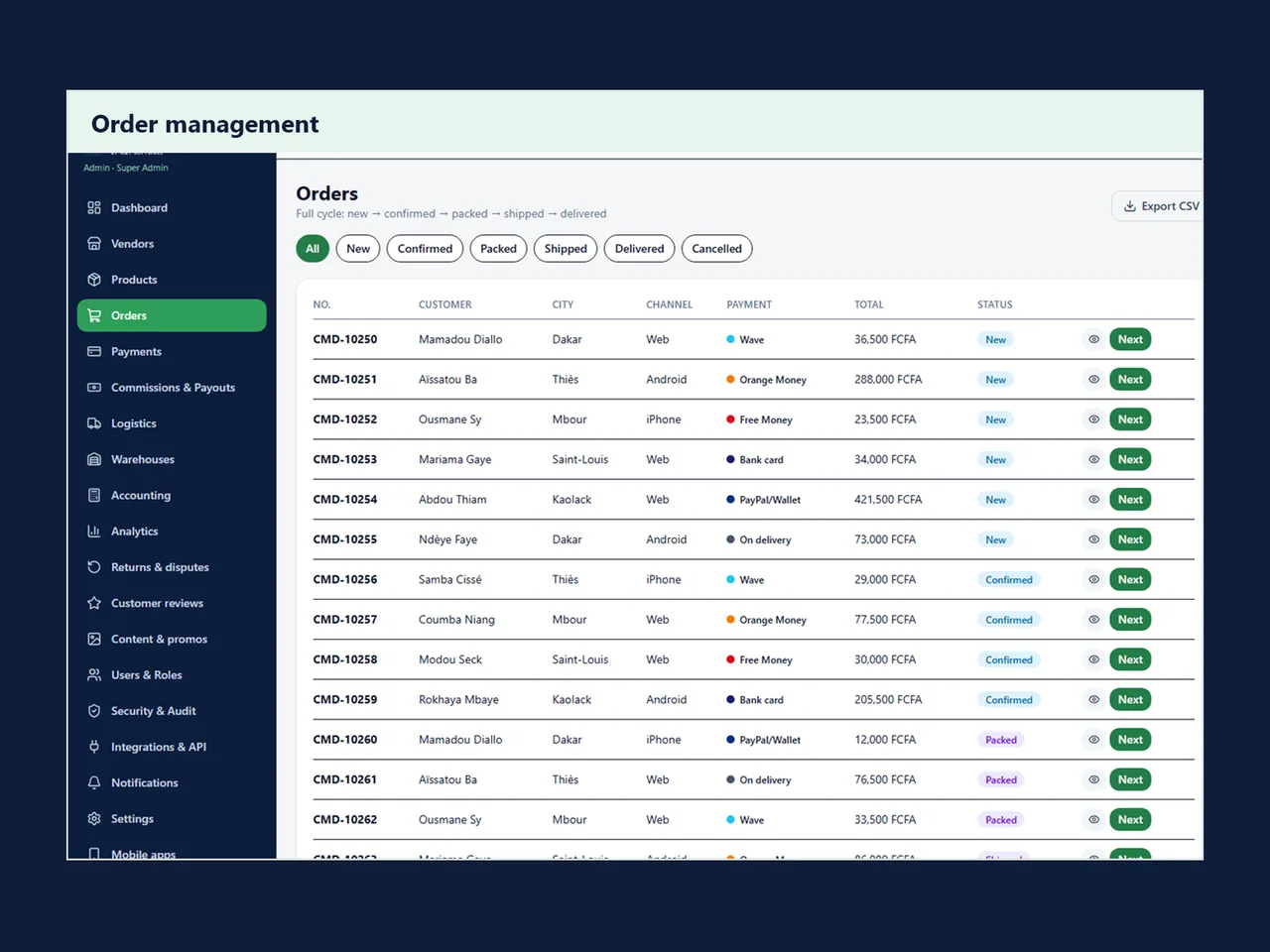
- Govern and grow: Moderation, commissions, promotions, reviews and dispute handling.
- Scale: Buyer and seller apps, new categories, cities and service areas.
Features of your multi-vendor marketplace in Silchar
Nothing here is fixed: modules are switched on, reshaped or built from scratch around how your Silchar business sells.
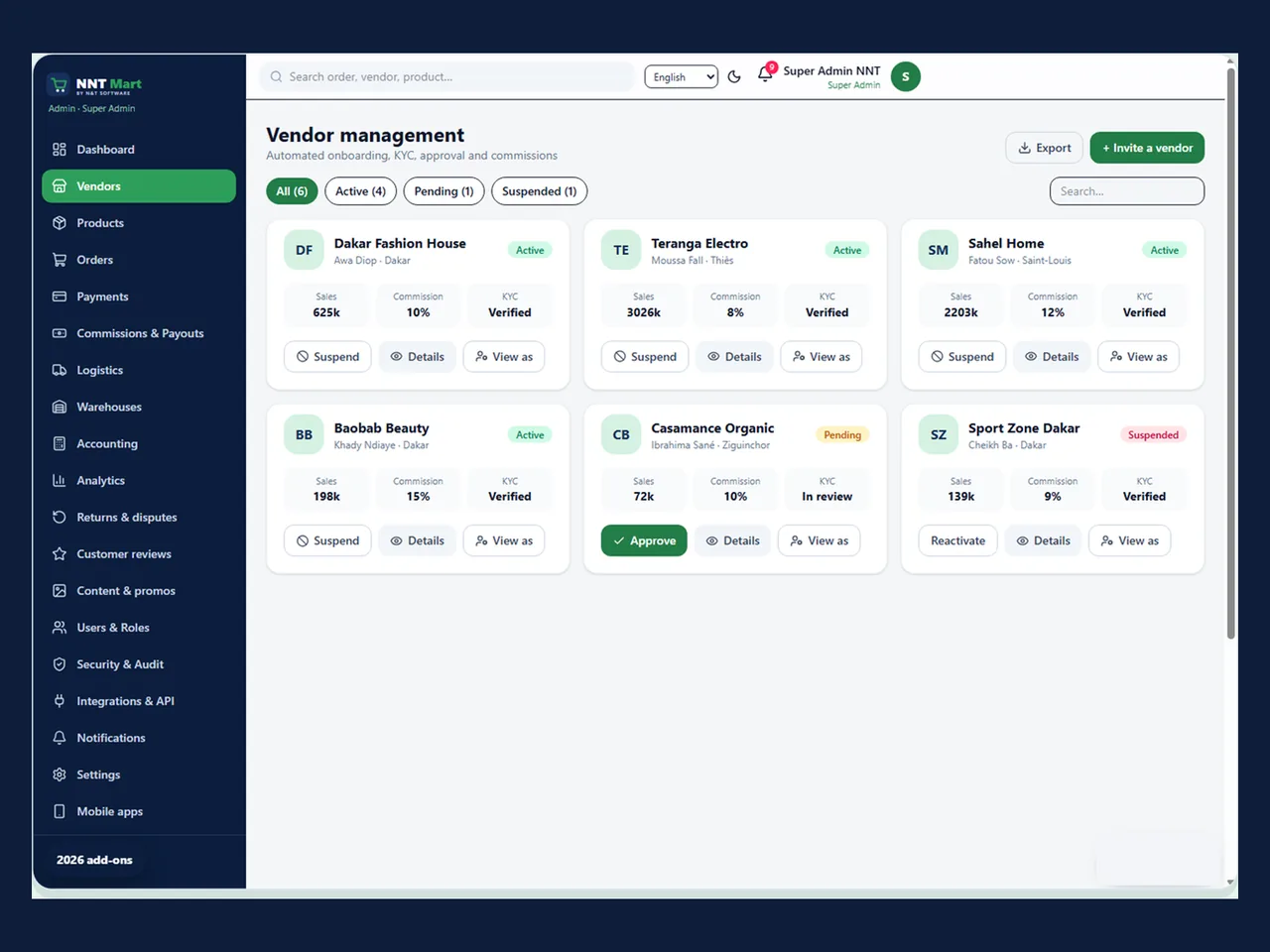
Vendor onboarding
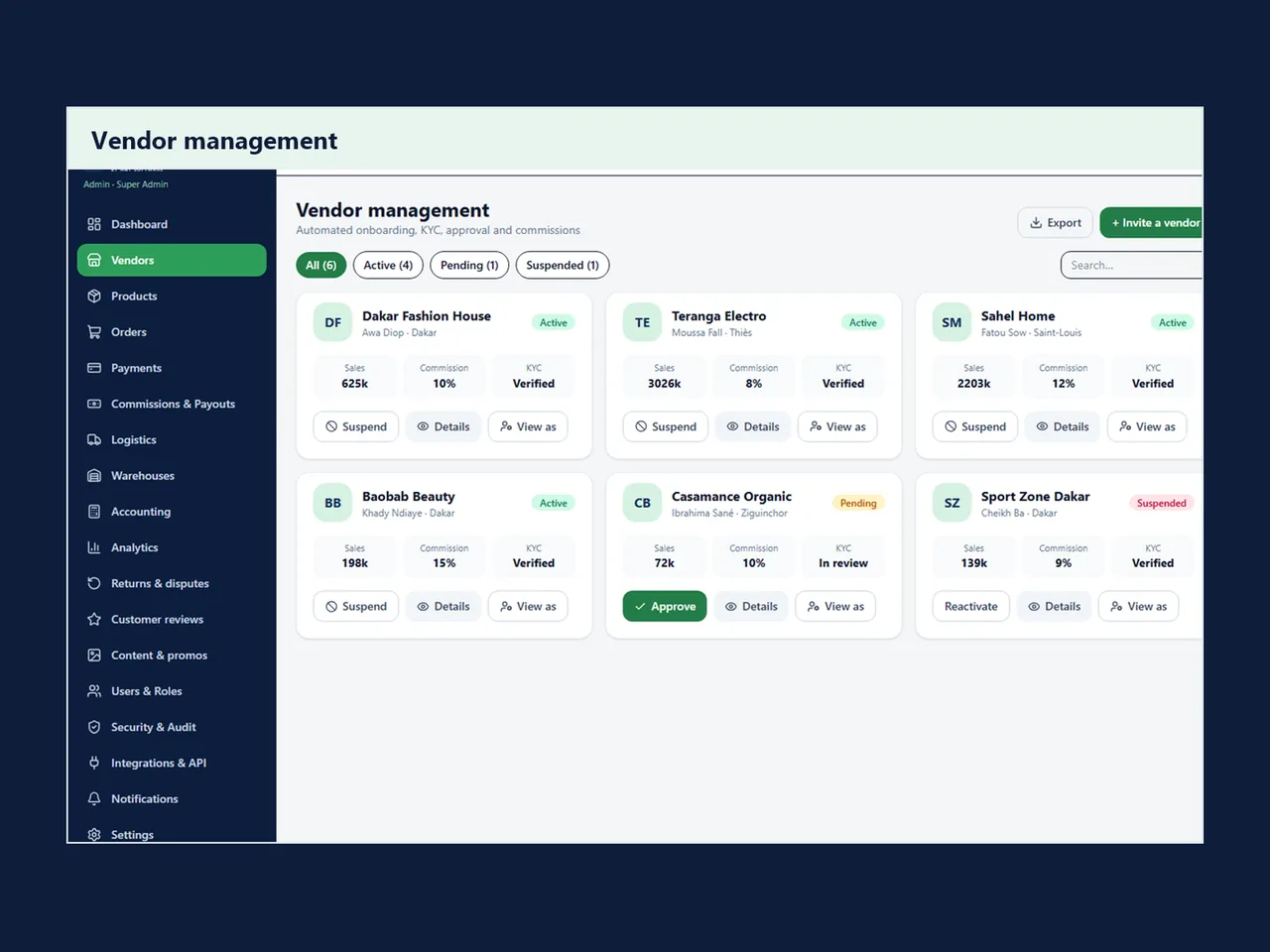
Application, document verification, agreements, approval and seller dashboards with team access. Stock can be held in Silchar or anywhere in Assam, with pickup and local-delivery options where they make sense.
Catalogue governance
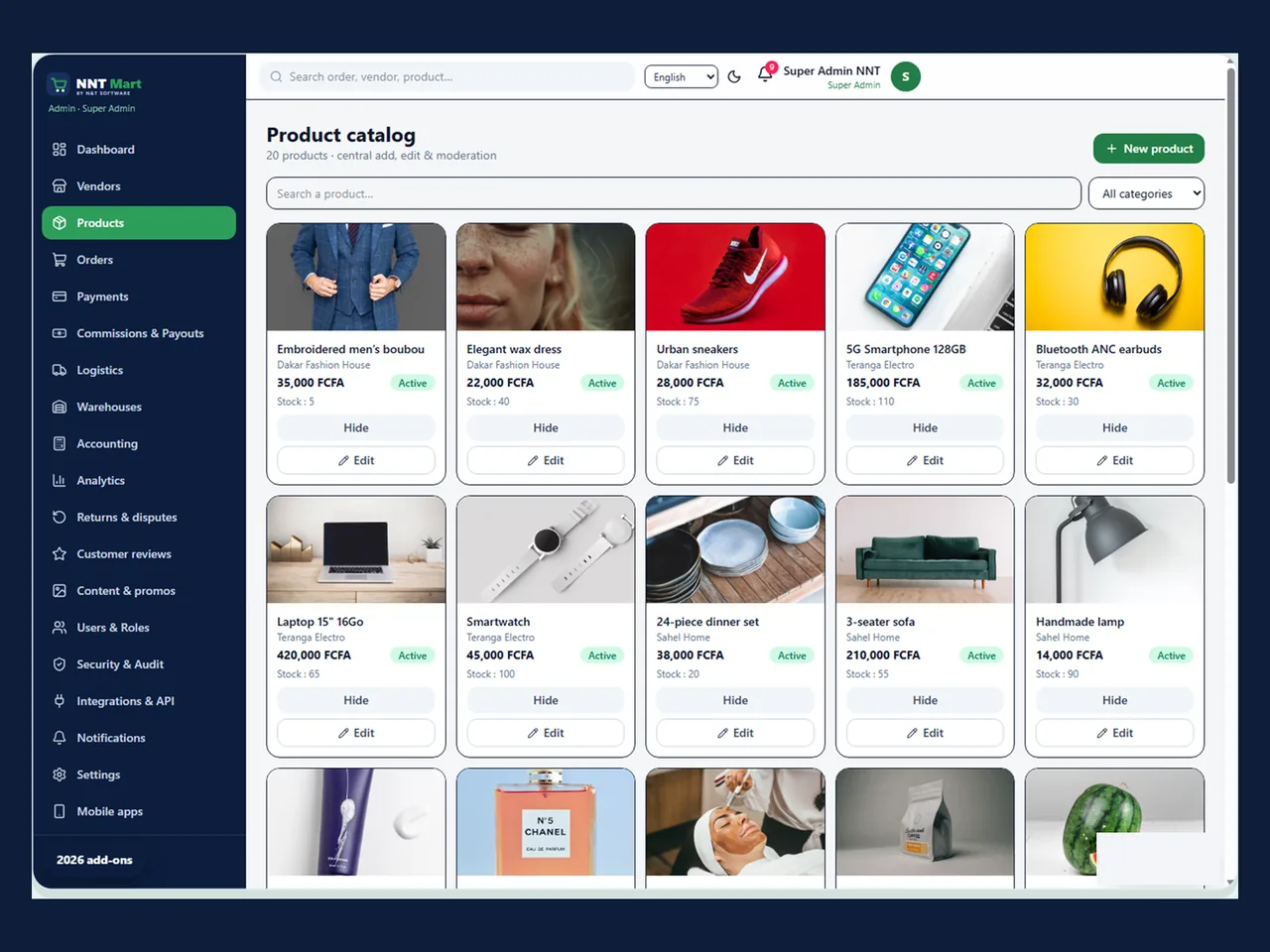
Listing templates, moderation queues, category rules, image standards and duplicate detection. Dashboards break sales down by product, customer and neighbourhood of Silchar, so you see what to promote.
Commission engine
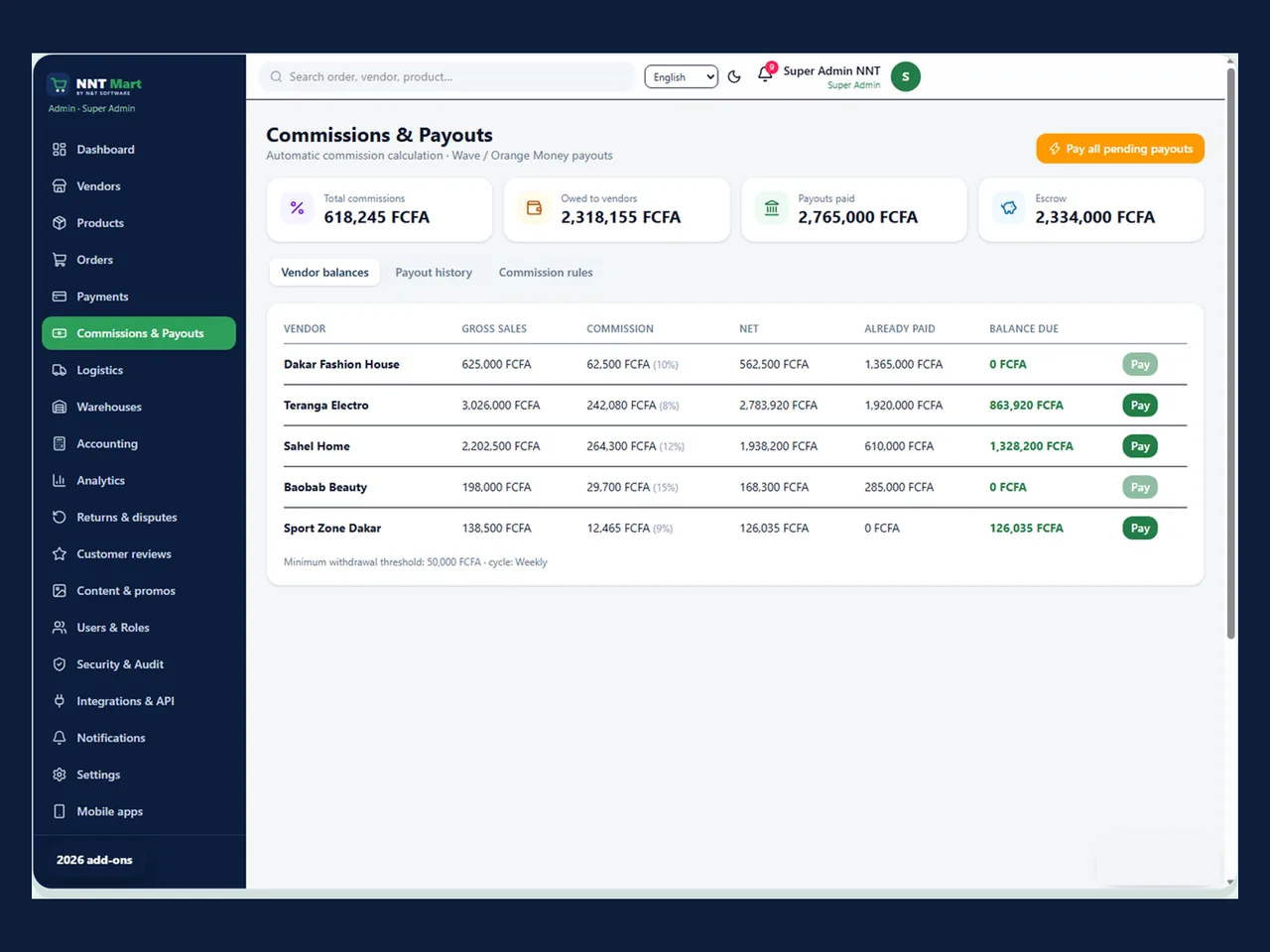
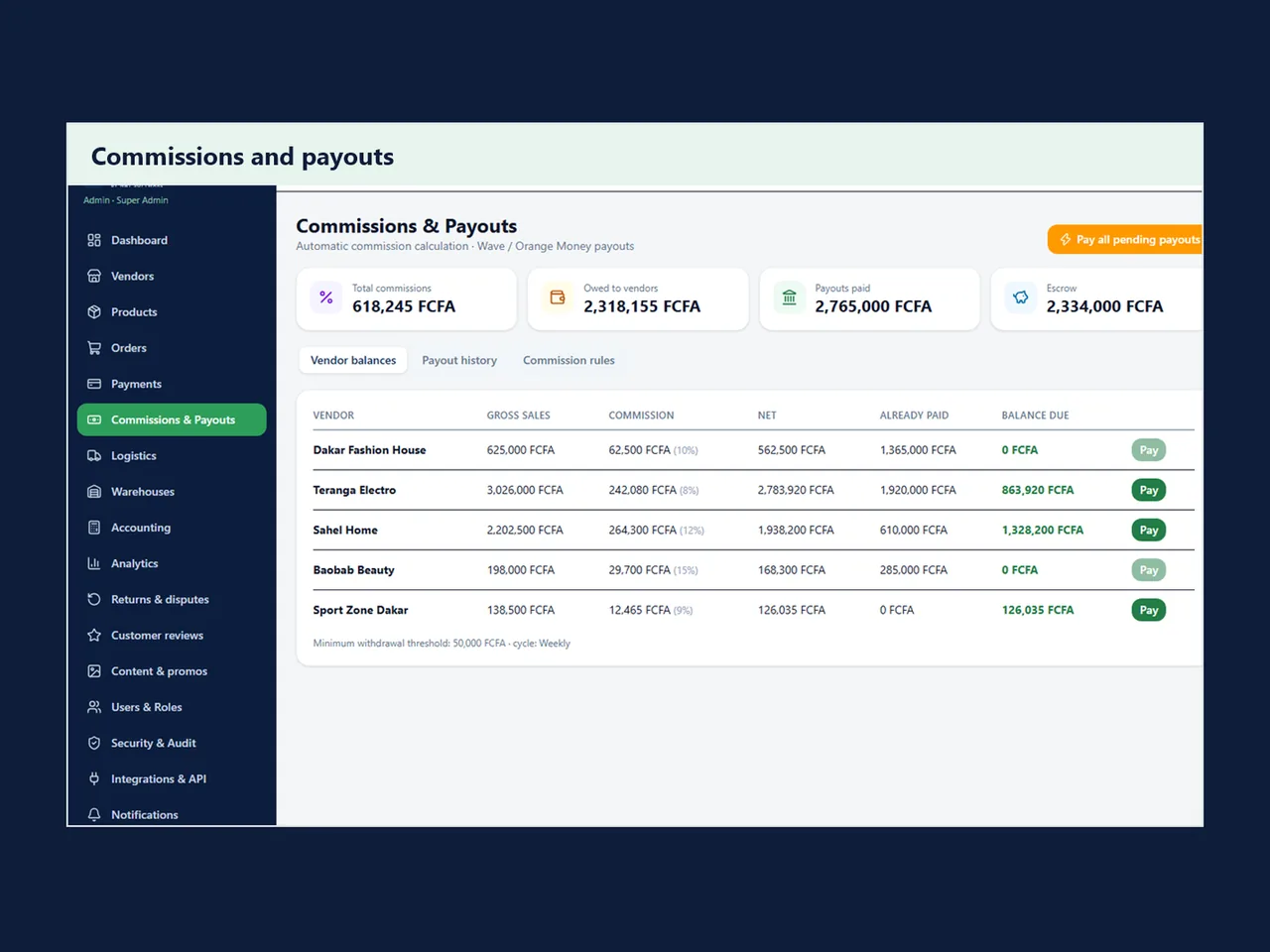
Commissions and fees by vendor, category, product or transaction, with promotions funded by either party. Pages, search filters and wording are tuned to how people in Silchar look for products, in Assamese and Bengali if your audience needs it.
Order routing
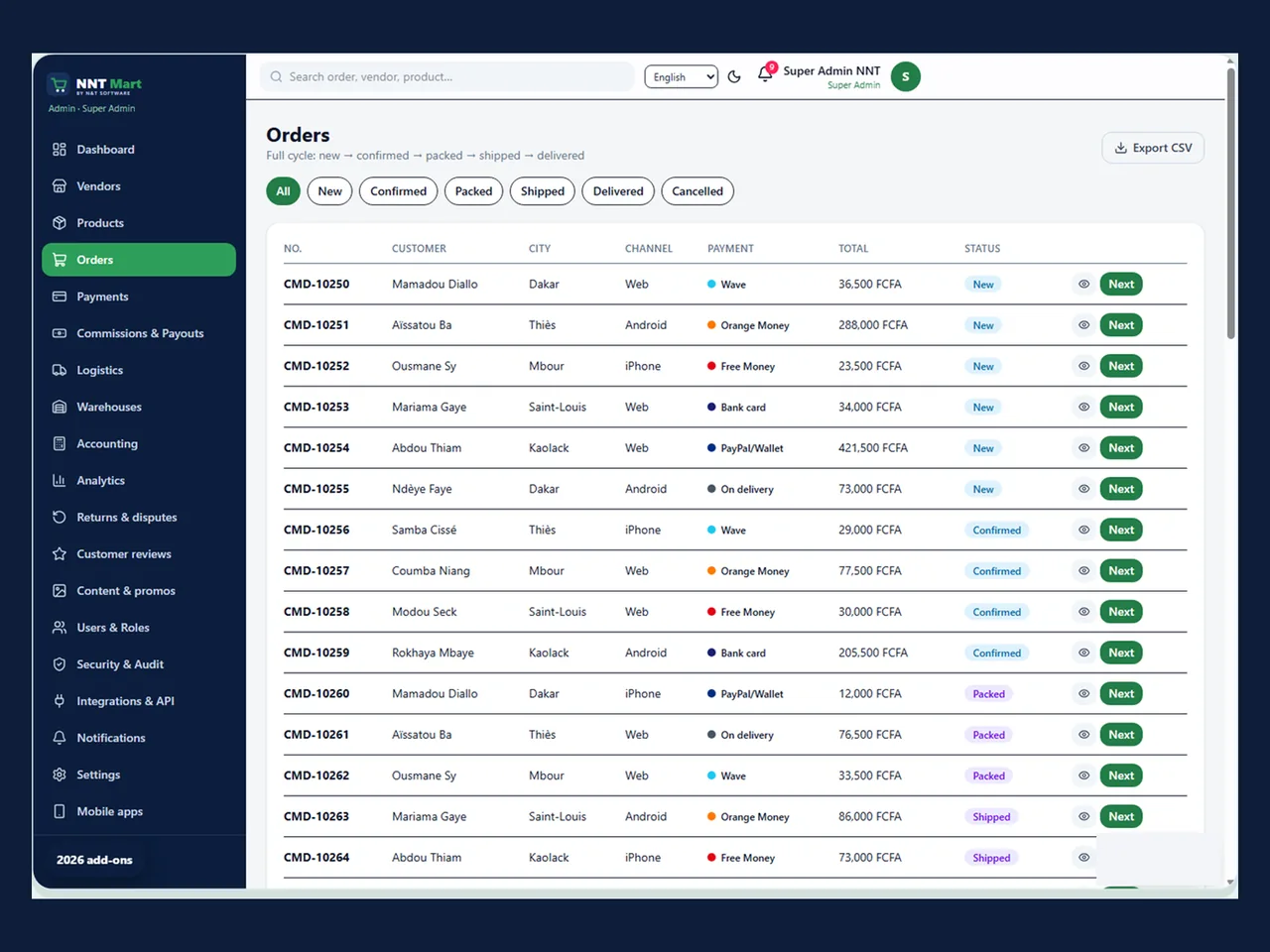
Split carts, vendor-wise fulfilment, shipping rules, service areas and delivery tracking. Catalogues come in from spreadsheets, ERP exports or supplier feeds, so your Silchar team keeps its current way of working.
Settlements
Payout calculations, reconciliation reports and integration with split-payment providers where permitted. Checkout is configured for UPI (Google Pay, PhonePe, Paytm), RuPay, Visa and Mastercard cards and net banking.
Trust and support
Ratings, reviews, returns, disputes, seller performance scores and customer-support workflows. Couriers such as Delhivery, Blue Dart and Shiprocket plug in alongside your own fleet for Silchar orders.
What businesses in Silchar ask us for
Businesses in Silchar search for these in different words. Each one is something NNT Mart designs, builds and supports:
Multi-vendor marketplace development in Silchar
Application, document verification, agreements, approval and seller dashboards with team access. For Silchar, prices, tax and invoices are in INR and GST-ready.
Marketplace website like Amazon in Silchar
Listing templates, moderation queues, category rules, image standards and duplicate detection. Built for Silchar: UPI and RuPay, Visa and Mastercard cards payments and Delhivery delivery.
Build an online marketplace in Silchar
Commissions and fees by vendor, category, product or transaction, with promotions funded by either party. In Silchar it takes UPI at checkout and ships through Delhivery.
Vendor marketplace platform in Silchar
Split carts, vendor-wise fulfilment, shipping rules, service areas and delivery tracking. For Silchar, prices, tax and invoices are in INR and GST-ready.
B2B marketplace development in Silchar
Payout calculations, reconciliation reports and integration with split-payment providers where permitted. Built for Silchar: UPI and RuPay, Visa and Mastercard cards payments and Delhivery delivery.
Local marketplace app in Silchar
Ratings, reviews, returns, disputes, seller performance scores and customer-support workflows. In Silchar it takes UPI at checkout and ships through Delhivery.
Marketplace commission software in Silchar
Application, document verification, agreements, approval and seller dashboards with team access. For Silchar, prices, tax and invoices are in INR and GST-ready.
Seller onboarding platform in Silchar
Listing templates, moderation queues, category rules, image standards and duplicate detection. Built for Silchar: UPI and RuPay, Visa and Mastercard cards payments and Delhivery delivery.
What you gain in Silchar
Here is what changes once the multi-vendor marketplace is live:
Keep the customer and the margin
Marketplaces such as Amazon.in and Flipkart bring reach but keep the buyer; your own multi-vendor marketplace brings repeat orders you do not pay a commission on.
Sell round the clock to Silchar
Customers order and pay at any hour, including evenings and weekends, with UPI (Google Pay, PhonePe, Paytm) and RuPay, Visa and Mastercard cards at checkout, so sales no longer depend on shop hours.
Run the business from one place
Vendor onboarding and catalogue governance sit in one admin, connected to split-payment and escrow providers, so the team stops re-typing orders and stock.
See what works
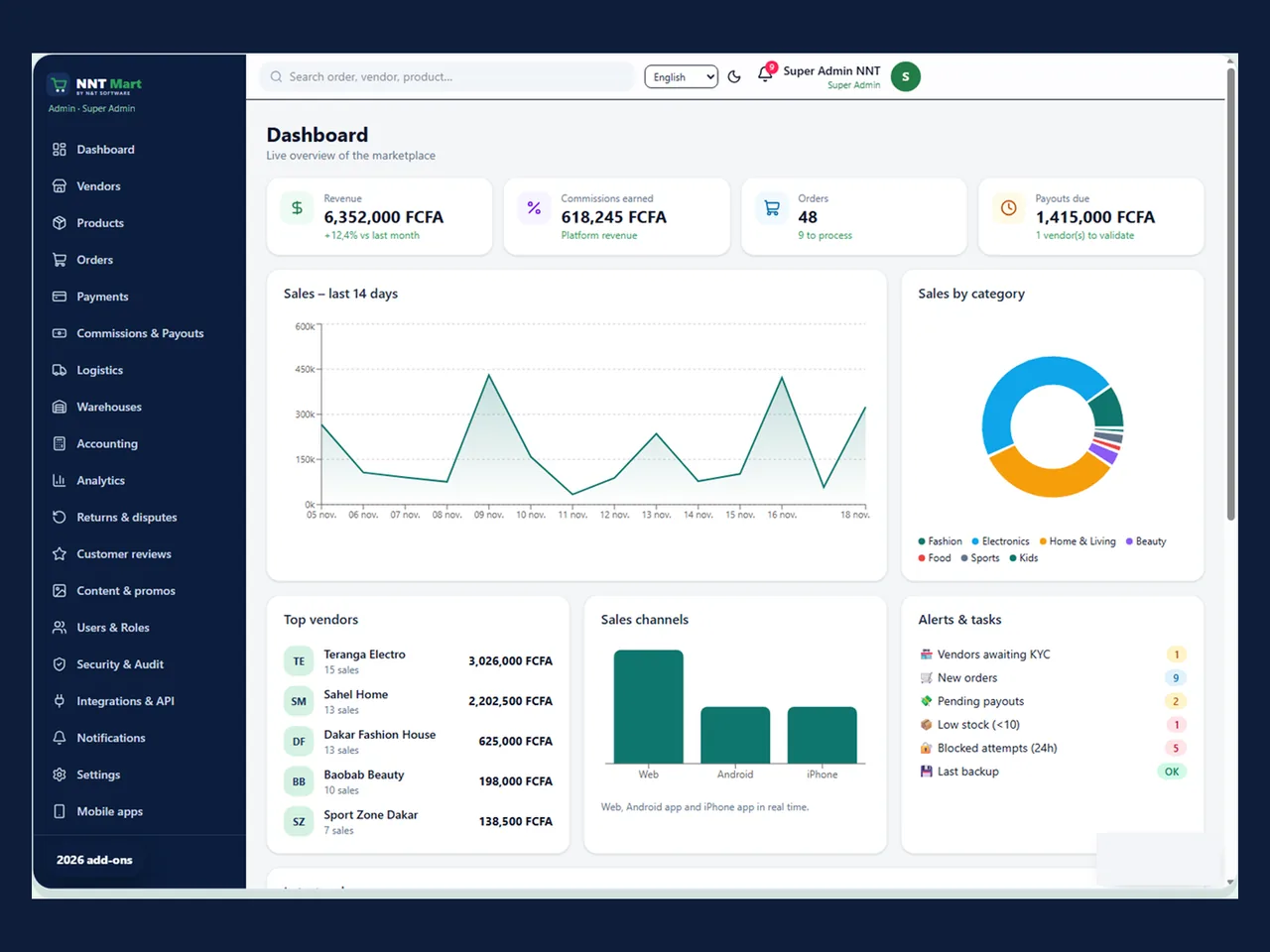
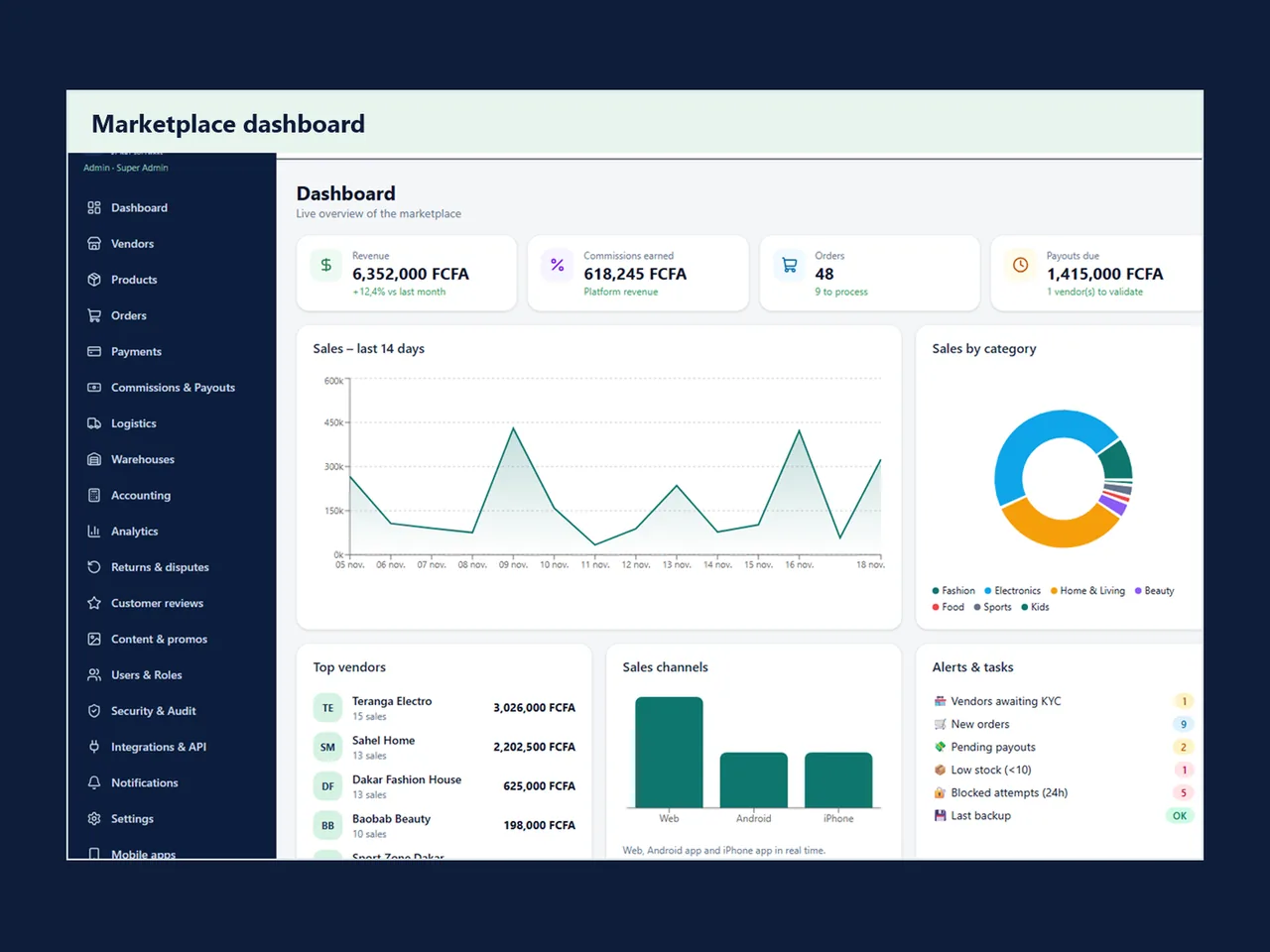
A live dashboard tracks active sellers, GMV and take rate and listing approval time, so Silchar decisions on stock, offers and spend come from numbers, not guesses.
Reach customers on their phones
An Android and iOS app on the same backend adds push alerts, saved details and one-tap reorder for repeat buyers in Silchar.
Be found by search and AI assistants
Fast pages, product and FAQ schema, a sitemap and direct-answer content let Google and AI assistants read, quote and recommend your multi-vendor marketplace when Silchar customers ask.
Take orders on WhatsApp and the app
Customers in Silchar can start an order from a link, WhatsApp or the mobile app and finish it in one checkout, so no enquiry is lost in a chat thread.
Own the technology
After final payment you receive 100% of the source code, design files and documentation, with a 90-day warranty, so growth never depends on a licence you cannot move.
Payments customers in Silchar expect
A store that serves Silchar should let customers pay the way they do offline: UPI (Google Pay, PhonePe, Paytm), RuPay, Visa and Mastercard cards, net banking and cash on delivery.
Gateway selection depends on your category and merchant approval; we connect the provider, reconcile payments, automate retries and refunds, and never store raw card data. Prices, taxes and refunds appear in Indian rupee (INR), with GST-ready invoices.
- Cash on delivery
- RuPay, Visa and Mastercard cards
- EMI and cardless EMI
- Net banking
- UPI (Google Pay, PhonePe, Paytm)
- Wallets and UPI AutoPay for subscriptions
Delivery and fulfilment from Silchar
Your multi-vendor marketplace can book shipments and share tracking with Delhivery, Blue Dart, Shiprocket, DTDC, Xpressbees, Ecom Express and India Post, or route orders to your own riders and stores across Silchar.
We set up shipping zones, cut-off times, free-shipping thresholds, cash-collection rules and returns so the promise on the product page matches what your team can deliver.
Tax, invoicing and compliance in Assam
On tax: India levies GST, rationalised in September 2025 into main slabs of 5% and 18% with a 40% rate for select goods; e-commerce operators collect TCS, and e-invoicing and e-way bills apply above set thresholds.
Businesses registered in Assam carry GST state code 18 in their GSTIN, and intra-state sales are billed as CGST + SGST while sales to other states are billed as IGST.
Customer data is handled with the Digital Personal Data Protection Act 2023 and the DPDP Rules 2025, alongside the IT Act 2000 in mind, and the storefront follows the Consumer Protection (E-Commerce) Rules 2020, which require seller details, country of origin, grievance officers and clear return and refund policies, plus the Legal Metrology rules on product labelling.
Our job is the engineering: price display with tax, invoice numbering, cookie and marketing consent, return and terms pages, role-based access and logs. Legal and tax conclusions stay with your own adviser in Assam.
Your own store alongside Amazon.in and Flipkart
For a Silchar business, Amazon.in, Flipkart, Meesho and Myntra are useful shop windows — but fees, ranking changes and shared customer data limit how far you can grow on them alone.
NNT Mart gives you a channel you own: your domain, your customer list, your pricing and your brand. Where it helps, we connect product feeds and orders from marketplaces so stock stays in sync and your team works from one dashboard.
Who we build for in Silchar
Popular online categories in India include mobiles and electronics, fashion and ethnic wear, beauty and personal care, groceries and FMCG, home and kitchen and B2B industrial supplies. Barak Valley trade centre — which shapes what local businesses need online. In Silchar, we most often build multi-vendor marketplaces for:
Industry-specific marketplaces
For industry-specific marketplaces, we usually start with catalogue governance, then add split-payment and escrow providers once orders are flowing.
Regional seller networks
Catalogue, pricing and fulfilment rules designed for regional seller networks in Silchar, connected to the systems you already use.
B2B supplier platforms
B2B supplier platforms get commission engine plus settlements workflows tailored to their operations.
Service-provider marketplaces
We map how service-provider marketplaces sell today and digitise it end to end — from enquiry and order to payment, dispatch and repeat purchase.
Institutional procurement platforms
For institutional procurement platforms, we usually start with trust and support, then add search and recommendation engines once orders are flowing.
Artisan and curated brand marketplaces
Catalogue, pricing and fulfilment rules designed for artisan and curated brand marketplaces in Silchar, connected to the systems you already use.
Android and iOS apps for your Silchar business
Phones carry most traffic in India. Separate buyer and seller apps let customers shop and track orders while vendors manage listings, accept orders and see payouts from their phones.
If you are looking for ecommerce app development in Silchar, the Android and iOS shopping app is built on the same backend as your store, in Flutter or native code, and ecommerce mobile app cost is quoted per screen and integration after the requirements meeting.
One backend serves the website and the apps, and the apps ship under your own Google Play and App Store accounts — so what you change once appears everywhere.
Order alerts, offers and abandoned-cart reminders go out on Silchar time (UTC+5:30), in Assamese and Bengali if you want.
- Logistics aggregators
- Tax and invoicing systems
- Analytics and BI
- Search and recommendation engines
- CRM and helpdesk
- Split-payment and escrow providers
- KYC and business verification
- WhatsApp and push notifications
Integrations above are examples; we connect any system that offers a suitable API, database access or approved import and export process.
From first demo to growth in Silchar
We launch the journeys that create value first, then add depth. A typical roadmap for a multi-vendor marketplace in Silchar:
| Phase | What goes live |
|---|---|
| Pilot marketplace | Seller onboarding, catalogue, checkout, order routing and basic payouts. Configured for INR, UPI (Google Pay, PhonePe, Paytm) and Delhivery from the start. |
| Govern and grow | Moderation, commissions, promotions, reviews and dispute handling. |
| Scale | Buyer and seller apps, new categories, cities and service areas. Reviewed against how Silchar customers actually buy. |
Success is measured on active sellers, GMV and take rate, listing approval time, order defect rate, seller payout accuracy and buyer repeat rate — tracked on a dashboard you can see from launch day.
Working with our team from Silchar
Our team covers UTC+5:30 — the same clock as our engineers in India — through three 8-hour shifts, so a Silchar client always reaches someone during the local working day.
Project communication is in English; storefront content can be produced in Assamese, Bengali and Bodo. You get a named lead, direct engineer access and an NDA if you ask.
Our head office is in Chhapi, Gujarat, with an office in Hyderabad and representation in Nigeria, South Africa, Ethiopia and Zambia; Silchar clients are served remotely with on-site workshops when the project needs them.