
The case for a multi-vendor marketplace in Port Sudan
Port Sudan is a commercial centre in Sudan with a population of roughly 580,000, and one of the places where we build multi-vendor marketplaces for local businesses.
Key sectors include port logistics, trade and fishing, with business districts such as the port area and the Sheikh Barghout district.
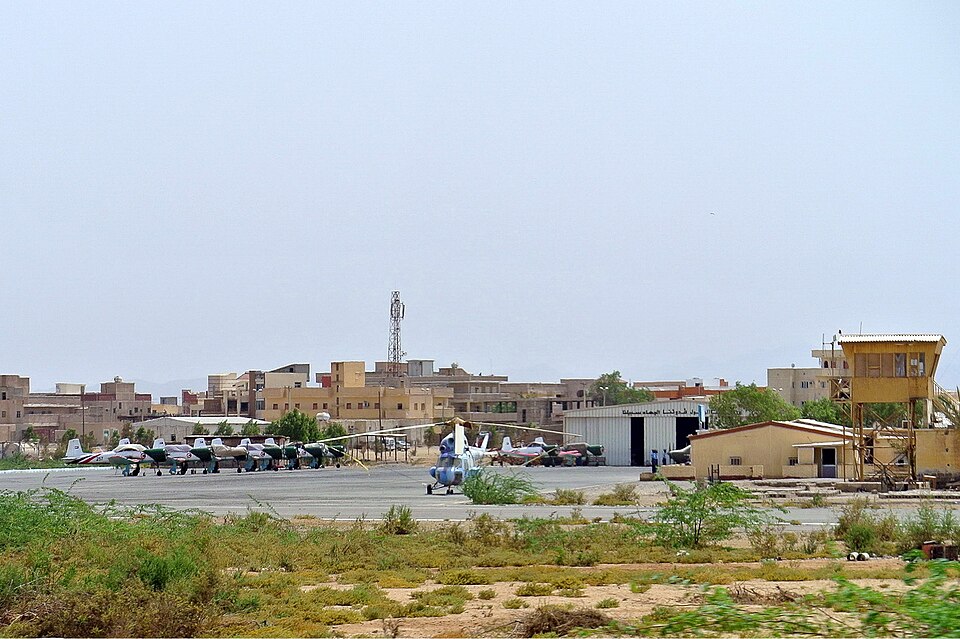
Logistics are supported by Port Sudan seaport and Port Sudan Airport, which matters when you promise customers fast delivery.
Sudan’s online commerce is small and uses mobile banking apps like Bankak, social media and cash. Conflict affects delivery, so stores must be flexible and keep clear order tracking.
For a business in Port Sudan, the opportunity is to own the customer relationship: your own multi-vendor marketplace keeps your margin, your data and your brand, while marketplaces and social channels become additional sales routes instead of the only one.
Why Port Sudan businesses need their own online channel today
Customers in Sudan already pay with Bankak (Bank of Khartoum) and cash on delivery and compare prices on Facebook Marketplace and WhatsApp commerce before they decide. Port Sudan alone has about 580,000 people, and a business that cannot be found, ordered from and paid online loses that buyer at the moment of choice.
Staying offline-only also hides your best data. A multi-vendor marketplace shows which products, areas and customers in Port Sudan earn money, which is how food and gum arabic, fashion and electronics sellers in Sudan decide what to stock and promote.
It is also a compliance move. VAT-ready invoices and records, and customer data handled under the Informatics Offences Act and electronic-transactions rules, are far easier to keep right in one system than across notebooks and chat threads.
| Area | Offline and chat orders | With your own multi-vendor marketplace in Port Sudan |
|---|---|---|
| Orders | Phone, WhatsApp, spreadsheets; open only in shop hours | Taken 24 hours a day, tracked end to end |
| Payments | Cash and manual follow-up | Bankak (Bank of Khartoum) and cash on delivery and other local methods at checkout |
| Reach | Walk-ins and word of mouth | Search, social, Facebook Marketplace and WhatsApp commerce and a link anyone can share |
| Records | Paper and chat history | VAT invoices, customer and stock data in one place |
Local details we build into every Port Sudan project
Conversion in Port Sudan depends on small local signals — the right currency, the right words and the right payment and courier names.
Currency and pricing
The store speaks Sudanese pound: SDG amounts from product page to invoice, so Port Sudan buyers never convert in their heads.
Language and content
Storefront copy, product pages and emails can run in Arabic and English, with local date and number formats.
Local trust signals
We add the payment logos, courier names and policy pages shoppers in Port Sudan recognise: Bankak (Bank of Khartoum) and cash on delivery and delivery through Sudan Post.
Domain, phone and contact
A .sd domain (or your own) builds local trust and search relevance. Contact buttons are pre-set with +249, so a customer in Port Sudan taps once to call or message.
Talent and partners nearby
Port Sudan draws on Red Sea University, which means plenty of local staff, interns and technology partners to run the store after launch.
Custom-built for how you sell in Port Sudan
We do not hand Port Sudan businesses a ready-made theme: we study how you sell, then build the online platform and Android/iOS app your customers and staff actually need.
Typical clients include regional seller networks, B2B supplier platforms, service-provider marketplaces and institutional procurement platforms. Categories that sell especially well online in Sudan — food and gum arabic, fashion, electronics and home goods — get catalogue structures and filters designed for them.
We start with a requirements meeting, show you a working demo within 24 hours, and only then propose scope, milestones and budget.
What a multi-vendor marketplace in Port Sudan should include first
Industry-specific marketplaces, regional seller networks and B2B supplier platforms in Port Sudan usually get the fastest return by launching the journeys that bring in orders first, then adding depth. The order we recommend:
- Pilot marketplace: Seller onboarding, catalogue, checkout, order routing and basic payouts. Set up for SDG, Bankak (Bank of Khartoum) and Sudan Post.
- Govern and grow: Moderation, commissions, promotions, reviews and dispute handling.
- Scale: Buyer and seller apps, new categories, cities and service areas.
Features of your multi-vendor marketplace in Port Sudan
Each module below is configured — or custom-developed — to your requirements. You choose what launches first and what follows in later phases.
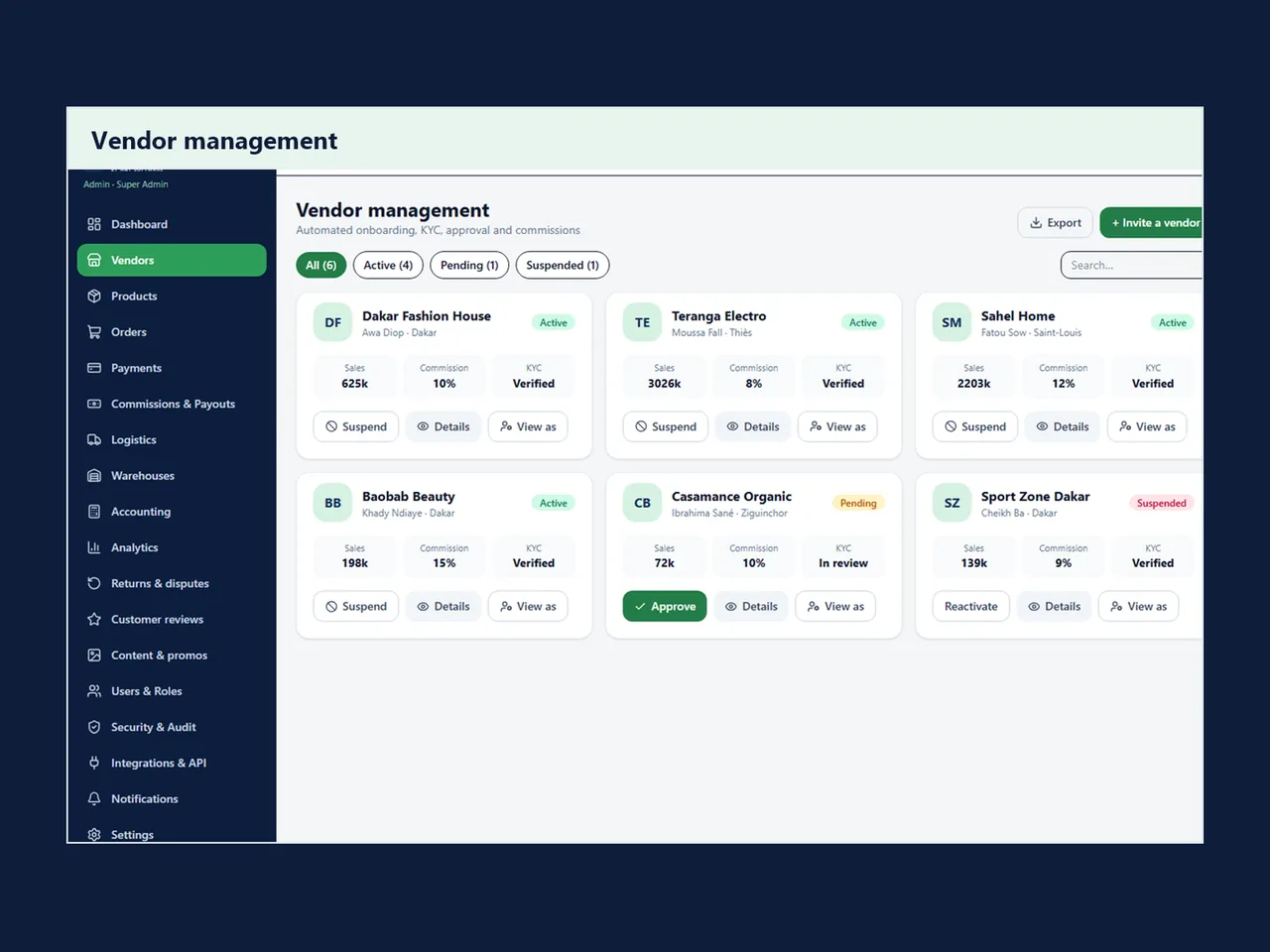
Vendor onboarding
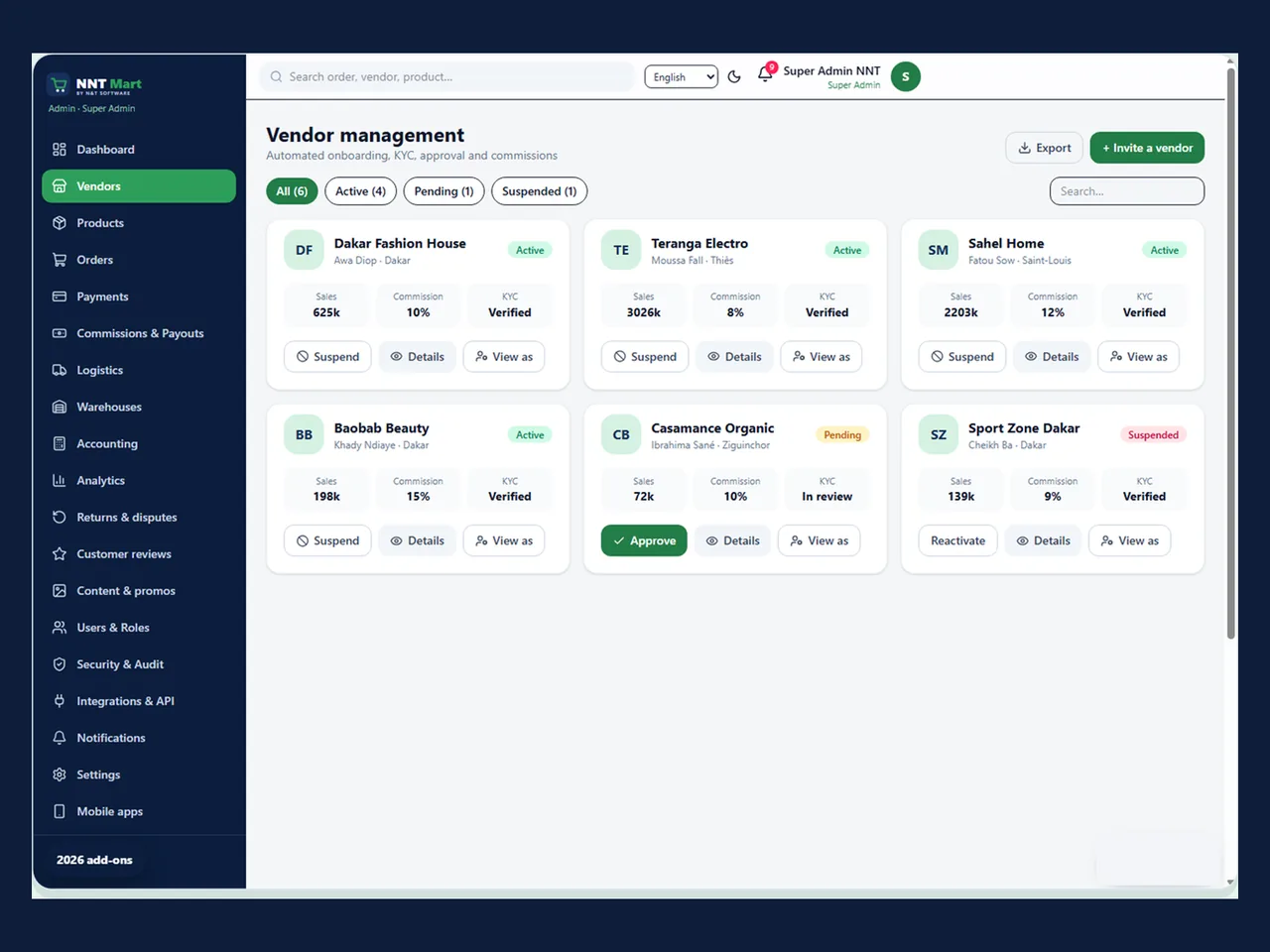
Application, document verification, agreements, approval and seller dashboards with team access. Payment steps are built around Bankak (Bank of Khartoum), cash on delivery and mobile wallets, the options shoppers here already trust.
Catalogue governance
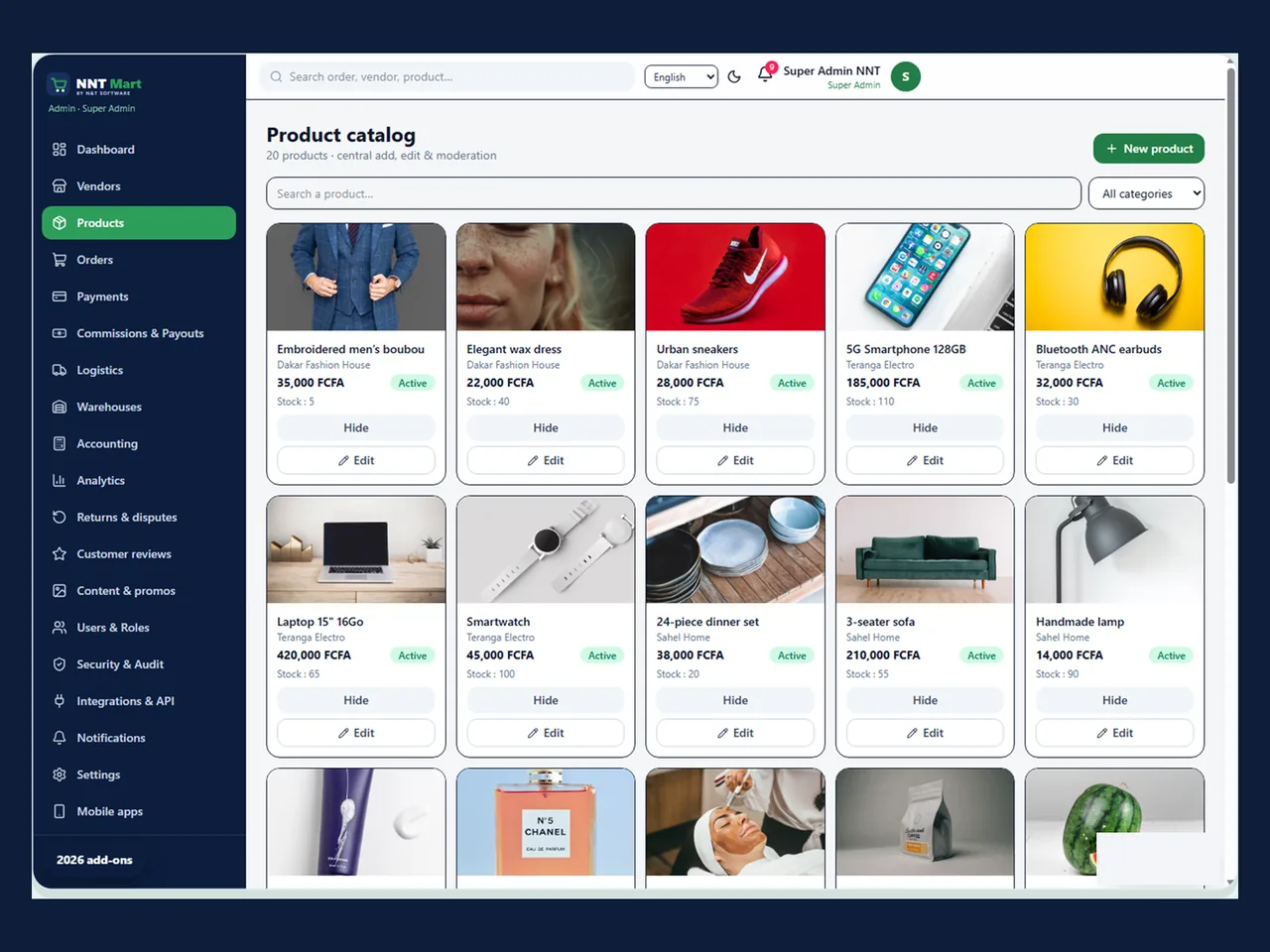
Listing templates, moderation queues, category rules, image standards and duplicate detection. Shipping rules can use Sudan Post, DHL and Aramex as well as your own delivery staff in Port Sudan.
Commission engine
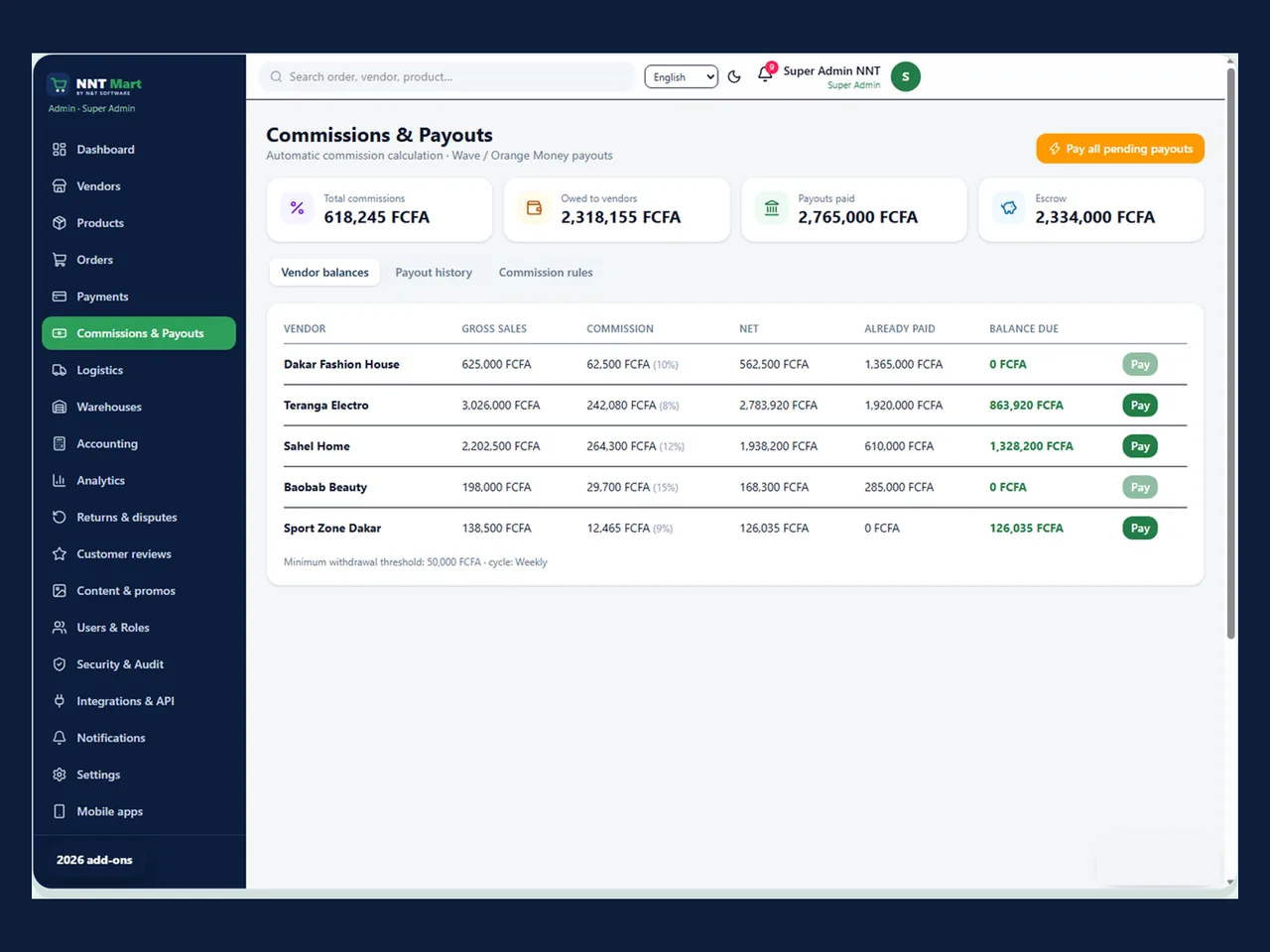
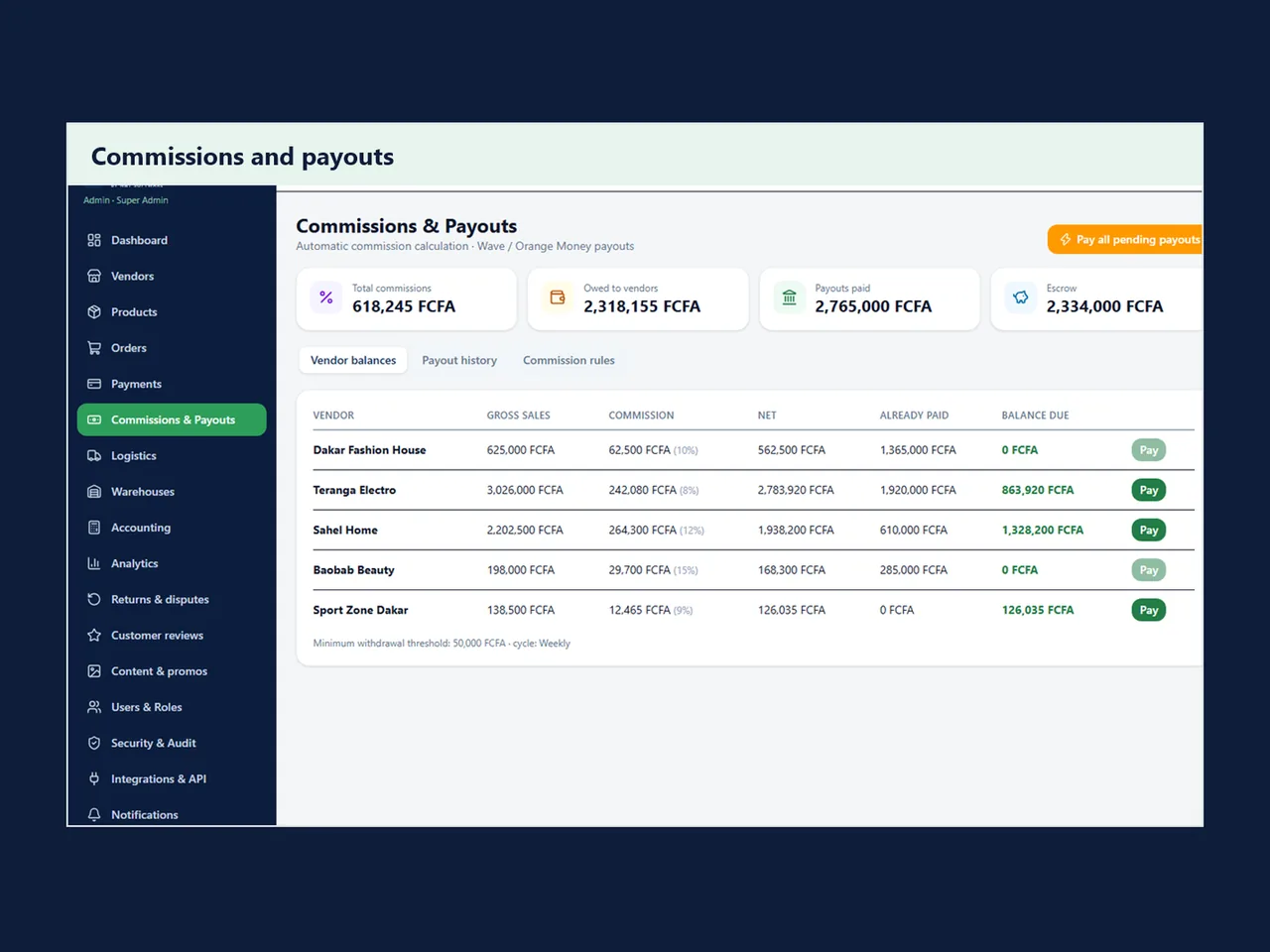
Commissions and fees by vendor, category, product or transaction, with promotions funded by either party. Stock can be held in Port Sudan or anywhere in Sudan, with pickup and local-delivery options where they make sense.
Order routing
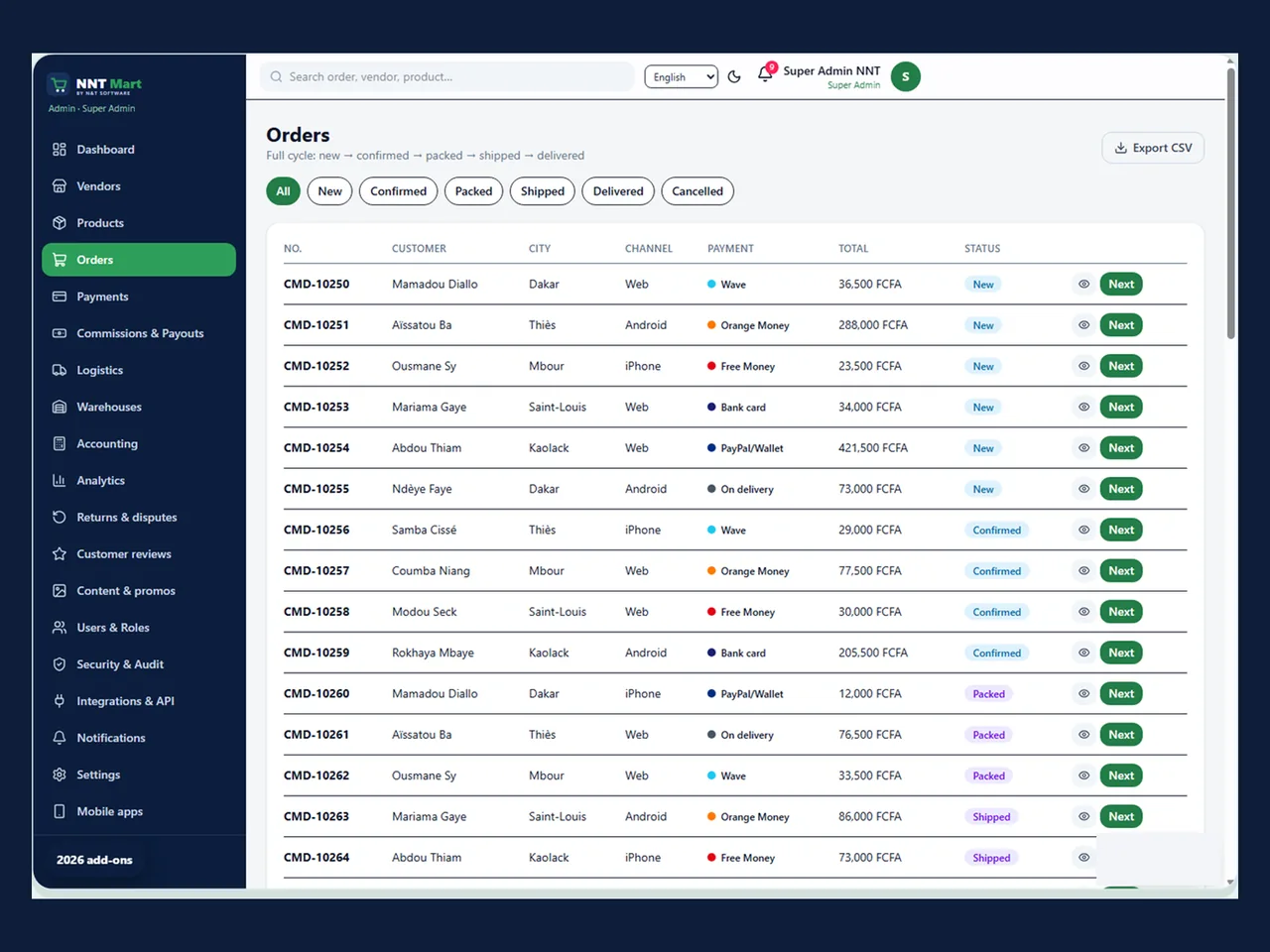
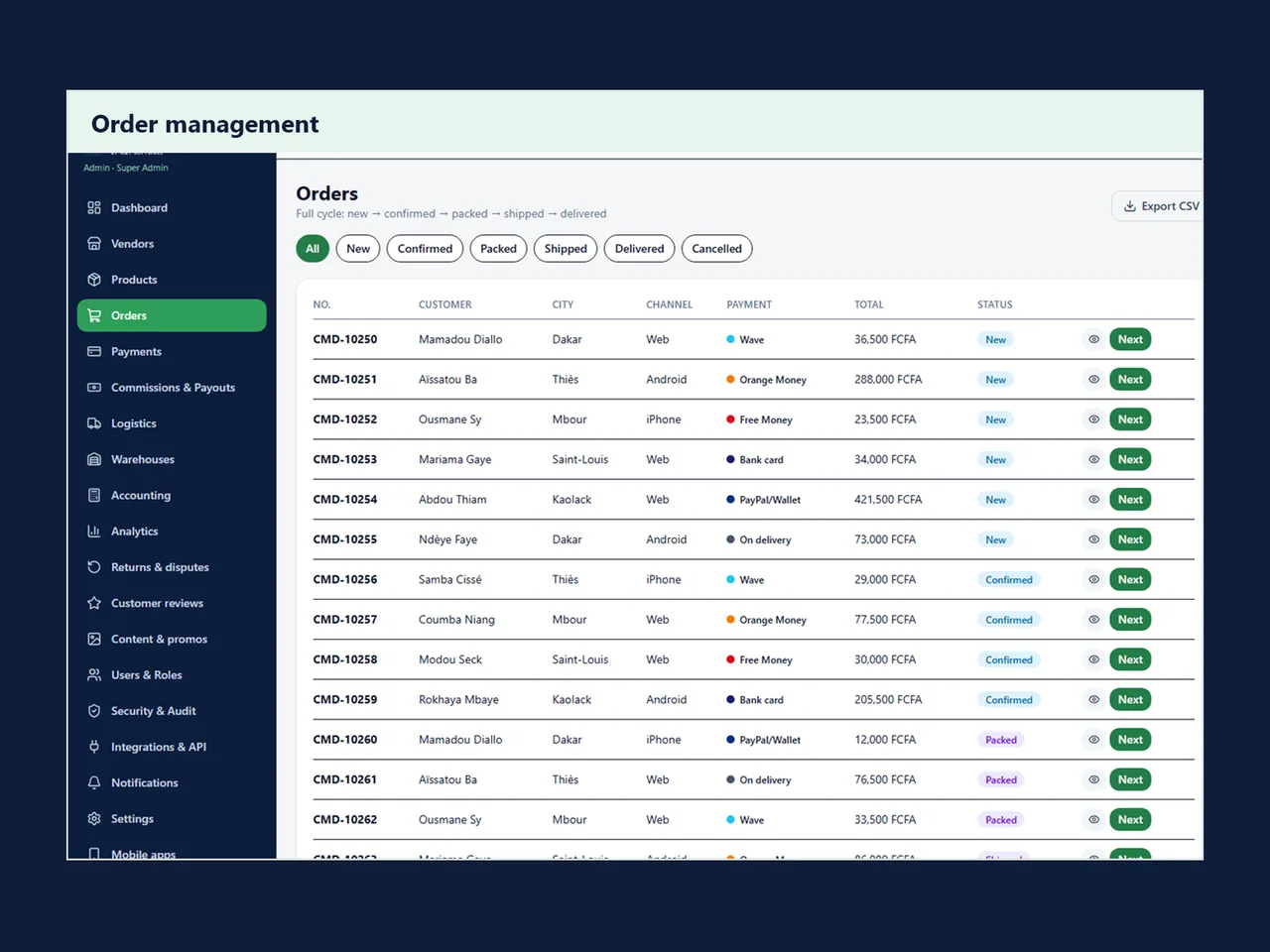
Split carts, vendor-wise fulfilment, shipping rules, service areas and delivery tracking. Dashboards break sales down by product, customer and neighbourhood of Port Sudan, so you see what to promote.
Settlements
Payout calculations, reconciliation reports and integration with split-payment providers where permitted. Content and design can follow how customers in Port Sudan search and buy, including Arabic and English where you need it.
Trust and support
Ratings, reviews, returns, disputes, seller performance scores and customer-support workflows. Bulk import and sync tools mean the Port Sudan team never re-keys stock, prices or descriptions by hand.
What businesses in Port Sudan ask us for
Businesses in Port Sudan search for these in different words. Each one is something NNT Mart designs, builds and supports:
Multi-vendor marketplace development in Port Sudan
Application, document verification, agreements, approval and seller dashboards with team access. For Port Sudan, prices, tax and invoices are in SDG and VAT-ready.
Marketplace website like Amazon in Port Sudan
Listing templates, moderation queues, category rules, image standards and duplicate detection. Built for Port Sudan: Bankak and cash on delivery payments and Sudan Post delivery.
Build an online marketplace in Port Sudan
Commissions and fees by vendor, category, product or transaction, with promotions funded by either party. In Port Sudan it takes Bankak at checkout and ships through Sudan Post.
Vendor marketplace platform in Port Sudan
Split carts, vendor-wise fulfilment, shipping rules, service areas and delivery tracking. For Port Sudan, prices, tax and invoices are in SDG and VAT-ready.
B2B marketplace development in Port Sudan
Payout calculations, reconciliation reports and integration with split-payment providers where permitted. Built for Port Sudan: Bankak and cash on delivery payments and Sudan Post delivery.
Local marketplace app in Port Sudan
Ratings, reviews, returns, disputes, seller performance scores and customer-support workflows. In Port Sudan it takes Bankak at checkout and ships through Sudan Post.
Marketplace commission software in Port Sudan
Application, document verification, agreements, approval and seller dashboards with team access. For Port Sudan, prices, tax and invoices are in SDG and VAT-ready.
Seller onboarding platform in Port Sudan
Listing templates, moderation queues, category rules, image standards and duplicate detection. Built for Port Sudan: Bankak and cash on delivery payments and Sudan Post delivery.
The benefits of a multi-vendor marketplace in Port Sudan
The gain is practical and measurable:
Keep the customer and the margin
Orders that come through your own multi-vendor marketplace keep your pricing, brand and customer list, instead of paying commission on Facebook Marketplace and WhatsApp commerce for every sale.
Sell round the clock to Port Sudan
Customers order and pay at any hour, including evenings and weekends, with Bankak (Bank of Khartoum) and cash on delivery at checkout, so sales no longer depend on shop hours.
Run the business from one place
Vendor onboarding and catalogue governance sit in one admin, connected to split-payment and escrow providers, so the team stops re-typing orders and stock.
See what works
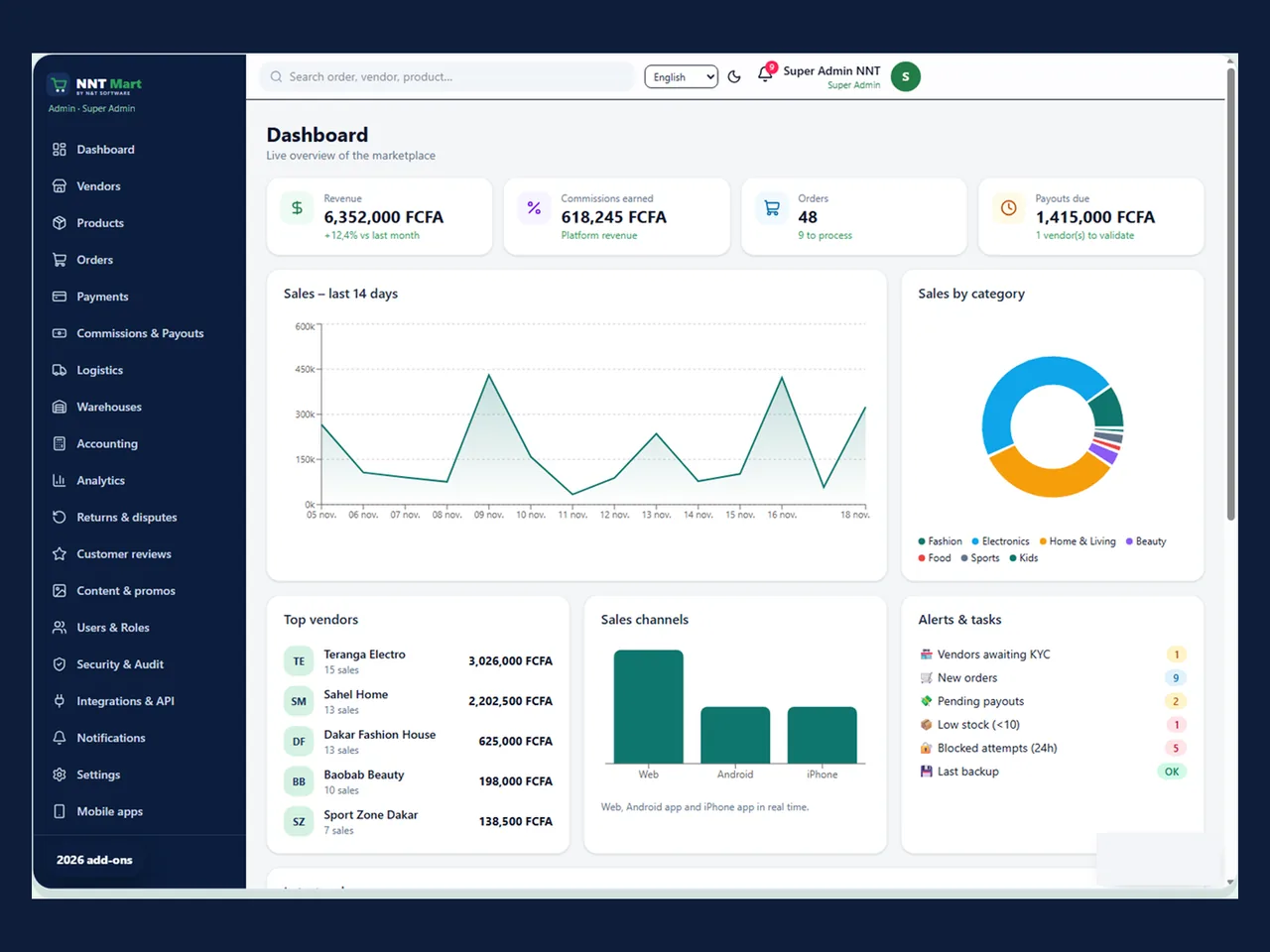
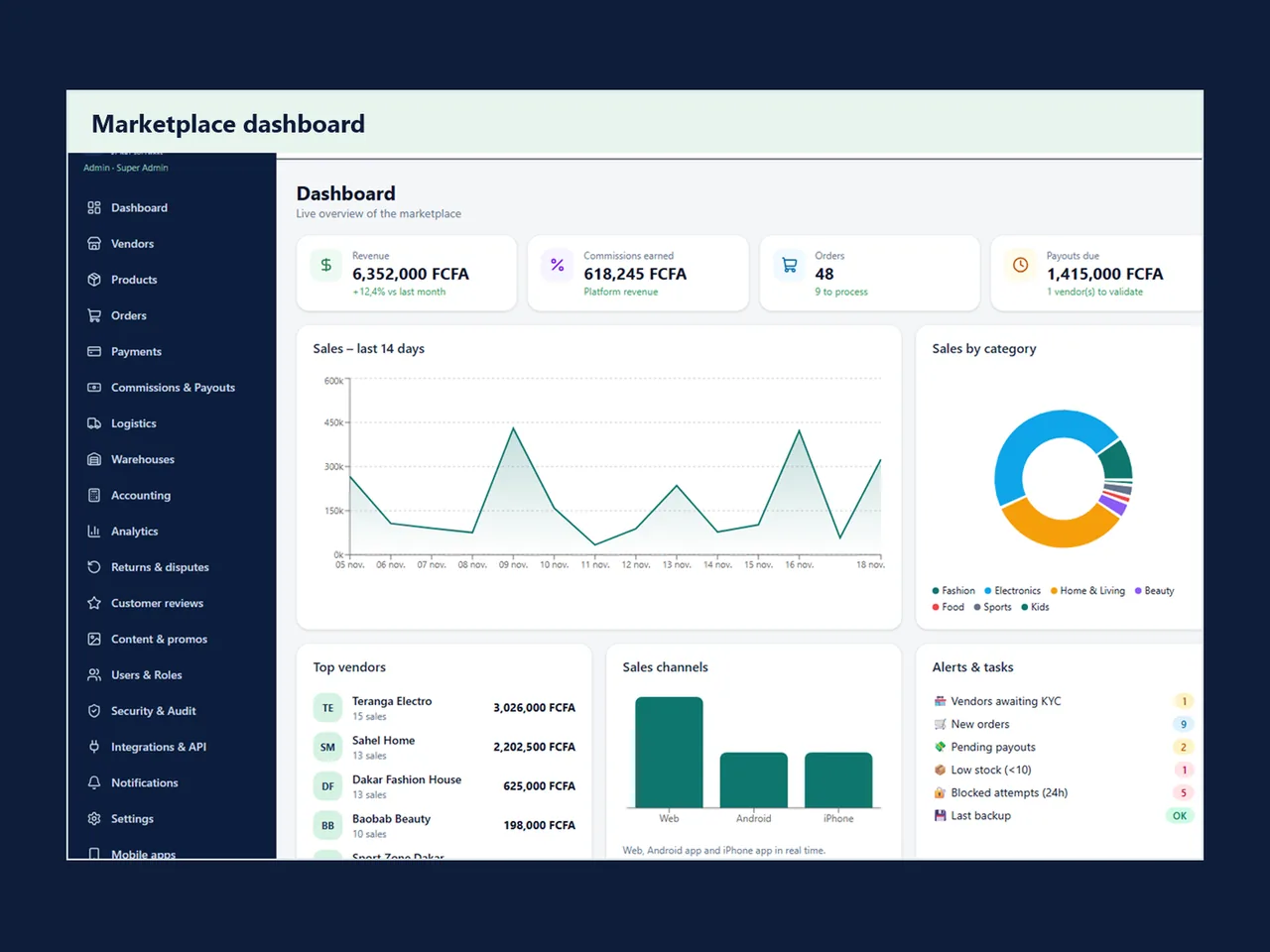
A live dashboard tracks active sellers, GMV and take rate and listing approval time, so Port Sudan decisions on stock, offers and spend come from numbers, not guesses.
Reach customers on their phones
An Android and iOS app on the same backend adds push alerts, saved details and one-tap reorder for repeat buyers in Port Sudan.
Be found by search and AI assistants
Fast pages, product and FAQ schema, a sitemap and direct-answer content let Google and AI assistants read, quote and recommend your multi-vendor marketplace when Port Sudan customers ask.
Take orders on WhatsApp and the app
Customers in Port Sudan can start an order from a link, WhatsApp or the mobile app and finish it in one checkout, so no enquiry is lost in a chat thread.
Own the technology
After final payment you receive 100% of the source code, design files and documentation, with a 90-day warranty, so growth never depends on a licence you cannot move.
Getting paid online in Port Sudan
A multi-vendor marketplace for Port Sudan must support the way people here actually pay: Bankak (Bank of Khartoum), cash on delivery, mobile wallets, bank transfer and remittance transfers.
We integrate suitable gateways and providers for your business category and merchant eligibility, handle payment status, failed-payment retries and refunds, and keep sensitive card data with the provider rather than on your servers. All amounts are shown in Sudanese pound (SDG).
Zone-based payment rules let you offer different options for the port area than for outer parts of Port Sudan.
- Cash on delivery
- Bankak (Bank of Khartoum)
- Remittance transfers
- Mobile wallets
- Bank transfer
Fulfilment options for Port Sudan orders
Your multi-vendor marketplace can book shipments and share tracking with Sudan Post, DHL, Aramex, local courier firms and bus parcel services, or route orders to your own riders and stores across Port Sudan.
Delivery rules can price by distance, weight, postcode or zone, offer same-day slots in dense areas, and switch on pickup points or click-and-collect where customers prefer them.
Connectivity in the area — Port Sudan seaport and Port Sudan Airport — makes regional and national dispatch from Port Sudan practical.
Selling online legally in Sudan
For Port Sudan sellers, tax first: Sudan charges VAT, income tax and customs duty under its finance laws; trade is also affected by sanctions and conflict.
Customer data is handled with the Informatics Offences Act and electronic-transactions rules; no dedicated data-protection law in mind, and the storefront follows the Consumer Protection Act and e-transactions provisions.
Controls we implement include compliant invoices, consent capture, policy pages, restricted staff access and audit trails. Please confirm the final legal and tax position with a local adviser in Port Sudan.
Owning your channel in Sudan
Facebook Marketplace, WhatsApp commerce and Telegram shops are where many shoppers in Port Sudan start, which is why sellers list there. The trade-off is commission, limited branding and rules the platform can change overnight.
With your own multi-vendor marketplace you keep the customer data, set the offers and the packaging, and still push stock to marketplaces from a single admin.
Businesses that use NNT Mart in Port Sudan
Popular online categories in Sudan include food and gum arabic, fashion, electronics, home goods, building materials and agri-products. Local demand in Port Sudan is shaped by port logistics, trade and fishing, so we often design catalogues and B2B ordering around those sectors. In Port Sudan, we most often build multi-vendor marketplaces for:
Industry-specific marketplaces
For industry-specific marketplaces, we usually start with catalogue governance, then add split-payment and escrow providers once orders are flowing.
Regional seller networks
Catalogue, pricing and fulfilment rules designed for regional seller networks in Port Sudan, connected to the systems you already use.
B2B supplier platforms
B2B supplier platforms get commission engine plus settlements workflows tailored to their operations.
Service-provider marketplaces
We map how service-provider marketplaces sell today and digitise it end to end — from enquiry and order to payment, dispatch and repeat purchase.
Institutional procurement platforms
For institutional procurement platforms, we usually start with trust and support, then add search and recommendation engines once orders are flowing.
Artisan and curated brand marketplaces
Catalogue, pricing and fulfilment rules designed for artisan and curated brand marketplaces in Port Sudan, connected to the systems you already use.
Mobile commerce in Port Sudan
Separate buyer and seller apps let customers shop and track orders while vendors manage listings, accept orders and see payouts from their phones.
If you are looking for ecommerce app development in Port Sudan, the Android and iOS shopping app is built on the same backend as your store, in Flutter or native code, and ecommerce mobile app cost is quoted per screen and integration after the requirements meeting.
One backend serves the website and the apps, and the apps ship under your own Google Play and App Store accounts — so what you change once appears everywhere.
Order alerts, offers and abandoned-cart reminders go out on Port Sudan time (UTC+2), in Arabic and English if you want.
- Logistics aggregators
- CRM and helpdesk
- WhatsApp and push notifications
- Split-payment and escrow providers
- Analytics and BI
- KYC and business verification
- Search and recommendation engines
- Tax and invoicing systems
Integrations above are examples; we connect any system that offers a suitable API, database access or approved import and export process.
How we phase your multi-vendor marketplace
Value first, depth later. For a multi-vendor marketplace serving Port Sudan, the usual sequence looks like this:
| Phase | What goes live |
|---|---|
| Pilot marketplace | Seller onboarding, catalogue, checkout, order routing and basic payouts. Configured for SDG, Bankak (Bank of Khartoum) and Sudan Post from the start. |
| Govern and grow | Moderation, commissions, promotions, reviews and dispute handling. |
| Scale | Buyer and seller apps, new categories, cities and service areas. Reviewed against how Port Sudan customers actually buy. |
We track active sellers, GMV and take rate, listing approval time, order defect rate, seller payout accuracy and buyer repeat rate on a live dashboard from day one, so Port Sudan results are visible, not promised.
How Port Sudan clients work with us
Our team covers UTC+2 — 3h 30m behind India (IST) — through three 8-hour shifts, so a Port Sudan client always reaches someone during the local working day.
We work in English and can deliver storefront content in Arabic and English. NDAs are signed on request, and you get a named project lead plus direct access to the engineers building your multi-vendor marketplace.
Our head office is in Chhapi, Gujarat, with an office in Hyderabad and representation in Nigeria, South Africa, Ethiopia and Zambia; Port Sudan clients are served remotely with on-site workshops when the project needs them.