
Skip to content
NNT Mart by N&T Software
Solutions
Markets
Live demosMobile AppsContact
N&T Software
Get a free demo

Multi-Vendor Marketplace · Sana’a, Yemen

Multi-Vendor Marketplace Development in Sana’a, Yemen

Looking for multi-vendor marketplace development in Sana’a, Yemen? NNT Mart designs and develops a custom multi-vendor marketplace and a matching Android/iOS app for businesses in Sana’a, Yemen, covering vendor application, verification and approval; vendor roles, teams and administration access. Sana’a is the capital and largest city of Yemen, home to about 3.0 million people. Checkout supports cash on delivery, mobile wallets (Kuraimi Pay, M-Floos), delivery runs through Yemen Post, and invoicing is sales-tax-ready while customer data follows telecom and electronic-transactions rules. Our team works remotely from India with working hours arranged to overlap yours, shows a working demo within 24 hours and hands over full source-code ownership with a 90-day warranty. Rates are US$15–40 per hour, depending on your budget and the team members on the project.

  • Web platform + Android/iOS app
  • cash on delivery and mobile wallets (Kuraimi Pay, M-Floos)
  • Delivery via Yemen Post
  • Demo within 24 hours
Marketplace sale campaign across many vendors — Sana’a

Quick answer

Who builds a multi-vendor marketplace in Sana’a, Yemen?

NNT Mart, the e-commerce platform of N&T Software, builds custom multi-vendor marketplaces for businesses in Sana’a, Yemen. It serves 188 countries with custom builds, full source-code ownership and a 90-day warranty. Here it supports cash on delivery and Yemen Post delivery, quotes in YER, and demos within 24 hours.

Reviewed by Shahnavaz Syed, Chief Operating Officer (COO) · Last updated

Pricing and team

How does N&T Software price multi-vendor marketplace in Sana’a, Yemen, and who does the work?

N&T Software works on a fixed-cost basis, an hourly basis or with dedicated developers for clients in Sana’a, Yemen, as per the client's budget. Pricing starts at USD 15–40 per hour; final charges and timeline are set after we confirm your requirements, and depend on your budget and the team members assigned to the project.

Our multi-vendor marketplace work for businesses in Sana’a, Yemen is handled by in-house DBA, development and hosting teams with 15+ years of experience, overseen by COO Shahnavaz Syed, who has built software since 2010.

Live demo

Try a live multi-vendor marketplace demo

Use it yourself, on sample data: nothing is stored and no payment is taken. This is a demo built by NNT Mart to show how the product works; your Sana’a project is built to your own requirements.

See it before you decide

A multi-vendor marketplace for Sana’a: the screens your customers and team use

Real screens from our live multi-vendor marketplace demo, shown for a business in Sana’a, Yemen. Open the demo to try each one.

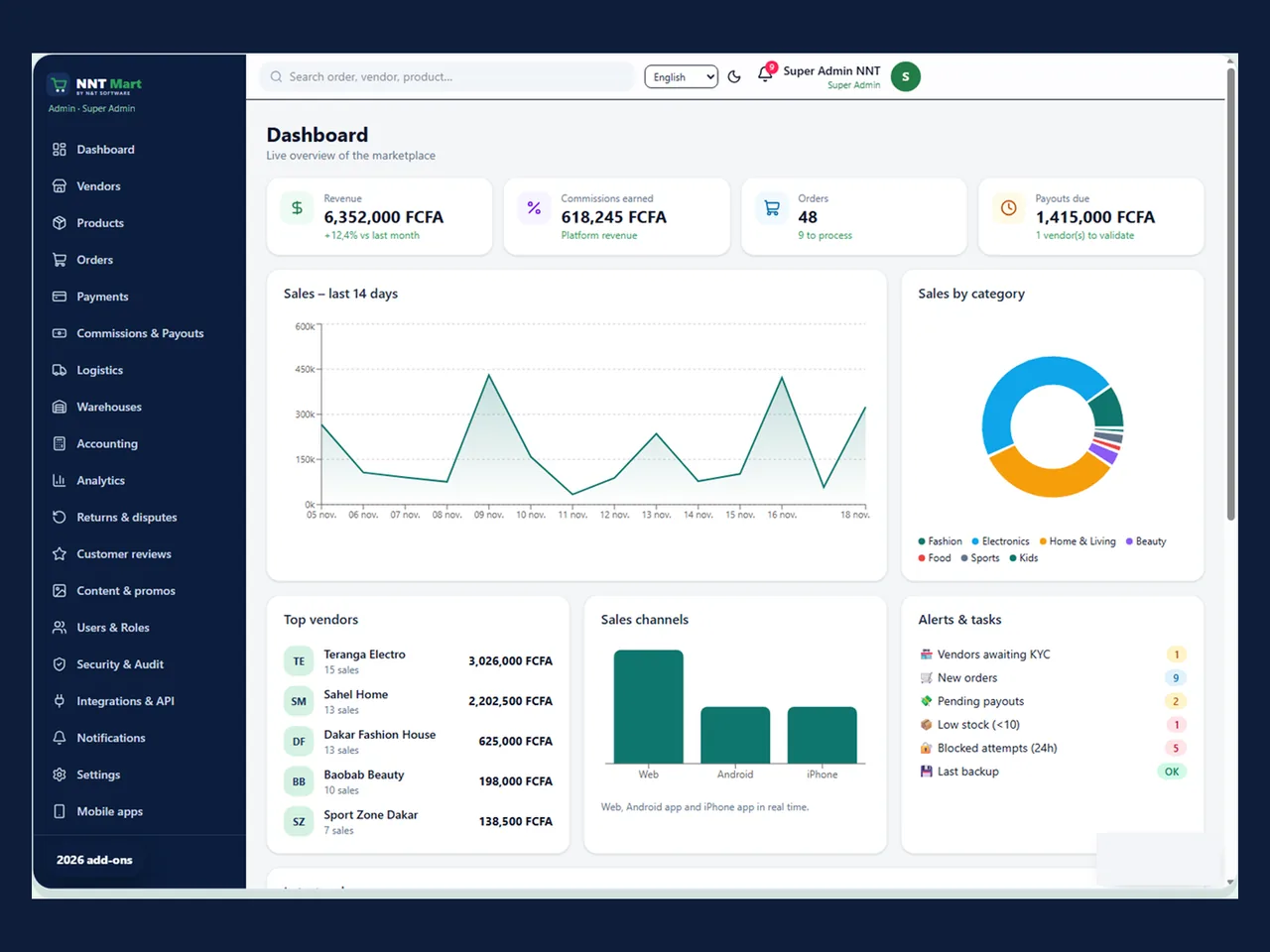
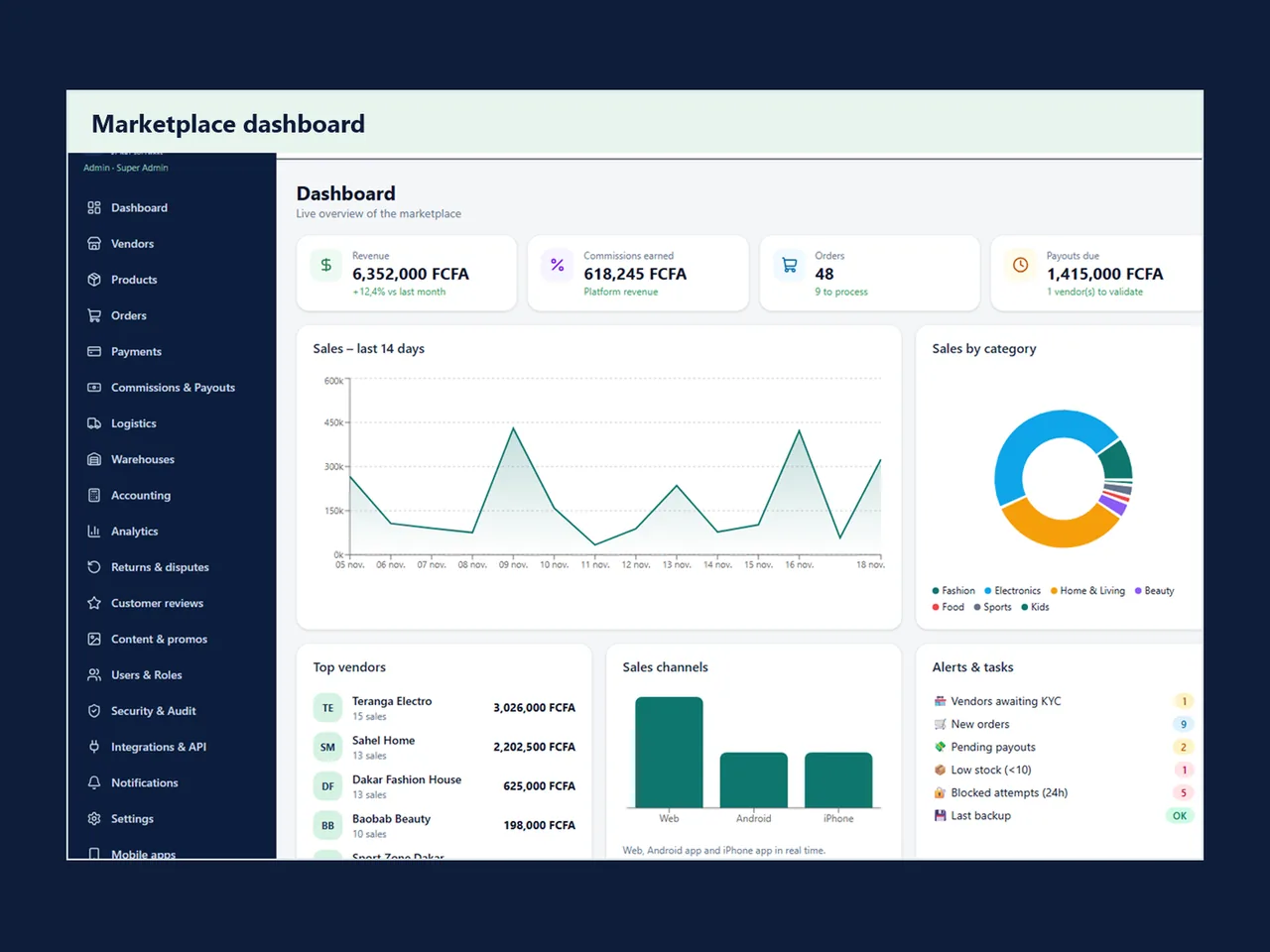
  • Marketplace admin dashboard with revenue, orders, a sales chart, sales by category and top vendors (multi-vendor marketplace demo for Sana’a, Yemen)
    Marketplace dashboard · multi-vendor marketplace for Sana’a, Yemen
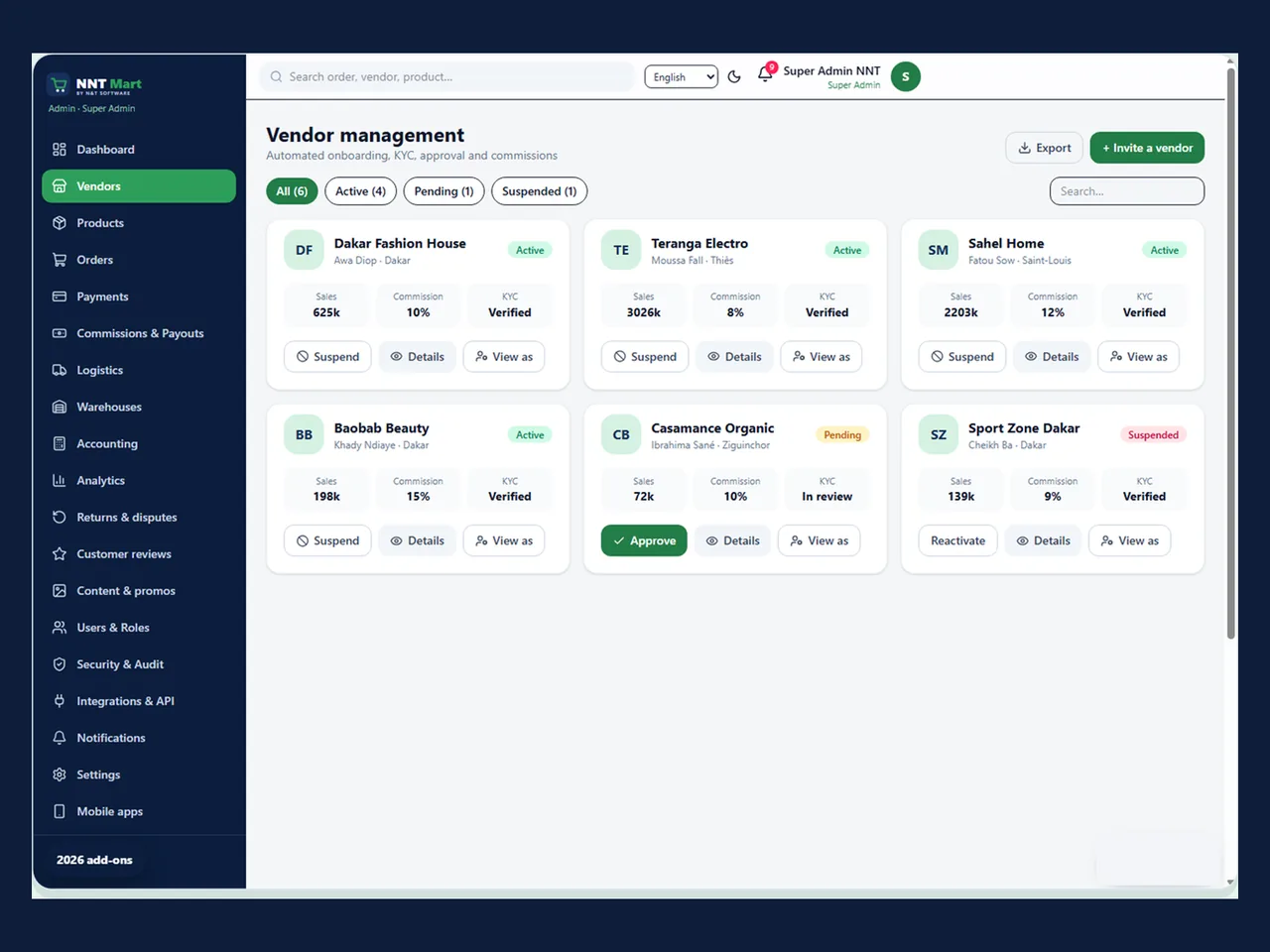
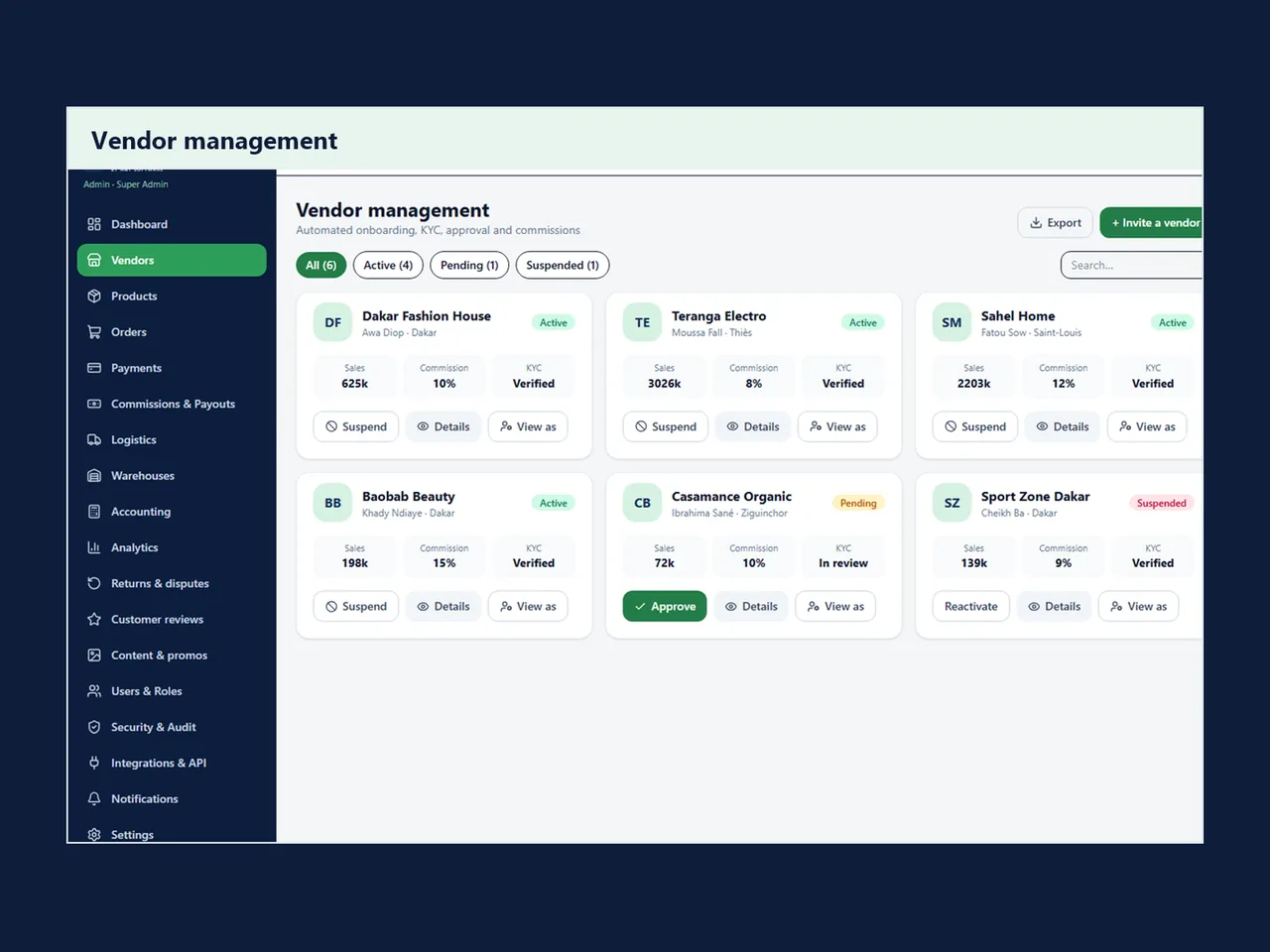
  • Vendor list with approval status, KYC check and commission for each seller, NNT Mart multi-vendor marketplace for Sana’a, Yemen
    Vendor management · multi-vendor marketplace for Sana’a, Yemen
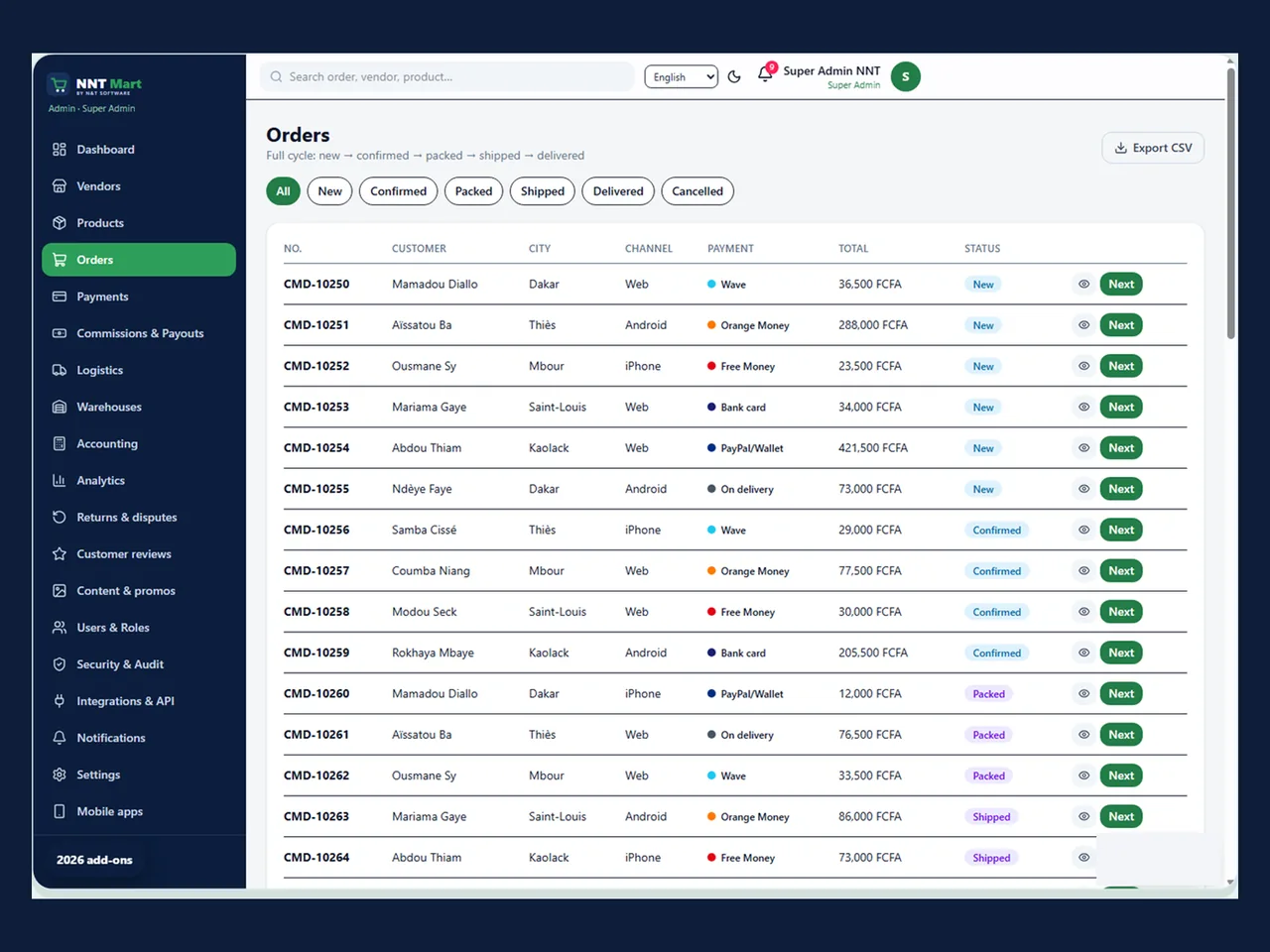
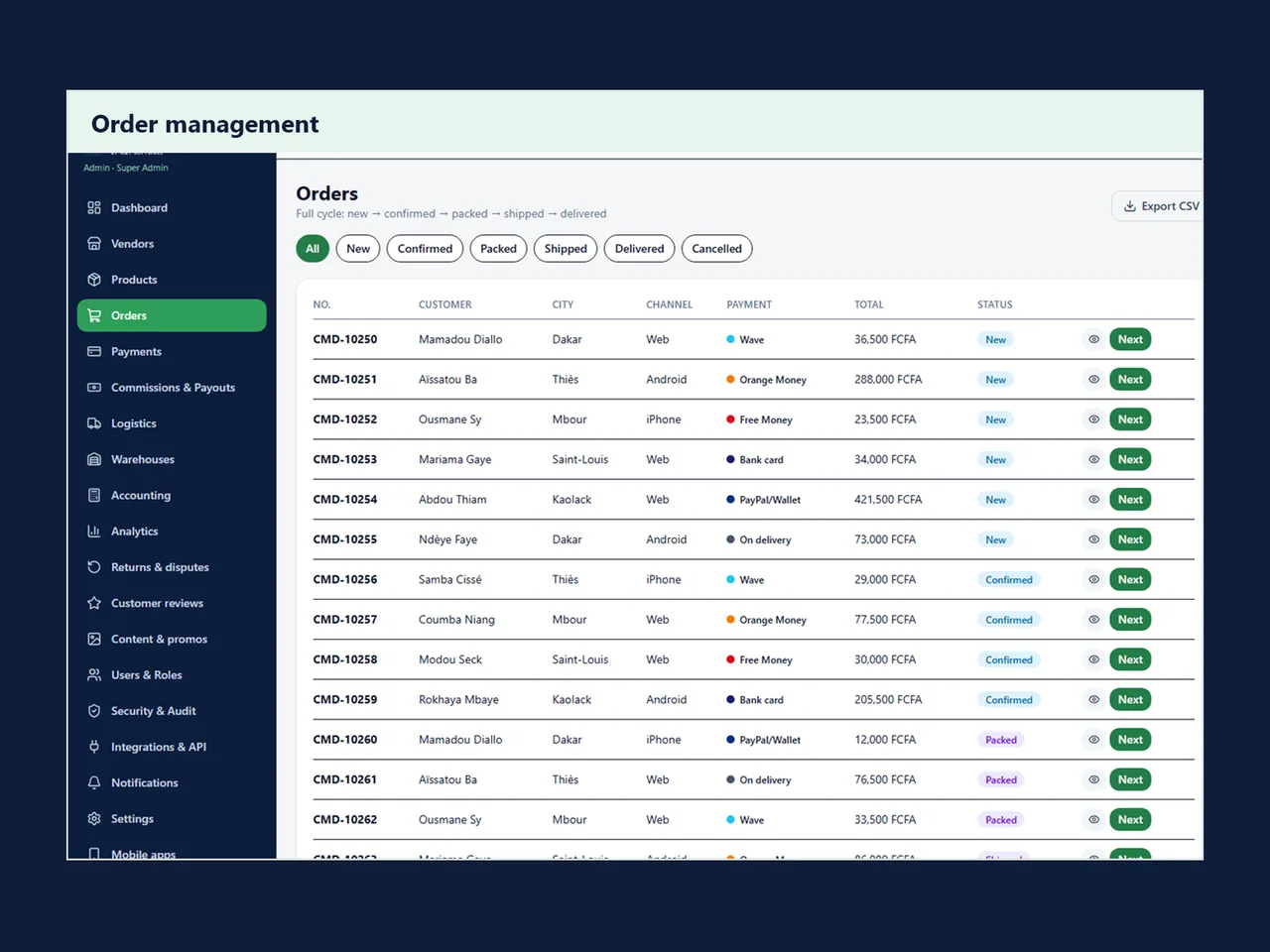
  • Order table with customer, city, payment method, total and status, multi-vendor marketplace built for Sana’a, Yemen
    Marketplace orders · multi-vendor marketplace for Sana’a, Yemen
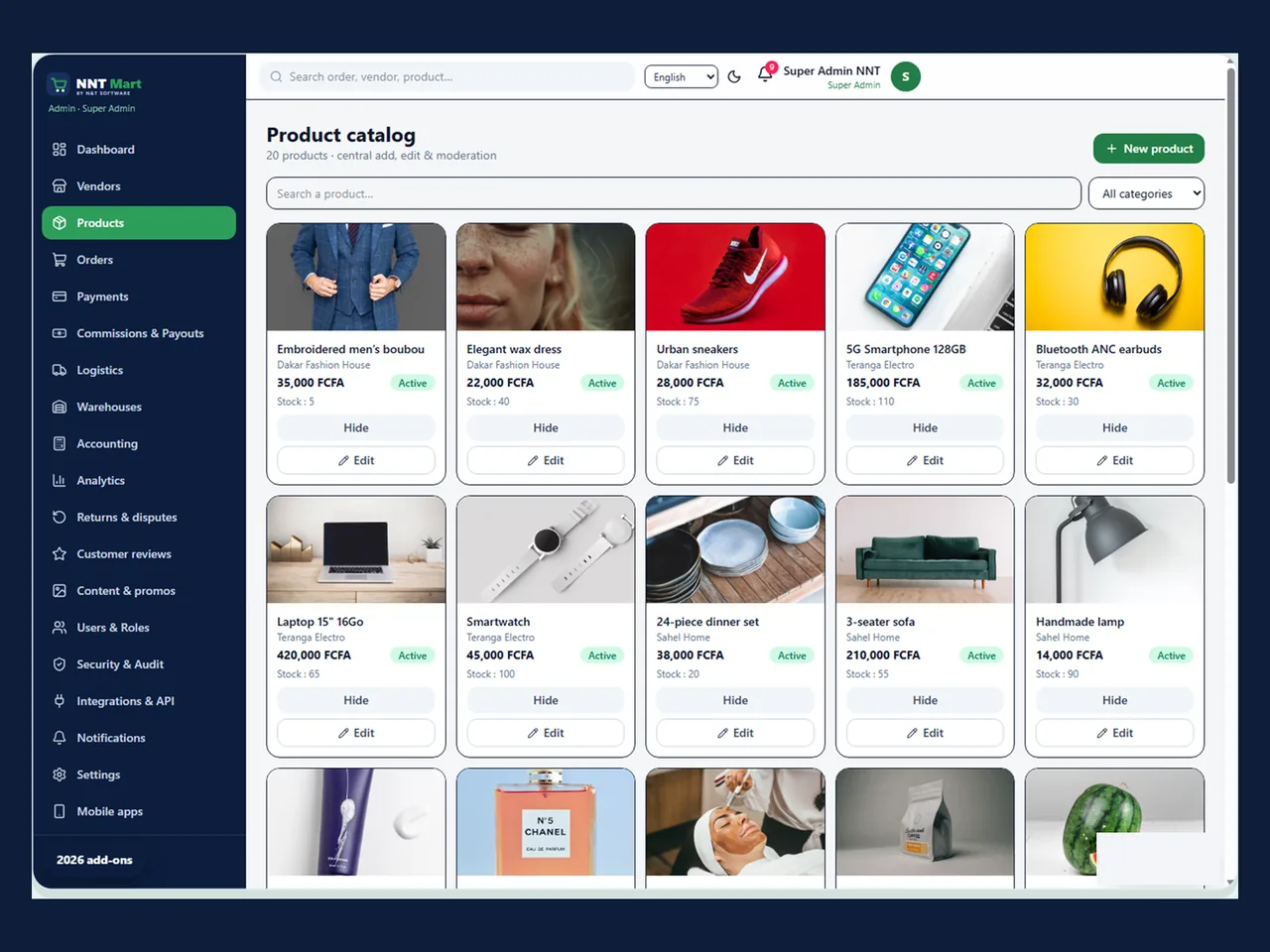
  • multi-vendor marketplace for Sana’a, Yemen: product catalogue with photos, prices and stock across all vendors
    Marketplace products · multi-vendor marketplace for Sana’a, Yemen
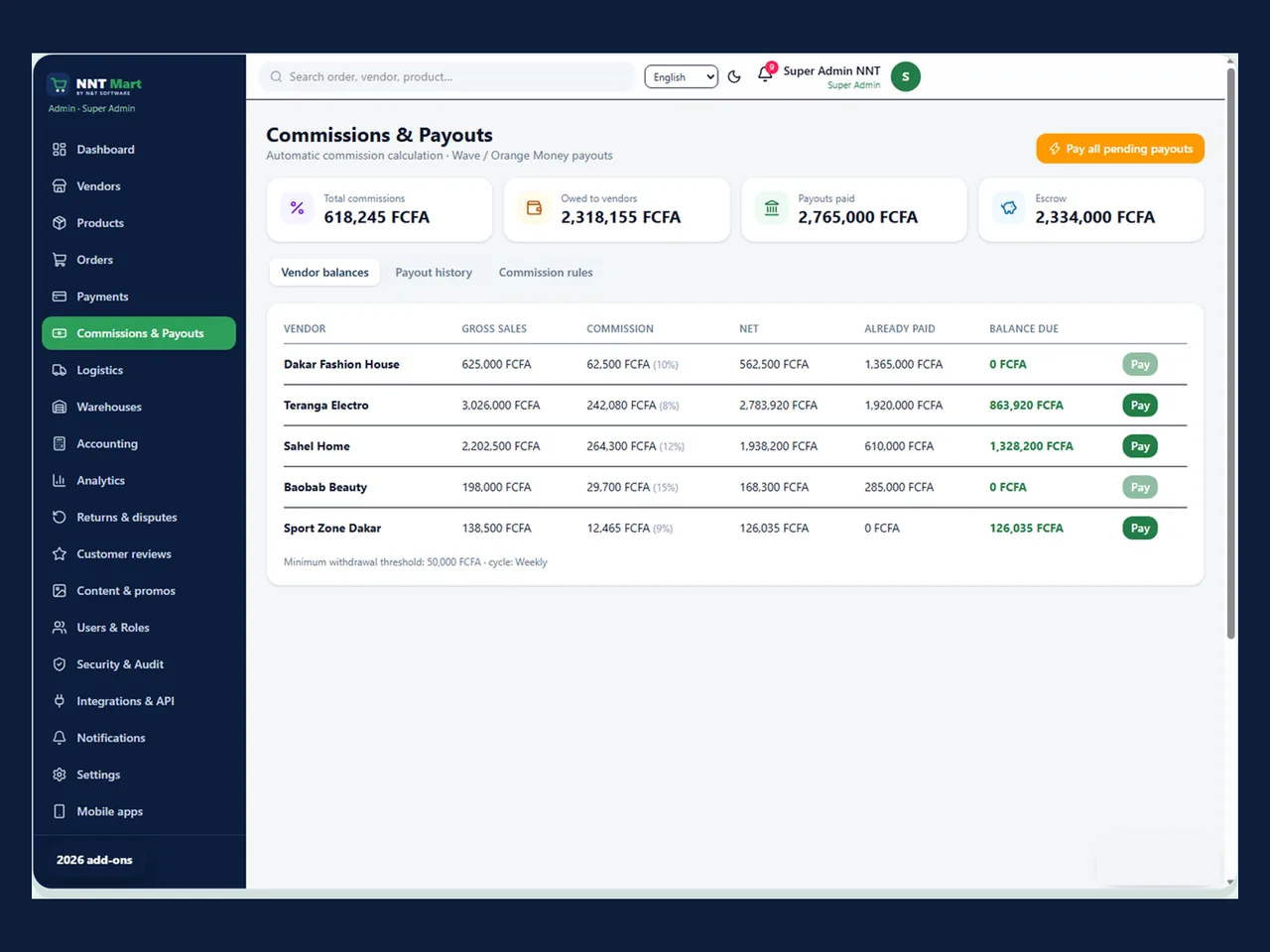
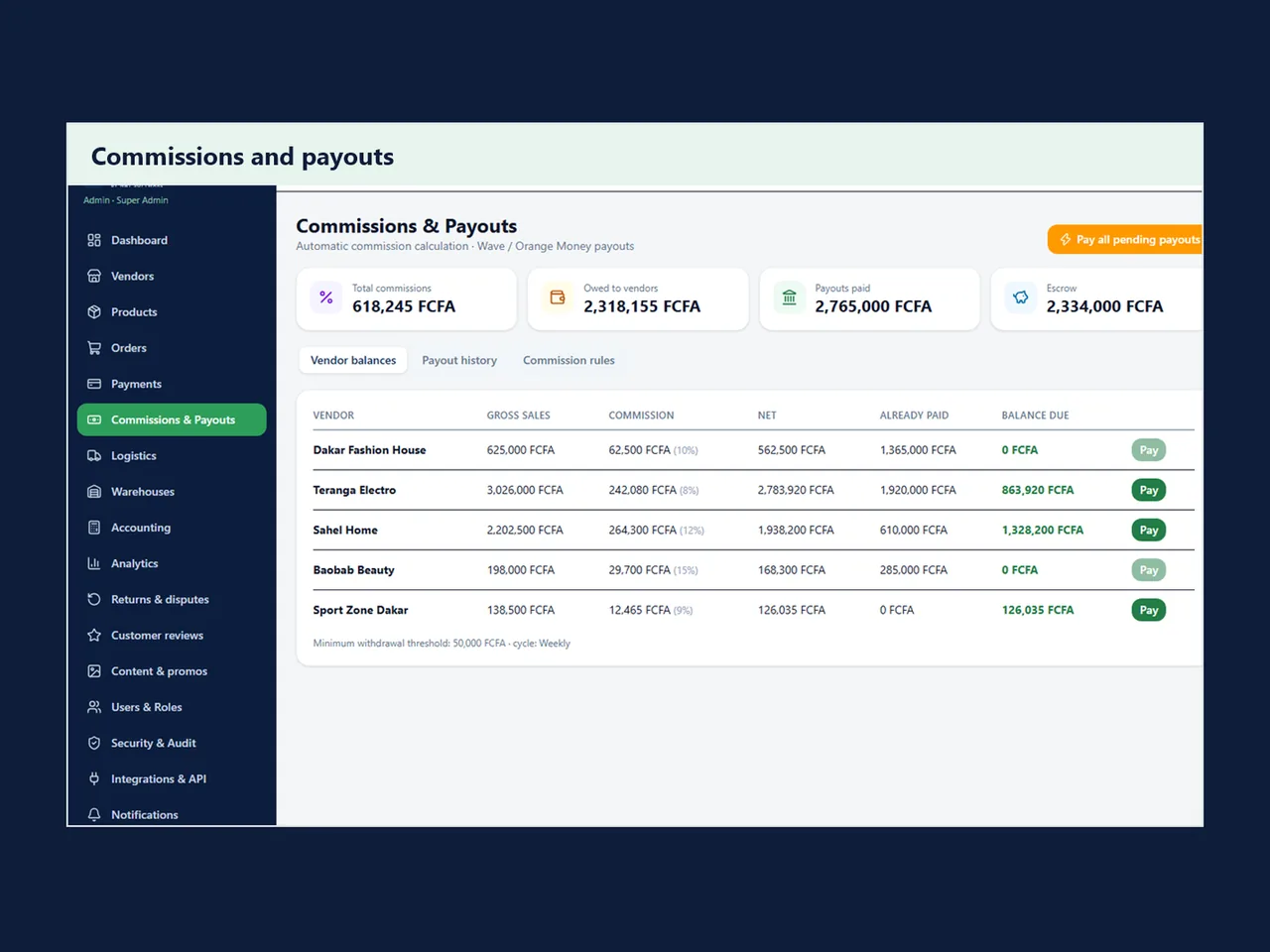
  • Commissions and payouts with gross sales, commission, net amount and balance for each vendor, multi-vendor marketplace built for Sana’a, Yemen
    Commissions and payouts · multi-vendor marketplace for Sana’a, Yemen
  • Dashboard with revenue, commission, orders, a sales trend, sales by category and alerts, NNT Mart multi-vendor marketplace for Sana’a, Yemen
    Marketplace dashboard · multi-vendor marketplace for Sana’a, Yemen
  • Vendor cards with sales, commission rate, KYC status and approve or suspend buttons, multi-vendor marketplace built for Sana’a, Yemen
    Vendor management · multi-vendor marketplace for Sana’a, Yemen
  • Order list with status filters, payment method, city and a button to move each order forward, NNT Mart multi-vendor marketplace for Sana’a, Yemen
    Order management · multi-vendor marketplace for Sana’a, Yemen
  • Automatic commission calculation with a payout amount and pay button for each vendor, multi-vendor marketplace built for Sana’a, Yemen
    Commissions and payouts · multi-vendor marketplace for Sana’a, Yemen

Project blueprint

Example: how we would build a multi-vendor marketplace for a business in Sana’a

An illustrative example of how an engagement like this is scoped, from the first meeting to the first release. It is a worked example, not a client case study, and it carries no client names or results.

The market in Sana’a

Sana’a is shaped by trade, services, construction and food. Food, electronics and fashion sell well online across Yemen, shoppers already use Facebook Marketplace and WhatsApp commerce, and they pay with cash on delivery and mobile wallets. A multi-vendor marketplace here has to fit those habits from the first release.

The situation

A founder in Sana’a wants a marketplace where local sellers list their products. Buyers should pay once, sellers should be paid their share on time, and disputes must be handled fairly. The risk is building the buyer side and neglecting the seller side.

Key decisions we would make

Seller tools are half the product

Each vendor gets a dashboard for products, stock, orders, shipping and earnings, so sellers do not need to call you.

Commission rules as configuration

Percentage, flat, category-based and subscription fees are settings, not code changes.

Split payments and payout statements

Money is split between the platform and each vendor with clear statements, holds and reconciliation.

Trust tools from the start

Seller verification, reviews, returns and a dispute flow with admin moderation.

Checkout built around cash on delivery and mobile wallets

Customers in Sana’a pay with cash on delivery and mobile wallets. The first release supports them through the gateway you choose, with every amount in Yemeni rial (YER) and refunds handled in the same admin.

Delivery, tax and data rules for Sana’a

Orders ship through Yemen Post and DHL (limited) or your own team. Invoices are sales-tax-ready, customer data is handled under telecom and electronic-transactions rules, and returns follow basic consumer-protection provisions in trade and civil laws.

Working with your team in Sana’a

Sana’a runs on UTC+3, 2h 30m behind India (IST). Meetings and demos are in your working hours, and content can run in Arabic and English.

Delivery zones around Sana’a

Zones and charges are set for Hadda, the Old City markets and Al-Zubairy Street and the surrounding areas, with pickup points where customers prefer them. Logistics planning takes account of sana’a international airport and the highland road network.

What the first release contains

  1. Seller application, approval and dashboard
  2. Product listing with moderation
  3. Checkout with cash on delivery and YER pricing
  4. Single checkout with split payment
  5. Commission engine and payout statements
  6. Reviews, returns and dispute handling
  7. Sales-tax-ready invoices and consent records for Sana’a

Phased plan

PhaseWhat goes live
Pilot marketplaceSeller onboarding, catalogue, checkout, order routing and basic payouts.
Govern and growModeration, commissions, promotions, reviews and dispute handling.
ScaleBuyer and seller apps, new categories, cities and service areas.

Launch checklist for Sana’a

The steps that differ by country and usually decide the go-live date. They run in parallel with the build.

  1. 1Open the merchant account for cash on delivery and mobile wallets, with the documents your business category needs in Yemen. This usually sets the go-live date, so it starts in week one.
  2. 2Set up sales-tax on products, shipping and invoices as the rules require: Yemen applies general sales tax, income tax and customs duty under its tax laws; rules differ between regions.
  3. 3Publish a privacy notice and consent flow that follow telecom and electronic-transactions rules, and keep the records the law asks for.
  4. 4Write the returns, refund and delivery policy to meet basic consumer-protection provisions in trade and civil laws.
  5. 5Onboard Yemen Post and DHL (limited) for Sana’a: rates, pickup, tracking links and failed-delivery rules.
  6. 6Prepare storefront and emails in Arabic and English, with YER formats, and review them with a native speaker.
  7. 7Agree support hours for Sana’a (UTC+3) and the go-live window, then run a rehearsal order end to end.

Rules in Sana’a and what we build for each

AreaWhat appliesWhat the build does
TaxYemen applies general sales tax, income tax and customs duty under its tax laws; rules differ between regionsSales-tax-ready prices, invoices and tax reports.
Customer dataTelecom and electronic-transactions rules; there is no dedicated data-protection lawConsent capture, data export and deletion tools, retention rules.
Consumer rulesBasic consumer-protection provisions in trade and civil lawsReturn window, refund flow and clear delivery and price terms.
PaymentsCustomers expect cash on delivery and mobile wallets.Gateway adapters for cash on delivery and mobile wallets, with YER settlement.
DeliveryCommon carriers: Yemen Post, DHL (limited) and local courier firms.Rate, label and tracking links, with zone and weight rules.

Rules are summarised for planning; your accountant and lawyer confirm what applies to your business.

Risks and how we handle them

RiskWhat we do about it
Not enough sellers or buyers at launchLaunch with a seeded set of trusted sellers and your own catalogue, then open up.
Payout errorsDaily automated matching of gateway reports against the ledger, with an exceptions list.
Fake or low-quality listingsModeration queue, seller scoring and listing rules enforced in the admin.
Payment-provider approval in YemenThe merchant application for cash on delivery and mobile wallets starts in week one, in parallel with the build, with the documents your business category needs.
Local rules changeTax, consent and policy texts are settings, so a change in telecom and electronic-transactions rules or sales-tax rules does not need a new build.
Demand concentrated in Sana’aA city of about 3.0 million people can fill a first release quickly, so stock, delivery slots and support are sized for the launch weeks and reviewed weekly.

How success is measured

A live dashboard tracks active sellers, GMV and take rate, listing approval time, order defect rate from launch day.

What is not included

Seller recruitment, marketing, payment licences and legal terms for sellers stay with you.

Plan yours: free requirements meeting and demo in 24 hours

Key takeaways

  • We do not hand Sana’a businesses a ready-made theme: we study how you sell, then build the online platform and Android/iOS app your customers and staff actually need.
  • Checkout ready for cash on delivery, mobile wallets (Kuraimi Pay, M-Floos) and bank transfer, with delivery through Yemen Post and DHL (limited) or your own team.
  • Sales-tax-ready invoicing and controls designed around telecom and electronic-transactions rules; there is no dedicated data-protection law.
  • Free demo within 24 hours of the requirements meeting; you own 100% of the source code after final payment.

The case for a multi-vendor marketplace in Sana’a

Sana’a is a capital and largest city of yemen, home to about 3.0 million people, and one of the markets in Yemen where we build multi-vendor marketplaces.

Businesses here work in trade, services, construction and food; many are based around Hadda, the Old City markets and Al-Zubairy Street.

Logistics are supported by Sana’a International Airport and the highland road network, which matters when you promise customers fast delivery.

Yemen’s online selling is social-media driven and cash-based, with wallets growing. Conflict and banking limits make delivery and payment the main design problems.

That is why more companies in Sana’a are moving from phone, WhatsApp and spreadsheet orders to a proper multi-vendor marketplace — one place where products, prices, payments, orders and customers are managed together.

Why going digital matters for a business in Sana’a

In Yemen, buying starts on a phone: shoppers search, compare on Facebook Marketplace and WhatsApp commerce and pay with cash on delivery and mobile wallets (Kuraimi Pay, M-Floos). Sana’a alone has about 3.0 million people, and a business without its own multi-vendor marketplace hands those orders to whoever is easier to buy from.

Orders taken by phone, WhatsApp or spreadsheet cost real money: stock goes wrong, payments are chased by hand and sales stop when the shop closes. Food, electronics and fashion are among the strongest online categories in Yemen, so the demand is already there to capture.

It is also a compliance move. Sales-tax-ready invoices and records, and customer data handled under telecom and electronic-transactions rules, are far easier to keep right in one system than across notebooks and chat threads.

AreaOffline and chat ordersWith your own multi-vendor marketplace in Sana’a
OrdersPhone, WhatsApp, spreadsheets; open only in shop hoursTaken 24 hours a day, tracked end to end
PaymentsCash and manual follow-upCash on delivery and mobile wallets (Kuraimi Pay, M-Floos) and other local methods at checkout
ReachWalk-ins and word of mouthSearch, social, Facebook Marketplace and WhatsApp commerce and a link anyone can share
RecordsPaper and chat historySales-tax invoices, customer and stock data in one place

Local details we build into every Sana’a project

A store that works in Sana’a respects local habits as well as local law. These are the details we configure first.

Currency and pricing

Everything a Sana’a shopper sees — price, tax, delivery fee, refund — is in YER, written the local way.

Language and content

We localise pages, emails and notifications into Arabic and English where your audience needs it.

Local trust signals

Trust is local: familiar names such as cash on delivery and mobile wallets (Kuraimi Pay, M-Floos) and Yemen Post sit next to the buy button.

Domain, phone and contact

Using .ye where it suits you signals a local business to shoppers and search engines. Click-to-call and WhatsApp buttons use the +967 calling code so customers reach you without dialling errors.

Talent and partners nearby

With Sana’a University close by, finding people to manage catalogues, content and support after launch is realistic in Sana’a.

A multi-vendor marketplace built around your Sana’a business

Sana’a businesses tell us what they sell and how they want to sell it; our engineers turn that into a custom multi-vendor marketplace, an admin system and a mobile app shaped around their operations.

In Sana’a we typically work with industry-specific marketplaces, regional seller networks, B2B supplier platforms and service-provider marketplaces, and with sellers in categories such as food, electronics, fashion and building materials that have strong online demand in Yemen.

We start with a requirements meeting, show you a working demo within 24 hours, and only then propose scope, milestones and budget.

What a multi-vendor marketplace in Sana’a should include first

Industry-specific marketplaces, regional seller networks and B2B supplier platforms in Sana’a usually get the fastest return by launching the journeys that bring in orders first, then adding depth. The order we recommend:

  1. Pilot marketplace: Seller onboarding, catalogue, checkout, order routing and basic payouts. Set up for YER, cash on delivery and Yemen Post.
  2. Govern and grow: Moderation, commissions, promotions, reviews and dispute handling.
  3. Scale: Buyer and seller apps, new categories, cities and service areas.

Core modules we build for Sana’a clients

Nothing here is fixed: modules are switched on, reshaped or built from scratch around how your Sana’a business sells.

Vendor onboarding

Application, document verification, agreements, approval and seller dashboards with team access. Payment steps are built around cash on delivery, mobile wallets (Kuraimi Pay, M-Floos) and bank transfer, the options shoppers here already trust.

Catalogue governance

Listing templates, moderation queues, category rules, image standards and duplicate detection. Couriers such as Yemen Post, DHL (limited) and local courier firms plug in alongside your own fleet for Sana’a orders.

Commission engine

Commissions and fees by vendor, category, product or transaction, with promotions funded by either party. Multiple stock points in Yemen are supported, so a Sana’a order ships from the nearest one.

Order routing

Split carts, vendor-wise fulfilment, shipping rules, service areas and delivery tracking. Reports show which products, customers and areas of Sana’a drive revenue.

Settlements

Payout calculations, reconciliation reports and integration with split-payment providers where permitted. Pages, search filters and wording are tuned to how people in Sana’a look for products, in Arabic and English if your audience needs it.

Trust and support

Ratings, reviews, returns, disputes, seller performance scores and customer-support workflows. Product data imports from your existing sheets or ERP, so Sana’a teams do not re-type thousands of items.

Multi-vendor marketplace services in Sana’a

Businesses in Sana’a search for these in different words. Each one is something NNT Mart designs, builds and supports:

Multi-vendor marketplace development in Sana’a

Application, document verification, agreements, approval and seller dashboards with team access. In Sana’a it takes cash on delivery at checkout and ships through Yemen Post.

Marketplace website like Amazon in Sana’a

Listing templates, moderation queues, category rules, image standards and duplicate detection. For Sana’a, prices, tax and invoices are in YER and sales-tax-ready.

Build an online marketplace in Sana’a

Commissions and fees by vendor, category, product or transaction, with promotions funded by either party. Built for Sana’a: cash on delivery and mobile wallets payments and Yemen Post delivery.

Vendor marketplace platform in Sana’a

Split carts, vendor-wise fulfilment, shipping rules, service areas and delivery tracking. In Sana’a it takes cash on delivery at checkout and ships through Yemen Post.

B2B marketplace development in Sana’a

Payout calculations, reconciliation reports and integration with split-payment providers where permitted. For Sana’a, prices, tax and invoices are in YER and sales-tax-ready.

Local marketplace app in Sana’a

Ratings, reviews, returns, disputes, seller performance scores and customer-support workflows. Built for Sana’a: cash on delivery and mobile wallets payments and Yemen Post delivery.

Marketplace commission software in Sana’a

Application, document verification, agreements, approval and seller dashboards with team access. In Sana’a it takes cash on delivery at checkout and ships through Yemen Post.

Seller onboarding platform in Sana’a

Listing templates, moderation queues, category rules, image standards and duplicate detection. For Sana’a, prices, tax and invoices are in YER and sales-tax-ready.

What you gain in Sana’a

Here is what changes once the multi-vendor marketplace is live:

Keep the customer and the margin

Orders that come through your own multi-vendor marketplace keep your pricing, brand and customer list, instead of paying commission on Facebook Marketplace and WhatsApp commerce for every sale.

Sell round the clock to Sana’a

Customers order and pay at any hour, including evenings and weekends, with cash on delivery and mobile wallets (Kuraimi Pay, M-Floos) at checkout, so sales no longer depend on shop hours.

Run the business from one place

Vendor onboarding and catalogue governance sit in one admin, connected to split-payment and escrow providers, so the team stops re-typing orders and stock.

See what works

A live dashboard tracks active sellers, GMV and take rate and listing approval time, so Sana’a decisions on stock, offers and spend come from numbers, not guesses.

Reach customers on their phones

An Android and iOS app on the same backend adds push alerts, saved details and one-tap reorder for repeat buyers in Sana’a.

Be found by search and AI assistants

Fast pages, product and FAQ schema, a sitemap and direct-answer content let Google and AI assistants read, quote and recommend your multi-vendor marketplace when Sana’a customers ask.

Take orders on WhatsApp and the app

Customers in Sana’a can start an order from a link, WhatsApp or the mobile app and finish it in one checkout, so no enquiry is lost in a chat thread.

Own the technology

After final payment you receive 100% of the source code, design files and documentation, with a 90-day warranty, so growth never depends on a licence you cannot move.

Getting paid online in Sana’a

Shoppers in Sana’a rarely abandon a cart over price alone — they leave when their usual method is missing. Here that means cash on delivery, mobile wallets (Kuraimi Pay, M-Floos) and bank transfer, then exchange-house transfers and cash at pickup.

Gateway selection depends on your category and merchant approval; we connect the provider, reconcile payments, automate retries and refunds, and never store raw card data. Prices, taxes and refunds appear in Yemeni rial (YER).

Zone-based payment rules let you offer different options for Hadda than for outer parts of Sana’a.

  • Cash at pickup
  • Mobile wallets (Kuraimi Pay, M-Floos)
  • Cash on delivery
  • Exchange-house transfers
  • Bank transfer

Delivery and fulfilment from Sana’a

Your multi-vendor marketplace can book shipments and share tracking with Yemen Post, DHL (limited), local courier firms, taxi and bus parcel services and in-city motorbike couriers, or route orders to your own riders and stores across Sana’a.

Delivery rules can price by distance, weight, postcode or zone, offer same-day slots in dense areas, and switch on pickup points or click-and-collect where customers prefer them.

Connectivity in the area — Sana’a International Airport and the highland road network — makes regional and national dispatch from Sana’a practical.

Selling online legally in Yemen

Tax basics: Yemen applies general sales tax, income tax and customs duty under its tax laws; rules differ between regions.

On privacy we design around telecom and electronic-transactions rules; there is no dedicated data-protection law; on consumer rights the store reflects basic consumer-protection provisions in trade and civil laws.

Controls we implement include compliant invoices, consent capture, policy pages, restricted staff access and audit trails. Please confirm the final legal and tax position with a local adviser in Sana’a.

Marketplaces vs. your own multi-vendor marketplace in Sana’a

Facebook Marketplace, WhatsApp commerce and Telegram shops are where many shoppers in Sana’a start, which is why sellers list there. The trade-off is commission, limited branding and rules the platform can change overnight.

NNT Mart gives you a channel you own: your domain, your customer list, your pricing and your brand. Where it helps, we connect product feeds and orders from marketplaces so stock stays in sync and your team works from one dashboard.

Industries in Sana’a we work with

Popular online categories in Yemen include food, electronics, fashion, building materials, honey and coffee and household goods. Local demand in Sana’a is shaped by trade, services, construction and food, so we often design catalogues and B2B ordering around those sectors. In Sana’a, we most often build multi-vendor marketplaces for:

Industry-specific marketplaces

We map how industry-specific marketplaces sell today and digitise it end to end — from enquiry and order to payment, dispatch and repeat purchase.

Regional seller networks

For regional seller networks, we usually start with commission engine, then add KYC and business verification once orders are flowing.

B2B supplier platforms

Catalogue, pricing and fulfilment rules designed for B2B supplier platforms in Sana’a, connected to the systems you already use.

Service-provider marketplaces

Service-provider marketplaces get order routing plus trust and support workflows tailored to their operations.

Institutional procurement platforms

We map how institutional procurement platforms sell today and digitise it end to end — from enquiry and order to payment, dispatch and repeat purchase.

Artisan and curated brand marketplaces

For artisan and curated brand marketplaces, we usually start with vendor onboarding, then add CRM and helpdesk once orders are flowing.

Mobile commerce in Sana’a

Separate buyer and seller apps let customers shop and track orders while vendors manage listings, accept orders and see payouts from their phones.

If you are looking for ecommerce app development in Sana’a, the Android and iOS shopping app is built on the same backend as your store, in Flutter or native code, and ecommerce mobile app cost is quoted per screen and integration after the requirements meeting.

One backend serves the website and the apps, and the apps ship under your own Google Play and App Store accounts — so what you change once appears everywhere.

Push notifications can be timed to UTC+3 so offers reach Sana’a customers when they are awake, and the interface can run in Arabic and English.

  • Tax and invoicing systems
  • Logistics aggregators
  • KYC and business verification
  • Search and recommendation engines
  • Split-payment and escrow providers
  • CRM and helpdesk
  • Analytics and BI
  • WhatsApp and push notifications

Integrations above are examples; we connect any system that offers a suitable API, database access or approved import and export process.

How we phase your multi-vendor marketplace

We launch the journeys that create value first, then add depth. A typical roadmap for a multi-vendor marketplace in Sana’a:

PhaseWhat goes live
Pilot marketplaceSeller onboarding, catalogue, checkout, order routing and basic payouts. Configured for YER, cash on delivery and Yemen Post from the start.
Govern and growModeration, commissions, promotions, reviews and dispute handling.
ScaleBuyer and seller apps, new categories, cities and service areas. Reviewed against how Sana’a customers actually buy.

Success is measured on active sellers, GMV and take rate, listing approval time, order defect rate, seller payout accuracy and buyer repeat rate — tracked on a dashboard you can see from launch day.

Time zones, language and support

Our team covers UTC+3 — 2h 30m behind India (IST) — through three 8-hour shifts, so a Sana’a client always reaches someone during the local working day.

Project communication is in English; storefront content can be produced in Arabic. You get a named lead, direct engineer access and an NDA if you ask.

Our head office is in Chhapi, Gujarat, with an office in Hyderabad and representation in Nigeria, South Africa, Ethiopia and Zambia; Sana’a clients are served remotely with on-site workshops when the project needs them.

Sana’a — local market for multi-vendor marketplaces
Sana’a · Photo: Wikimedia Commons
Products from independent vendors displayed together — Sana’a

Sana’a — the market we build for

Shopper carrying bags from several sellers on one marketplace — Sana’a
Multi-Vendor Marketplace

Multi-Vendor Marketplace in Sana’a: cost, timeline and local setup

There is no fixed package. Your budget and launch date are set from your requirements in a free meeting, and a working demo follows within 24 hours. The quote is given in Yemeni rial (YER) or US dollars, split into milestones you approve one by one.

What decides the cost in Sana’a

Catalogue and rules
Number of products, variants and price lists your Sana’a customers see.
Payments
How many of cash on delivery, mobile wallets (Kuraimi Pay, M-Floos) and bank transfer you need at checkout, with amounts in Yemeni rial (YER).
Delivery
Courier links such as Yemen Post and DHL (limited), own riders, pickup points or zone-based rates.
Tax and law
Yemen applies general sales tax, income tax and customs duty under its tax laws; rules differ between regions; consent and policies under telecom and electronic-transactions rules; there is no dedicated data-protection law.
Languages
Storefront, emails and invoices in Arabic and English.
Integrations
ERP, accounting, CRM and marketplaces like Facebook Marketplace and WhatsApp commerce.
Mobile apps
Android and iOS apps for customers, staff or dealers on the same backend.

How the timeline is set

  1. Requirements meeting — online, in your time zone (UTC+3).
  2. Demo within 24 hours — so you see the multi-vendor marketplace before you commit.
  3. Written scope, budget and dates — agreed to your deadline, with priority journeys first.
  4. Two-week sprints — a demo every sprint and a daily written update.
  5. Launch and 90-day warranty — then optional fixed-fee support.

Rules we build for in Yemen

  • Tax: Yemen applies general sales tax, income tax and customs duty under its tax laws; rules differ between regions.
  • Privacy: telecom and electronic-transactions rules; there is no dedicated data-protection law
  • Consumer: basic consumer-protection provisions in trade and civil laws

Local payment rails in Yemen

  • cash on delivery
  • mobile wallets (Kuraimi Pay, M-Floos)
  • bank transfer
  • exchange-house transfers
  • cash at pickup

How we work

How we deliver your multi-vendor marketplace in Sana’a

We do not sell a fixed template. Each multi-vendor marketplace for businesses in Sana’a moves through seven gated stages, and nothing advances — and nothing is invoiced — until you have approved the working result.

  1. 01

    Discover

    ✓ Model signed off

  2. 02

    Design

    ✓ Payouts agreed

  3. 03

    Build

    ✓ Sprint accepted

  4. 04

    Secure & Test

    ✓ Payouts reconciled

  5. 05

    Deploy

    ✓ Marketplace live

  6. 06

    Handover

    ✓ Handover signed

  7. 07

    Support

    ✓ SLA active

A milestone payment plan built around acceptance

Milestones are customised to your requirements — six or more is typical, and delivery time is agreed around your scope. Every payment after the advance is released only after you have seen the working result and given written sign-off. Here is an example plan for a multi-vendor marketplace:

Launch is where your multi-vendor marketplace starts earning — so we stay accountable

Every project includes a free 90-day defect warranty. After that, the same team that built your multi-vendor marketplace keeps it secure, updated and running on a fixed annual fee agreed up front — no open-ended hourly billing and no surprise invoices.

You own the code, the data and the IP

For every multi-vendor marketplace, upon full and final payment the complete source code and intellectual property are transferred to you — so you can host, maintain and enhance the system with any developer.

Read the full Multi-Vendor Marketplace delivery process — reporting, payment milestones, warranty, team and engagement models →

Multi-Vendor Marketplace in Sana’a — FAQs

What sells best online in Sana’a?

Food, electronics, fashion and building materials are strong online categories in Yemen, and local demand in Sana’a is shaped by trade, services, construction and food. We shape the catalogue, filters and checkout around what your own customers buy.

Can I also sell on Facebook Marketplace and WhatsApp commerce?

Yes. Your own multi-vendor marketplace can sit alongside Facebook Marketplace, WhatsApp commerce and Telegram shops; where APIs allow, we sync products, stock and orders so your team manages everything from one admin.

Which payment methods can my multi-vendor marketplace accept in Sana’a?

We can integrate cash on delivery, mobile wallets (Kuraimi Pay, M-Floos), bank transfer, exchange-house transfers and cash at pickup, subject to provider approval for your business category. Amounts are handled in Yemeni rial.

Is the platform compliant with local tax and privacy law in Yemen?

We build the technical controls — tax-inclusive pricing, compliant invoices and consent management — with telecom and electronic-transactions rules; there is no dedicated data-protection law in mind. Final legal and tax positions should be confirmed with your adviser.

How long does it take to launch a multi-vendor marketplace in Sana’a?

Timelines are agreed around your scope. You see a demo within 24 hours of our requirements meeting, and a phased plan lets priority journeys go live first while further modules follow.

Which couriers do you integrate for deliveries from Sana’a?

Common choices are Yemen Post, DHL (limited), local courier firms, taxi and bus parcel services and in-city motorbike couriers. We can also route orders to your own riders, stores or warehouses and set rules by zone, weight or delivery slot.

Can you migrate my existing website or store in Sana’a?

Yes. We review your current platform, products, customers, orders and URLs, then migrate with redirects so you keep search rankings and order history.

Can you build a mobile app along with the multi-vendor marketplace for my Sana’a business?

Yes. We build Android and iOS apps for customers, dealers, delivery staff or administrators on the same backend as your multi-vendor marketplace, and publish them under your own Google Play and App Store accounts.

Is there a multi-vendor marketplace development company near me in Sana’a?

NNT Mart serves Sana’a remotely from India, so you do not need a local office. The requirements meeting is online or by phone in your working hours (2h 30m behind India (IST)), we reply within 10 minutes any day, and you see a working demo within 24 hours of the meeting.

How do I choose the best multi-vendor marketplace development company for Sana’a?

Compare partners on four things: custom work to your requirements, local payment and delivery support, full source-code ownership and post-launch support. NNT Mart covers all four, with cash on delivery, mobile wallets (Kuraimi Pay, M-Floos) and bank transfer checkout, Yemen Post delivery, 100% source code after final payment and a free 90-day defect warranty.

Shopify or a custom multi-vendor marketplace — which is better for a Sana’a business?

Shopify suits a small catalogue that fits its templates and apps, with monthly fees and app costs that grow with you. A custom multi-vendor marketplace from NNT Mart fits your own pricing, payment (cash on delivery and mobile wallets (Kuraimi Pay, M-Floos)), delivery and approval rules, has no per-sale platform fee, and you own the full source code.

What do I need to start selling online in Sana’a?

A registered business, a bank account for settlements, a payment gateway account (cash on delivery and mobile wallets (Kuraimi Pay, M-Floos) are common in Yemen), a delivery partner such as Yemen Post, your product list with photos and prices, and your sales-tax and return policies. NNT Mart helps set up the gateway, courier and store itself.

Can I manage products, prices and orders myself without coding?

Yes. Every NNT Mart multi-vendor marketplace has an admin panel where your team adds products, changes prices and stock, runs offers and handles orders, refunds and invoices without a developer. Staff roles control who can see and change what, and training is part of the handover.

Is NNT Mart an ecommerce agency or an ecommerce platform for Sana’a businesses?

Both. NNT Mart is the e-commerce platform of N&T Group, built and managed by N & T Software Private Limited. It works as your development partner: we design, build, launch and support online stores, B2B ecommerce portals, marketplaces and shopping apps to your requirements.

Can the store and this website be used in my language in Sana’a?

Yes. This website can be read in 130+ languages through the language switcher in the header, and your store is built multilingual: storefront, checkout and emails in Arabic and English, right-to-left layouts where needed, and prices in Yemeni rial.

Will my store rank on Google and appear in AI answers in Sana’a?

We build it search-ready: fast pages, clean URLs, product and FAQ schema, XML sitemaps and mobile-first design, so Google and AI assistants can read and quote your pages. Rankings depend on competition and content, so we do not promise a position.

Free demo in 24 hours

Plan your multi-vendor marketplace in Sana’a

Tell us what you sell and how you take orders today. We reply within 10 minutes, meet you to understand your requirements, and share a working demo within 24 hours.

We reply within 10 minutes, 24×7. Your details are used only to respond to your enquiry — see our privacy policy.

Tell us what you sell. We will show you a working demo in 24 hours.

Free requirements meeting, a demo built on your use case and a proposal priced to your budget — with no obligation.

Our prototypes

Try a live demo, then get yours built

All live demos →

Tagged with