
Skip to content
NNT Mart by N&T Software
Solutions
Markets
Live demosMobile AppsContact
N&T Software
Get a free demo

International & Multi-Region Commerce · Tehran, Iran

International E-Commerce Platform in Tehran, Iran

Looking for international ecommerce platform in Tehran, Iran? NNT Mart designs and develops a custom international e-commerce platform and a matching Android/iOS app for businesses in Tehran, Iran, covering country, region or language-specific storefronts; multi-language content and hreflang implementation. Tehran is the capital and largest city of Iran, home to about 8.7 million people. Checkout supports Shetab domestic cards, Shaparak payment gateways (Zarinpal, IDPay), delivery runs through Iran Post, and invoicing is VAT-ready while customer data follows the Electronic Commerce Law and cybercrime rules. Our team works remotely from India with working hours arranged to overlap yours, shows a working demo within 24 hours and hands over full source-code ownership with a 90-day warranty. Rates are US$15–40 per hour, depending on your budget and the team members on the project.

  • Web platform + Android/iOS app
  • Shetab domestic cards and Shaparak payment gateways (Zarinpal, IDPay)
  • Delivery via Iran Post
  • Demo within 24 hours
Multi-currency payments for cross-border orders — Tehran

Quick answer

Who builds an international e-commerce platform in Tehran, Iran?

NNT Mart, the e-commerce platform of N&T Software, builds custom international and multi-region stores for businesses in Tehran, Iran. It serves 188 countries with custom builds, full source-code ownership and a 90-day warranty. Here it supports Shetab domestic cards and Iran Post delivery, quotes in IRR, and demos within 24 hours.

Reviewed by Shahnavaz Syed, Chief Operating Officer (COO) · Last updated

Pricing and team

How does N&T Software price international e-commerce platform in Tehran, Iran, and who does the work?

N&T Software works on a fixed-cost basis, an hourly basis or with dedicated developers for clients in Tehran, Iran, as per the client's budget. Pricing starts at USD 15–40 per hour; final charges and timeline are set after we confirm your requirements, and depend on your budget and the team members assigned to the project.

COO Shahnavaz Syed leads a DBA team, development team and hosting team with 15+ years of experience each, so your international e-commerce platform project in Tehran, Iran is designed, built and hosted by the same accountable group.

Live demo

Try a live international e-commerce platform demo

Use it yourself, on sample data: nothing is stored and no payment is taken. This is a demo built by NNT Mart to show how the product works; your Tehran project is built to your own requirements.

See it before you decide

An international e-commerce platform for Tehran: the screens your customers and team use

Real screens from our live international e-commerce platform demo, shown for a business in Tehran, Iran. Open the demo to try each one.

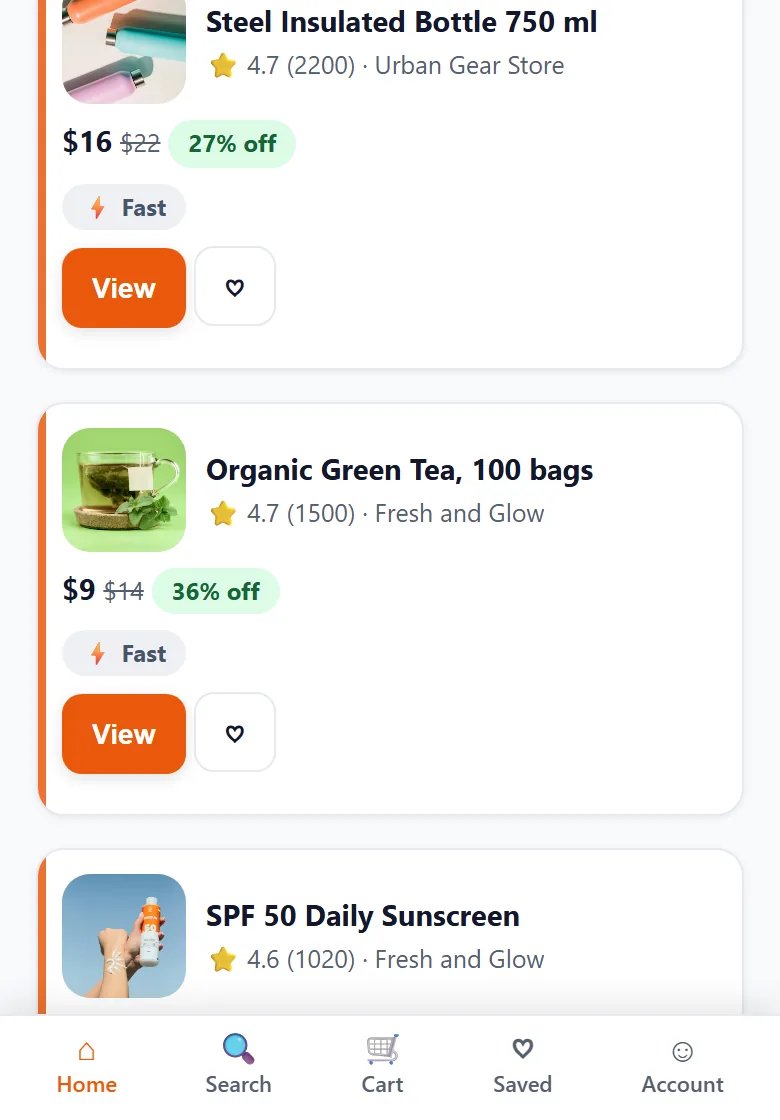
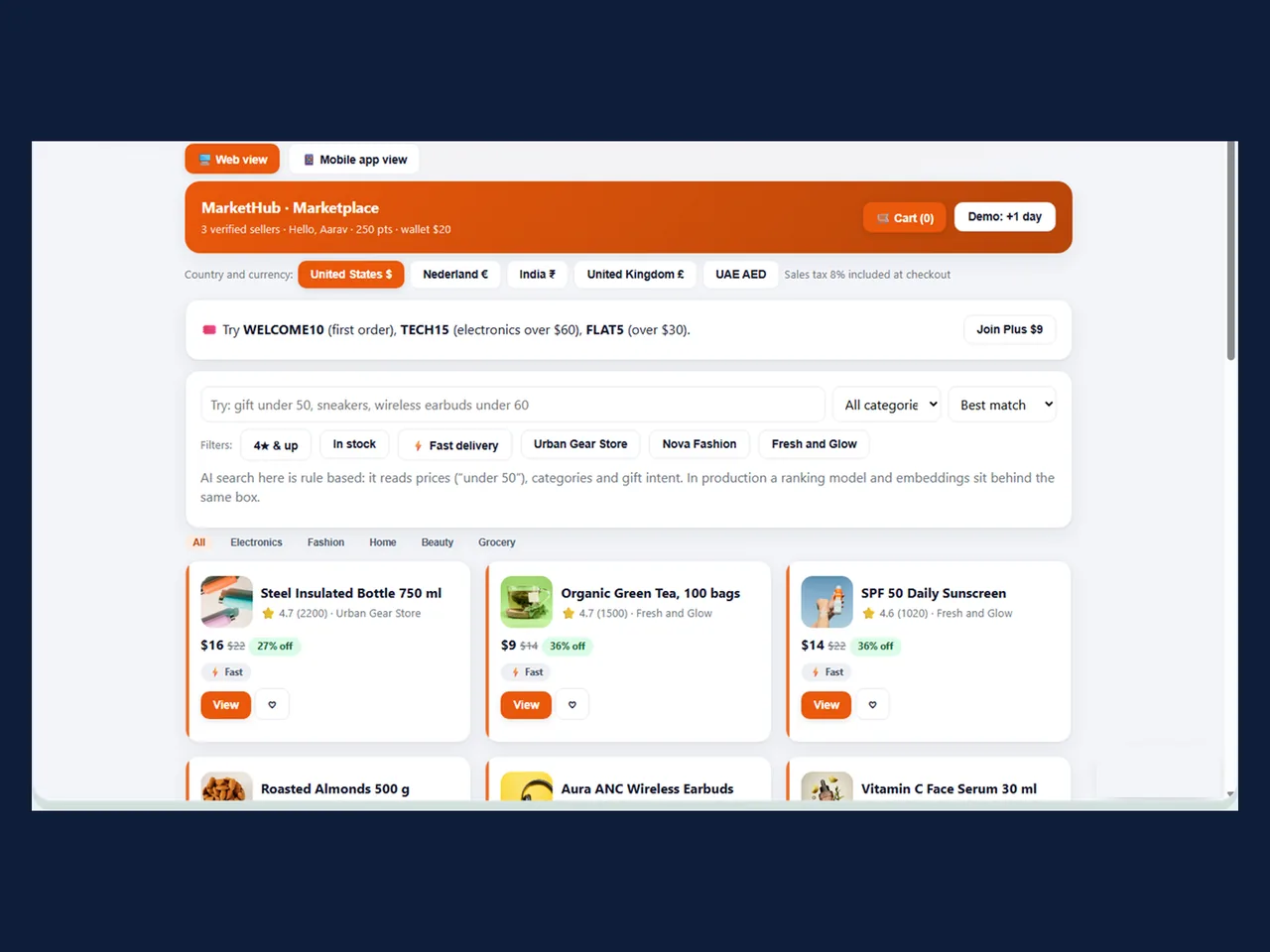
  • Online store product list with prices in US dollars, NNT Mart international e-commerce platform for Tehran, Iran
    Store in US dollars · international e-commerce platform for Tehran, Iran
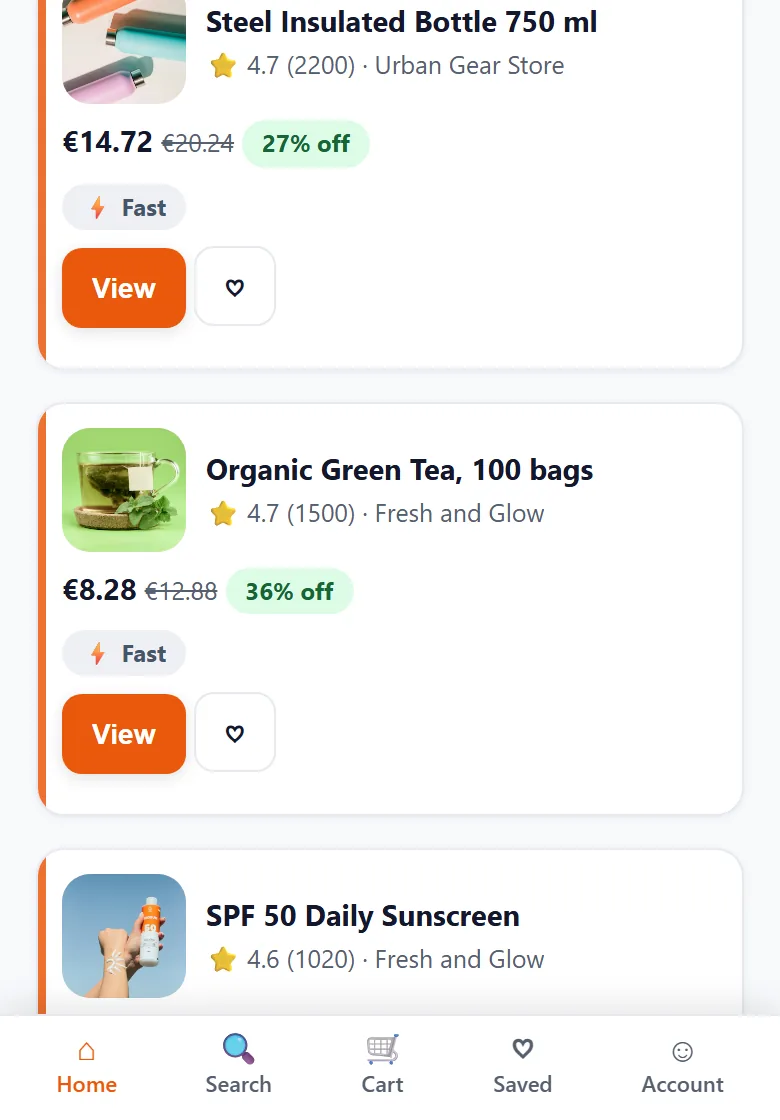
  • Online store product list with prices in euro for the Netherlands (international e-commerce platform demo for Tehran, Iran)
    Store in euro · international e-commerce platform for Tehran, Iran
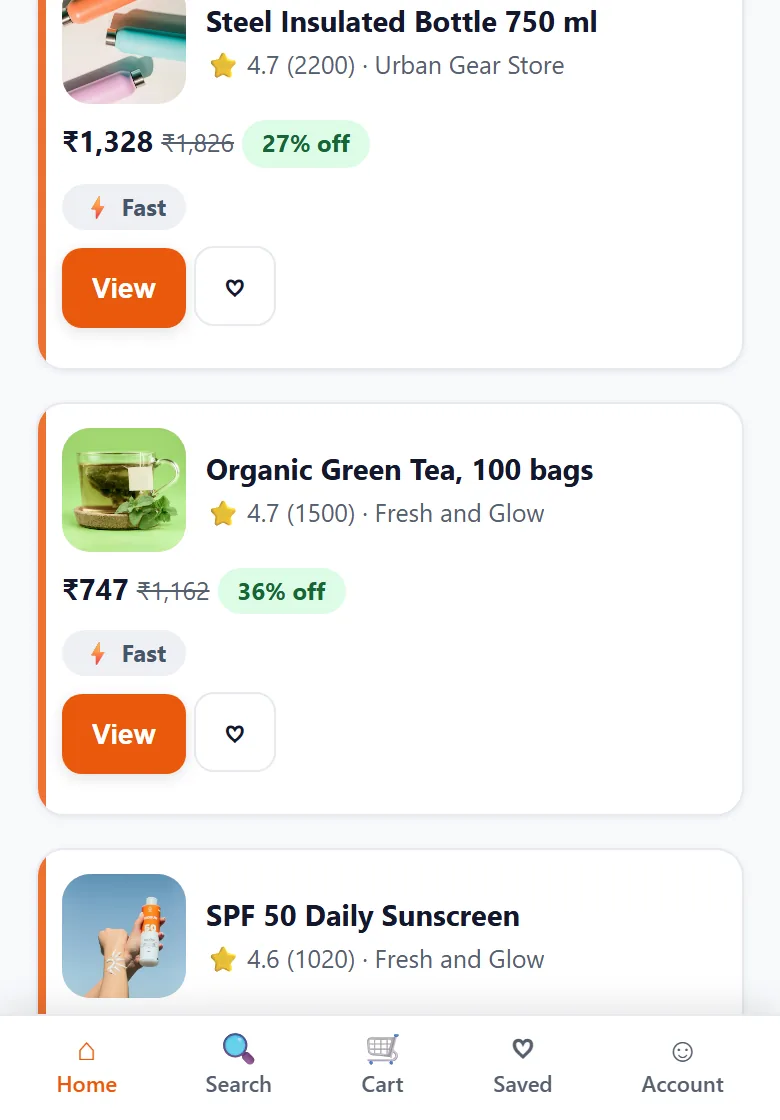
  • international e-commerce platform for Tehran, Iran: online store product list with prices in rupees for India
    Store in rupees · international e-commerce platform for Tehran, Iran
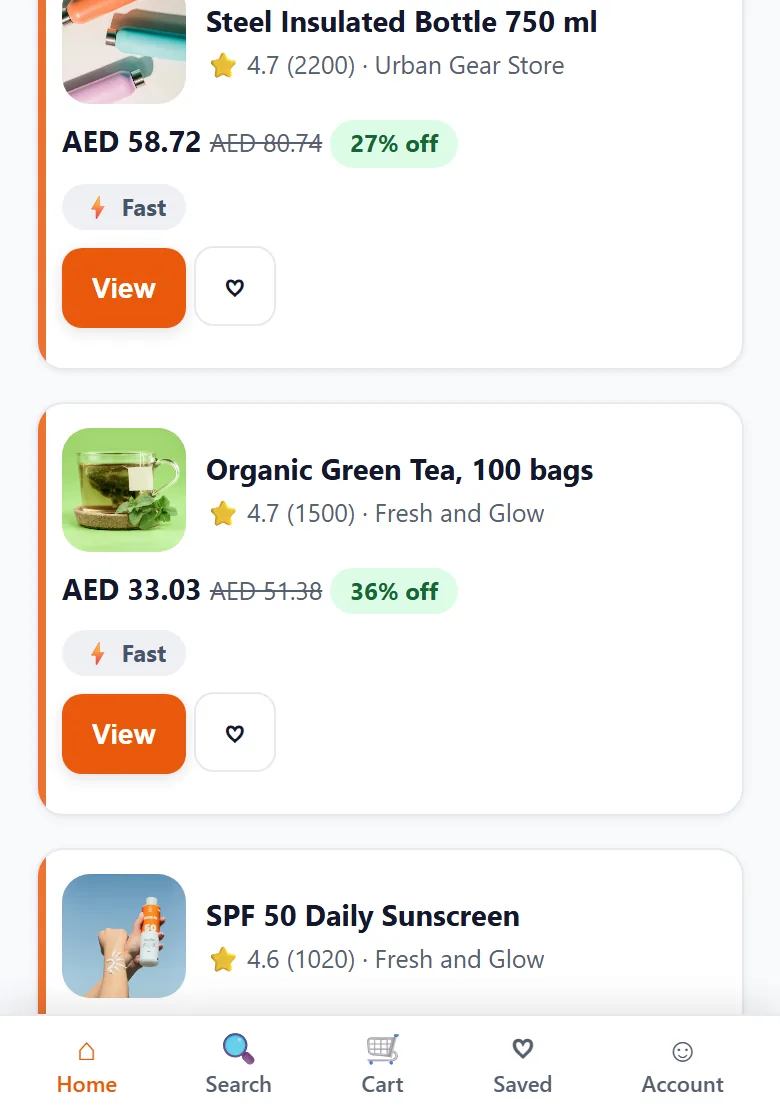
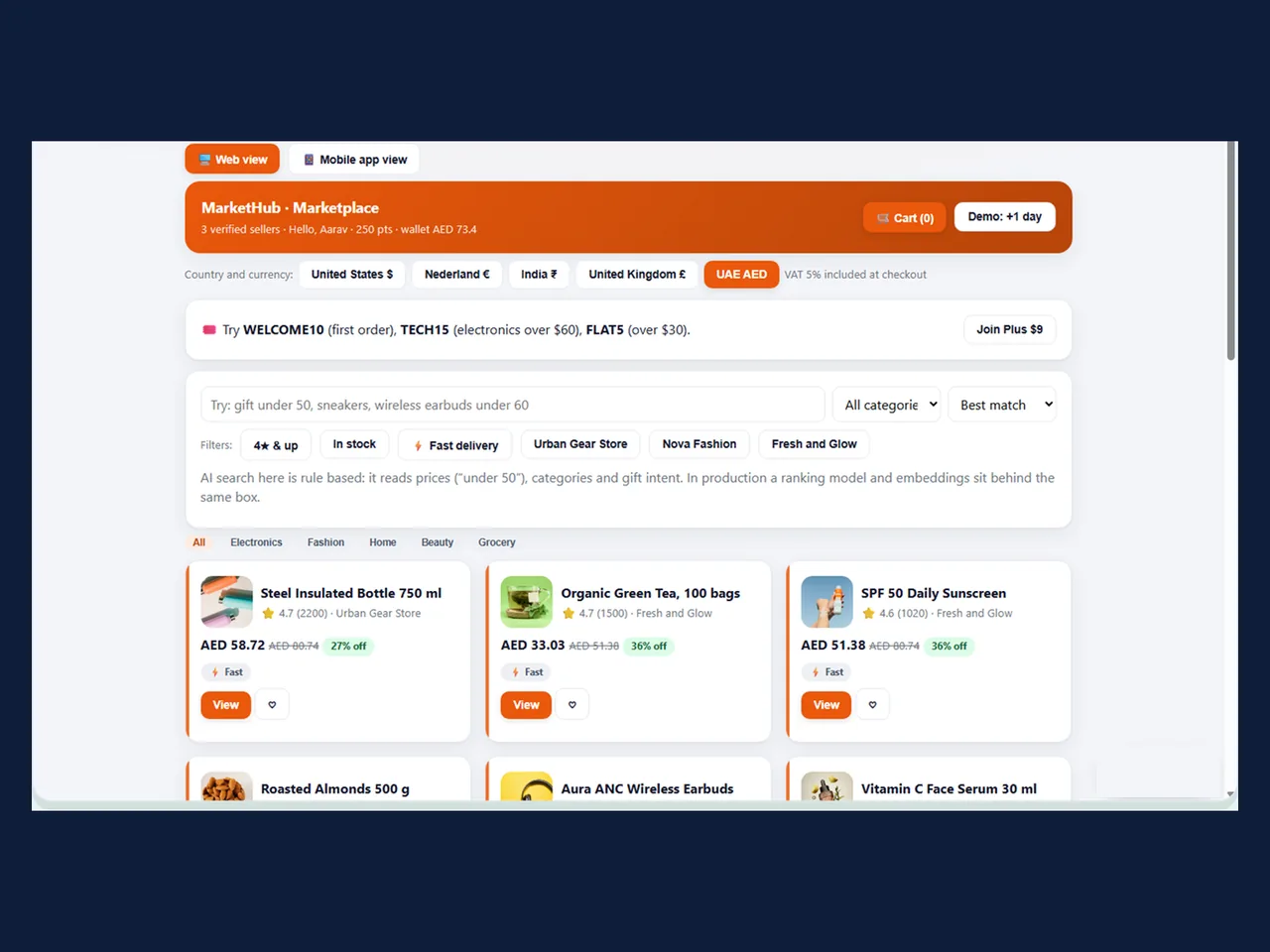
  • Online store product list with prices in AED for the UAE (international e-commerce platform demo for Tehran, Iran)
    Store in AED · international e-commerce platform for Tehran, Iran
  • Storefront for the United States with dollar prices and product cards (international e-commerce platform demo for Tehran, Iran)
    US storefront · international e-commerce platform for Tehran, Iran
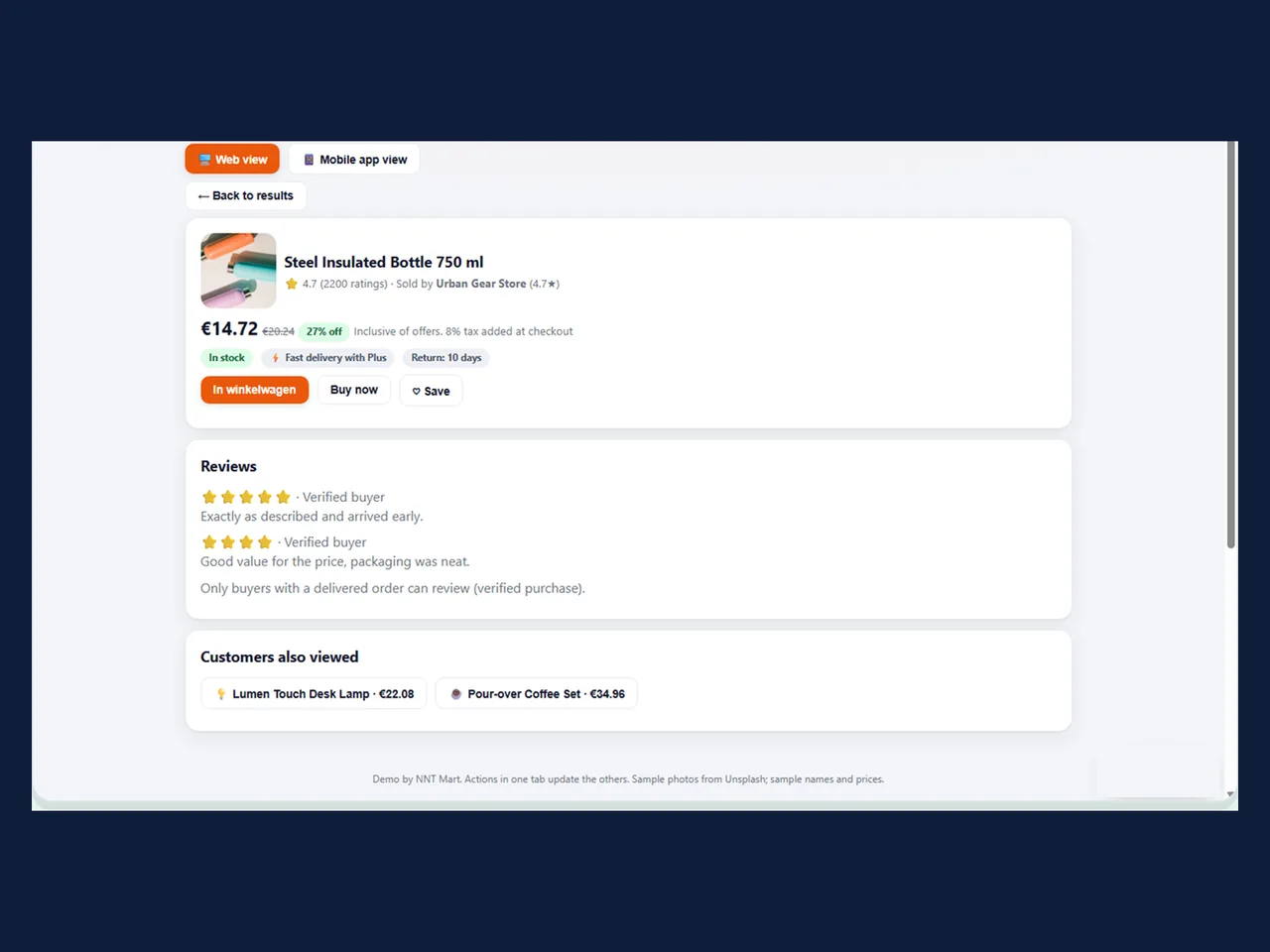
  • international e-commerce platform for Tehran, Iran: product page for the Netherlands with the price in euro and customer reviews
    Netherlands product page · international e-commerce platform for Tehran, Iran
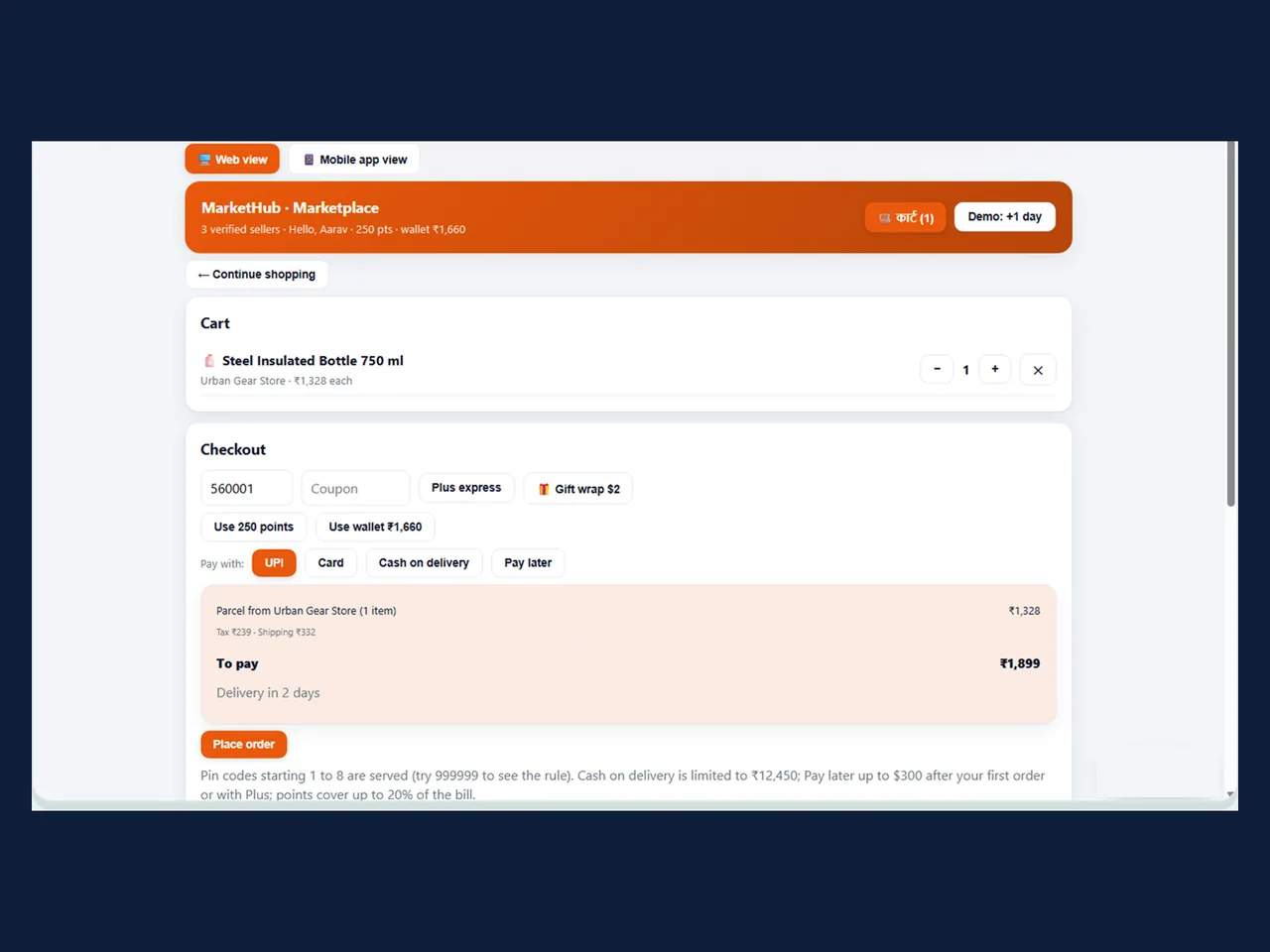
  • India checkout with PIN code, UPI and totals that include GST (international e-commerce platform demo for Tehran, Iran)
    India checkout · international e-commerce platform for Tehran, Iran
  • UAE storefront with prices in AED and local offers (international e-commerce platform demo for Tehran, Iran)
    UAE storefront · international e-commerce platform for Tehran, Iran
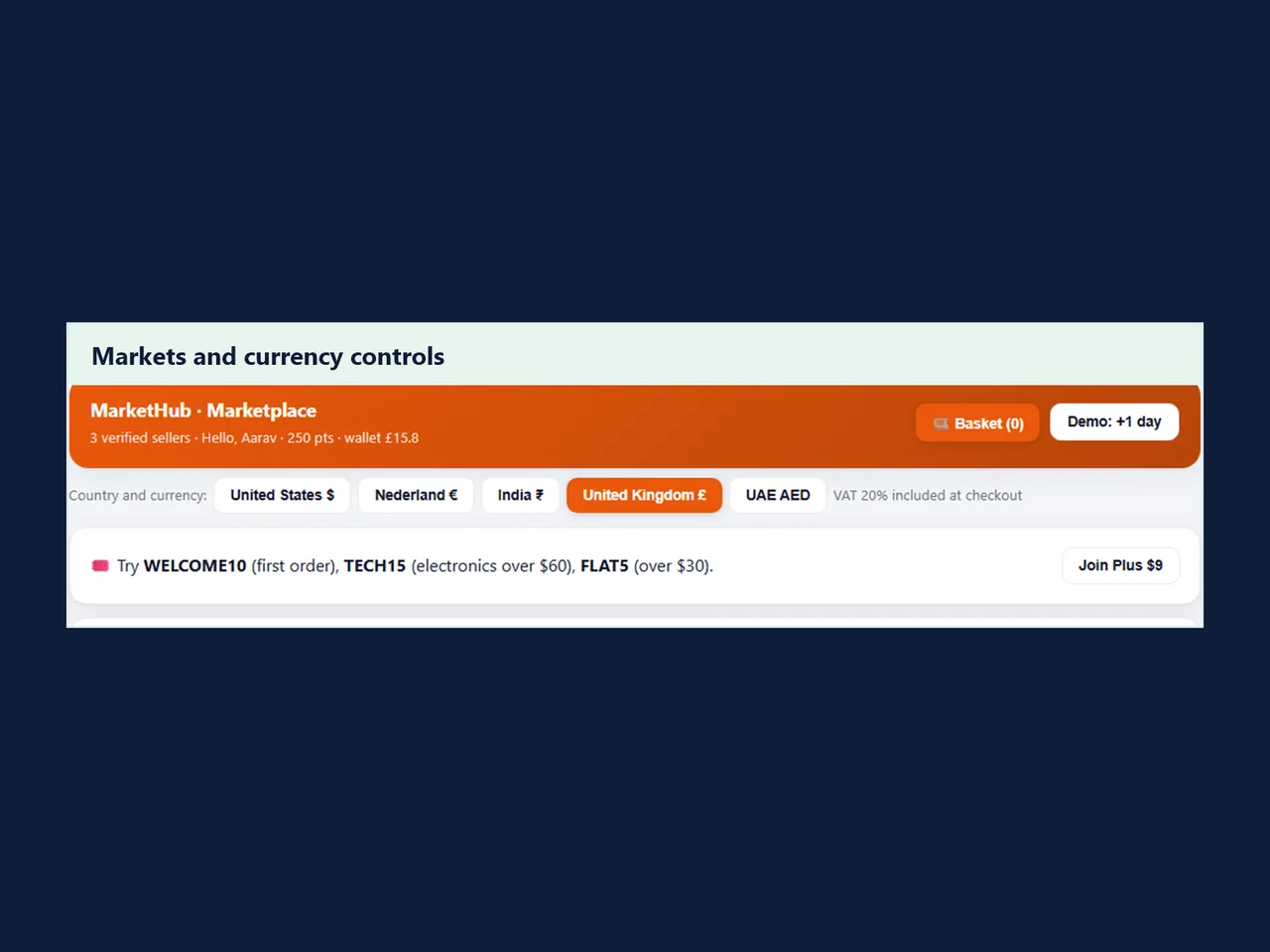
  • Market and currency controls for country, currency, tax and language (international e-commerce platform demo for Tehran, Iran)
    Markets and currency · international e-commerce platform for Tehran, Iran
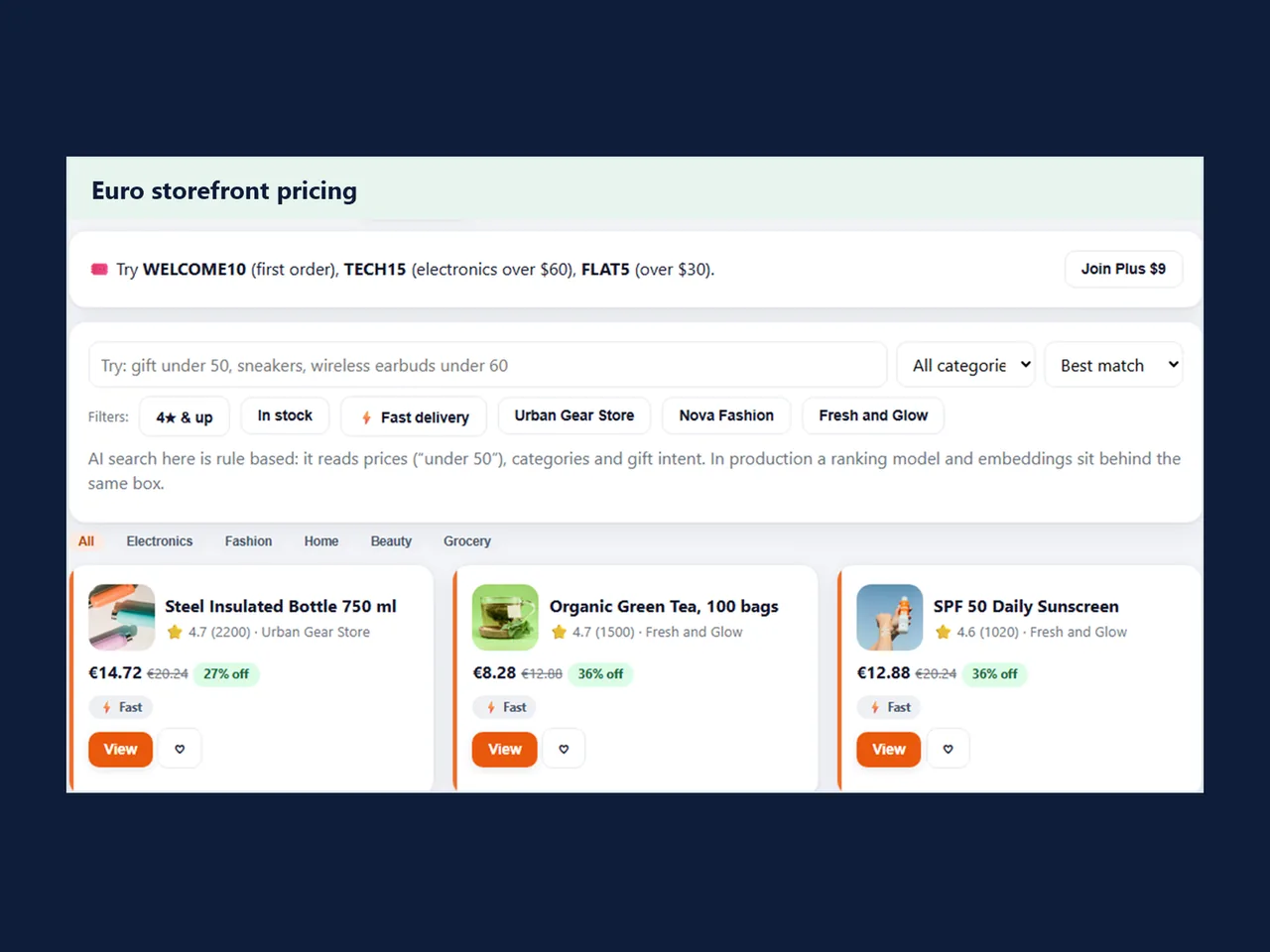
  • Euro storefront with local pricing and product cards, NNT Mart international e-commerce platform for Tehran, Iran
    Euro storefront · international e-commerce platform for Tehran, Iran
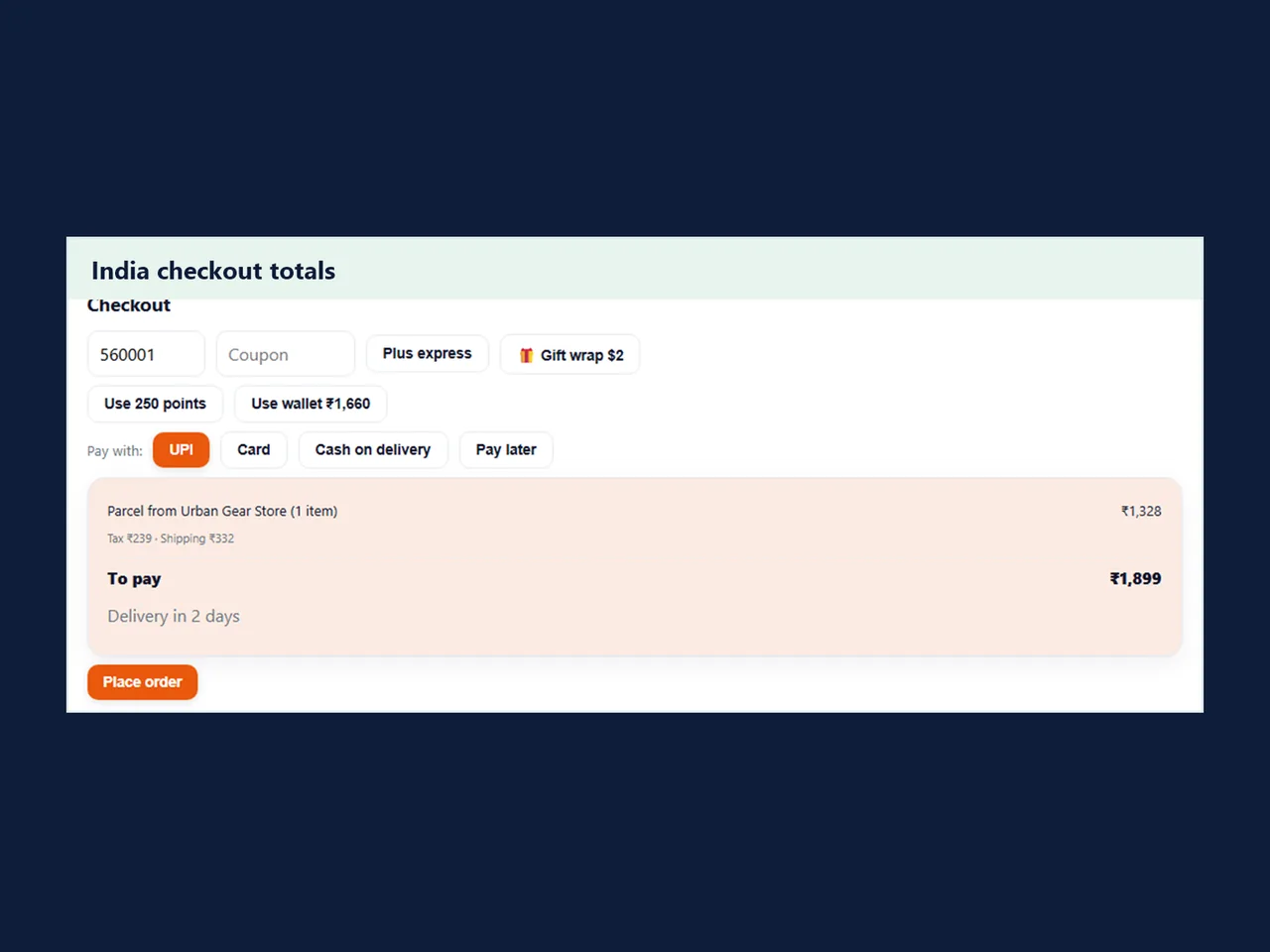
  • India checkout totals showing tax and shipping, payable in rupees (international e-commerce platform demo for Tehran, Iran)
    India checkout totals · international e-commerce platform for Tehran, Iran
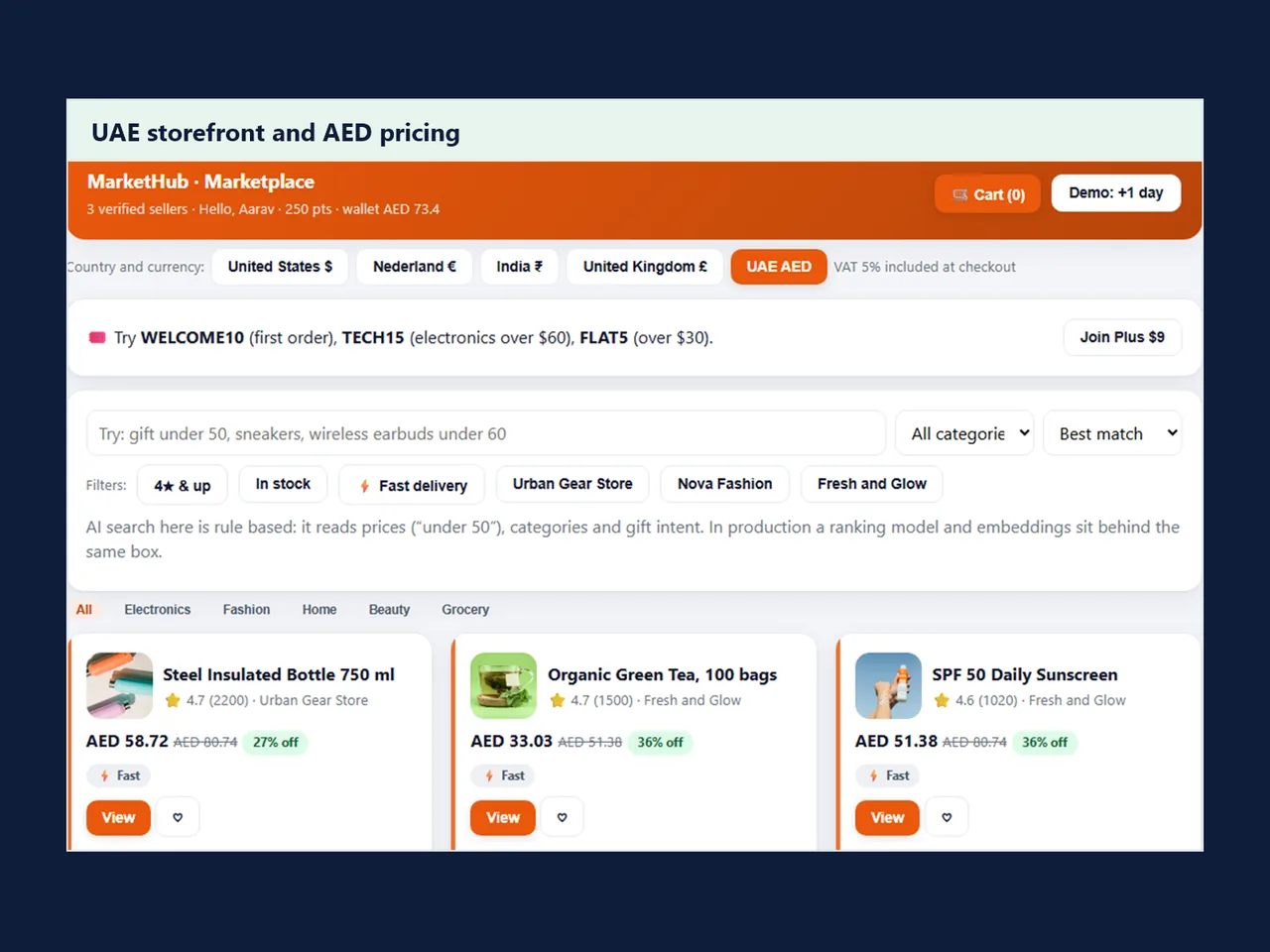
  • international e-commerce platform for Tehran, Iran: UAE storefront with prices in AED
    UAE storefront in AED · international e-commerce platform for Tehran, Iran

Project blueprint

Example: how we would build an international e-commerce platform for a business in Tehran

An illustrative example of how an engagement like this is scoped, from the first meeting to the first release. It is a worked example, not a client case study, and it carries no client names or results.

The market in Tehran

Tehran is shaped by retail, finance, services, manufacturing and IT. Electronics, fashion and home goods sell well online across Iran, shoppers already use Digikala and Divar, and they pay with Shetab domestic cards and Shaparak payment gateways. An international e-commerce platform here has to fit those habits from the first release.

The situation

A company in Tehran wants to sell to customers in other countries. Prices must show in local currency, checkout must support local payments, and tax, duties and delivery differ by market. The goal is one platform with market-specific pages.

Key decisions we would make

Market is a first-class setting

Currency, language, tax, shipping and payment methods are set per market, not hard-coded.

Local pages for each market

Properly tagged pages per market, with local currency and wording, so the right visitor finds the right page.

Landed cost shown at checkout

Tax and duty are shown where the model allows, so there are no surprise charges on delivery.

Data-law aware

Consent, retention and data location follow the rules of the markets served.

Checkout built around Shetab domestic cards and Shaparak payment gateways

Customers in Tehran pay with Shetab domestic cards and Shaparak payment gateways. The first release supports them through the gateway you choose, with every amount in Iranian rial (IRR) and refunds handled in the same admin.

Delivery, tax and data rules for Tehran

Orders ship through Iran Post and Tipax or your own team. Invoices are VAT-ready, customer data is handled under the Electronic Commerce Law and cybercrime rules, and returns follow the Electronic Commerce Law (2003) and the Consumer Rights Protection Law.

Working with your team in Tehran

Tehran runs on UTC+3:30, 2h behind India (IST). Meetings and demos are in your working hours, and content can run in Persian (Farsi) and Azerbaijani.

Delivery zones around Tehran

Zones and charges are set for Valiasr, Tajrish and the Tehran Grand Bazaar and the surrounding areas, with pickup points where customers prefer them. Logistics planning takes account of imam khomeini international airport, mehrabad airport and the tehran metro.

What the first release contains

  1. Multi-currency pricing with clear rounding rules
  2. Local payment methods for the first two markets
  3. Checkout with Shetab domestic cards and IRR pricing
  4. Translated store and market-specific pages
  5. Shipping rates and tax rules per market
  6. Reports by market and currency
  7. VAT-ready invoices and consent records for Tehran

Phased plan

PhaseWhat goes live
First marketOne new region with language, currency, payments, tax and shipping.
Multi-regionAdditional countries, local promotions and marketplace feeds.
OptimiseRegional apps, warehouses and localisation improvements.

Launch checklist for Tehran

The steps that differ by country and usually decide the go-live date. They run in parallel with the build.

  1. 1Open the merchant account for Shetab domestic cards and Shaparak payment gateways, with the documents your business category needs in Iran. This usually sets the go-live date, so it starts in week one.
  2. 2Set up VAT on products, shipping and invoices as the rules require: Iran charges 10% VAT (value-added tax) with e-commerce sellers registering through the Moodian tax system for….
  3. 3Publish a privacy notice and consent flow that follow the Electronic Commerce Law and cybercrime rules, and keep the records the law asks for.
  4. 4Write the returns, refund and delivery policy to meet the Electronic Commerce Law (2003) and the Consumer Rights Protection Law.
  5. 5Onboard Iran Post and Tipax for Tehran: rates, pickup, tracking links and failed-delivery rules.
  6. 6Prepare storefront and emails in Persian (Farsi) and Azerbaijani, with IRR formats, and review them with a native speaker.
  7. 7Agree support hours for Tehran (UTC+3:30) and the go-live window, then run a rehearsal order end to end.

Rules in Tehran and what we build for each

AreaWhat appliesWhat the build does
TaxIran charges 10% VAT (value-added tax) with e-commerce sellers registering through the Moodian tax system for electronic invoicesVAT-ready prices, invoices and tax reports.
Customer dataThe Electronic Commerce Law and cybercrime rules; data-protection rules are not consolidated in a single lawConsent capture, data export and deletion tools, retention rules.
Consumer rulesThe Electronic Commerce Law (2003) and the Consumer Rights Protection LawReturn window, refund flow and clear delivery and price terms.
PaymentsCustomers expect Shetab domestic cards and Shaparak payment gateways.Gateway adapters for Shetab domestic cards and Shaparak payment gateways, with IRR settlement.
DeliveryCommon carriers: Iran Post, Tipax and Mahex.Rate, label and tracking links, with zone and weight rules.

Rules are summarised for planning; your accountant and lawyer confirm what applies to your business.

Risks and how we handle them

RiskWhat we do about it
Payment methods missing in a marketMethods are researched per market before launch, and added through adapters.
Customs and returns are complexLogistics partners and return rules are agreed per market before go-live.
Translation qualityKey pages are reviewed by native speakers, not left to machine output alone.
Payment-provider approval in IranThe merchant application for Shetab domestic cards and Shaparak payment gateways starts in week one, in parallel with the build, with the documents your business category needs.
Local rules changeTax, consent and policy texts are settings, so a change in the Electronic Commerce Law and cybercrime rules or VAT rules does not need a new build.
Demand concentrated in TehranA city of about 8.7 million people can fill a first release quickly, so stock, delivery slots and support are sized for the launch weeks and reviewed weekly.

How success is measured

A live dashboard tracks conversion by country, international order share, checkout completion by payment method, delivery time by region from launch day.

What is not included

Customs filings, tax registration and legal advice for each market stay with you and your advisers.

Plan yours: free requirements meeting and demo in 24 hours

Key takeaways

  • Whatever your business sells in Tehran, N&T Software designs and develops the international e-commerce platform and the matching mobile app exactly to your requirements — your catalogue, your prices, your payment and delivery rules.
  • Checkout ready for Shetab domestic cards, Shaparak payment gateways (Zarinpal, IDPay) and Shatel and mobile wallets, with delivery through Iran Post and Tipax or your own team.
  • VAT-ready invoicing and controls designed around the Electronic Commerce Law and cybercrime rules; data-protection rules are not consolidated in a single law.
  • Free demo within 24 hours of the requirements meeting; you own 100% of the source code after final payment.

Why an international e-commerce platform makes sense for Tehran

Tehran is a capital and largest city of iran, where around 8.7 million people live and shop, and one of the markets in Iran where we build international and multi-region stores.

Key sectors include retail, finance, services, manufacturing and IT, with business districts such as Valiasr, Tajrish and the Tehran Grand Bazaar.

Logistics are supported by Imam Khomeini International Airport, Mehrabad Airport and the Tehran Metro, which matters when you promise customers fast delivery.

Iran’s online shopping is large and domestic: Digikala, Divar and Instagram dominate and Shetab cards process payments. International cards and many global cloud tools are unavailable, so stores here need local gateways and in-country hosting.

That is why more companies in Tehran are moving from phone, WhatsApp and spreadsheet orders to a proper international e-commerce platform — one place where products, prices, payments, orders and customers are managed together.

Why going digital matters for a business in Tehran

Customers in Iran already pay with Shetab domestic cards and Shaparak payment gateways (Zarinpal, IDPay) and compare prices on Digikala and Divar before they decide. Tehran alone has about 8.7 million people, and a business that cannot be found, ordered from and paid online loses that buyer at the moment of choice.

Staying offline-only also hides your best data. A international e-commerce platform shows which products, areas and customers in Tehran earn money, which is how electronics, fashion and home goods sellers in Iran decide what to stock and promote.

It is also a compliance move. VAT-ready invoices and records, and customer data handled under the Electronic Commerce Law and cybercrime rules, are far easier to keep right in one system than across notebooks and chat threads.

AreaOffline and chat ordersWith your own international e-commerce platform in Tehran
OrdersPhone, WhatsApp, spreadsheets; open only in shop hoursTaken 24 hours a day, tracked end to end
PaymentsCash and manual follow-upShetab domestic cards and Shaparak payment gateways (Zarinpal, IDPay) and other local methods at checkout
ReachWalk-ins and word of mouthSearch, social, Digikala and Divar and a link anyone can share
RecordsPaper and chat historyVAT invoices, customer and stock data in one place

What makes a Tehran store feel local

Conversion in Tehran depends on small local signals — the right currency, the right words and the right payment and courier names.

Currency and pricing

Everything a Tehran shopper sees — price, tax, delivery fee, refund — is in IRR, written the local way.

Language and content

Content can be produced in Persian (Farsi), Azerbaijani and Kurdish, so a Tehran customer reads the store in the language they use at home.

Local trust signals

Trust is local: familiar names such as Shetab domestic cards and Shaparak payment gateways (Zarinpal, IDPay) and Iran Post sit next to the buy button.

Domain, phone and contact

A .ir domain (or your own) builds local trust and search relevance. Contact buttons are pre-set with +98, so a customer in Tehran taps once to call or message.

Talent and partners nearby

Tehran draws on University of Tehran, Sharif University of Technology and Amirkabir University, which means plenty of local staff, interns and technology partners to run the store after launch.

An international e-commerce platform built around your Tehran business

Whatever your business sells in Tehran, N&T Software designs and develops the international e-commerce platform and the matching mobile app exactly to your requirements — your catalogue, your prices, your payment and delivery rules.

Typical clients include D2C brands expanding abroad, manufacturers selling to distributors overseas, diaspora-focused retailers and tourism and gifting businesses. Categories that sell especially well online in Iran — electronics, fashion, home goods and food and saffron — get catalogue structures and filters designed for them.

Before any commitment you get a free requirements meeting, a demo built on your use case and a proposal priced to your budget.

What to build first for your Tehran business

For Tehran, we suggest this sequence, so the first release already takes orders and later releases add the rest:

  1. First market: One new region with language, currency, payments, tax and shipping. Set up for IRR, Shetab domestic cards and Iran Post.
  2. Multi-region: Additional countries, local promotions and marketplace feeds.
  3. Optimise: Regional apps, warehouses and localisation improvements.

Core modules we build for Tehran clients

Nothing here is fixed: modules are switched on, reshaped or built from scratch around how your Tehran business sells.

Regional storefronts

Country or region sites with local language, content, currency, promotions and hreflang SEO. Couriers such as Iran Post, Tipax and Mahex plug in alongside your own fleet for Tehran orders.

Local payments

Market-specific cards, wallets, bank transfers, BNPL and cash methods through suitable providers. Inventory can sit in Tehran, in a partner warehouse or across Iran, with click-and-collect where customers want it.

Tax and duties

VAT, GST and sales-tax rules, tax-inclusive pricing, duties and landed-cost estimates where needed. Dashboards break sales down by product, customer and neighbourhood of Tehran, so you see what to promote.

Cross-border shipping

International couriers, regional warehouses, shipping zones, customs documents and returns. Content and design can follow how customers in Tehran search and buy, including Persian (Farsi) and Azerbaijani where you need it.

Compliance pages

Market-appropriate privacy notices, cookie consent, consumer terms and accessibility considerations. Product data imports from your existing sheets or ERP, so Tehran teams do not re-type thousands of items.

Regional reporting

Sales, margin, conversion and marketing performance by country and currency. Payment steps are built around Shetab domestic cards, Shaparak payment gateways (Zarinpal, IDPay) and Shatel and mobile wallets, the options shoppers here already trust.

What businesses in Tehran ask us for

Businesses in Tehran search for these in different words. Each one is something NNT Mart designs, builds and supports:

International ecommerce platform in Tehran

Country or region sites with local language, content, currency, promotions and hreflang SEO. In Tehran it takes Shetab domestic cards at checkout and ships through Iran Post.

Cross-border ecommerce development in Tehran

Market-specific cards, wallets, bank transfers, BNPL and cash methods through suitable providers. For Tehran, prices, tax and invoices are in IRR and VAT-ready.

Multi-currency online store in Tehran

VAT, GST and sales-tax rules, tax-inclusive pricing, duties and landed-cost estimates where needed. Built for Tehran: Shetab domestic cards and Shaparak payment gateways payments and Iran Post delivery.

Multi-language ecommerce website in Tehran

International couriers, regional warehouses, shipping zones, customs documents and returns. In Tehran it takes Shetab domestic cards at checkout and ships through Iran Post.

Global ecommerce solution in Tehran

Market-appropriate privacy notices, cookie consent, consumer terms and accessibility considerations. For Tehran, prices, tax and invoices are in IRR and VAT-ready.

Export ecommerce website in Tehran

Sales, margin, conversion and marketing performance by country and currency. Built for Tehran: Shetab domestic cards and Shaparak payment gateways payments and Iran Post delivery.

Multi-country store setup in Tehran

Country or region sites with local language, content, currency, promotions and hreflang SEO. In Tehran it takes Shetab domestic cards at checkout and ships through Iran Post.

Cross-border payments ecommerce in Tehran

Market-specific cards, wallets, bank transfers, BNPL and cash methods through suitable providers. For Tehran, prices, tax and invoices are in IRR and VAT-ready.

What an international e-commerce platform gives your Tehran business

The gain is practical and measurable:

Keep the customer and the margin

Orders that come through your own international e-commerce platform keep your pricing, brand and customer list, instead of paying commission on Digikala and Divar for every sale.

Sell round the clock to Tehran

Customers order and pay at any hour, including evenings and weekends, with Shetab domestic cards and Shaparak payment gateways (Zarinpal, IDPay) at checkout, so sales no longer depend on shop hours.

Run the business from one place

Regional storefronts and local payments sit in one admin, connected to multi-currency payment providers, so the team stops re-typing orders and stock.

See what works

A live dashboard tracks conversion by country, international order share and checkout completion by payment method, so Tehran decisions on stock, offers and spend come from numbers, not guesses.

Reach customers on their phones

An Android and iOS app on the same backend adds push alerts, saved details and one-tap reorder for repeat buyers in Tehran.

Be found by search and AI assistants

Fast pages, product and FAQ schema, a sitemap and direct-answer content let Google and AI assistants read, quote and recommend your international e-commerce platform when Tehran customers ask.

Take orders on WhatsApp and the app

Customers in Tehran can start an order from a link, WhatsApp or the mobile app and finish it in one checkout, so no enquiry is lost in a chat thread.

Own the technology

After final payment you receive 100% of the source code, design files and documentation, with a 90-day warranty, so growth never depends on a licence you cannot move.

Who we build for in Tehran

Popular online categories in Iran include electronics, fashion, home goods, food and saffron, carpets and crafts and cosmetics. Local demand in Tehran is shaped by retail, finance, services, manufacturing and IT, so we often design catalogues and B2B ordering around those sectors. In Tehran, we most often build international and multi-region stores for:

Exporters

For exporters, we usually start with local payments, then add multi-currency payment providers once orders are flowing.

D2C brands expanding abroad

Catalogue, pricing and fulfilment rules designed for D2C brands expanding abroad in Tehran, connected to the systems you already use.

Manufacturers selling to distributors overseas

Manufacturers selling to distributors overseas get tax and duties plus compliance pages workflows tailored to their operations.

Diaspora-focused retailers

We map how diaspora-focused retailers sell today and digitise it end to end — from enquiry and order to payment, dispatch and repeat purchase.

Tourism and gifting businesses

For tourism and gifting businesses, we usually start with regional reporting, then add geo-IP and consent platforms once orders are flowing.

Multi-country retail groups

Catalogue, pricing and fulfilment rules designed for multi-country retail groups in Tehran, connected to the systems you already use.

Checkout and payment methods for Tehran

Checkout is where most online sales are won or lost. In Iran, customers expect to pay with Shetab domestic cards, Shaparak payment gateways (Zarinpal, IDPay) and Shatel and mobile wallets, and many also look for cash on delivery and bank transfer.

We integrate suitable gateways and providers for your business category and merchant eligibility, handle payment status, failed-payment retries and refunds, and keep sensitive card data with the provider rather than on your servers. All amounts are shown in Iranian rial (IRR).

Zone-based payment rules let you offer different options for Valiasr than for outer parts of Tehran.

  • Shatel and mobile wallets
  • Shaparak payment gateways (Zarinpal, IDPay)
  • Cash on delivery
  • Shetab domestic cards
  • Bank transfer

Fulfilment options for Tehran orders

Your international e-commerce platform can book shipments and share tracking with Iran Post, Tipax, Mahex, Snapp! Express, Alopeyk and Chapar, or route orders to your own riders and stores across Tehran.

Delivery rules can price by distance, weight, postcode or zone, offer same-day slots in dense areas, and switch on pickup points or click-and-collect where customers prefer them.

Connectivity in the area — Imam Khomeini International Airport, Mehrabad Airport and the Tehran Metro — makes regional and national dispatch from Tehran practical.

Your own store alongside Digikala and Divar

Selling in Tehran through Digikala, Divar and Basalam gets you reach quickly, yet the buyer belongs to the platform, not to you.

Your international e-commerce platform becomes the hub: marketplaces and social shops become extra outlets fed from one catalogue, while repeat customers buy directly from you at better margins.

Tax, invoicing and compliance in Iran

For Tehran sellers, tax first: Iran charges 10% VAT (value-added tax) with e-commerce sellers registering through the Moodian tax system for electronic invoices.

Customer data is handled with the Electronic Commerce Law and cybercrime rules; data-protection rules are not consolidated in a single law in mind, and the storefront follows the Electronic Commerce Law (2003) and the Consumer Rights Protection Law.

We build the technical controls — tax-inclusive pricing, compliant invoices, consent banners, terms and return pages, data-access roles and audit logs. We are not a law firm, so final legal and tax positions should be confirmed with your own adviser in Iran.

Android and iOS apps for your Tehran business

In Tehran, shoppers browse on phones first. Region-aware mobile apps can switch language, currency and payment options automatically while sharing one codebase and backend.

For shopping app development company in Tehran: one team builds the Android and iOS shopping app and the store behind it, and the ecommerce mobile app cost depends on your screens, integrations and team size.

One backend serves the website and the apps, and the apps ship under your own Google Play and App Store accounts — so what you change once appears everywhere.

Order alerts, offers and abandoned-cart reminders go out on Tehran time (UTC+3:30), in Persian (Farsi) and Azerbaijani if you want.

  • Marketplace feeds by country
  • ERP and accounting
  • Regional analytics
  • Translation management
  • Geo-IP and consent platforms
  • Tax engines
  • International couriers and 3PLs
  • Multi-currency payment providers

Integrations above are examples; we connect any system that offers a suitable API, database access or approved import and export process.

Launch roadmap and success metrics

Value first, depth later. For an international e-commerce platform serving Tehran, the usual sequence looks like this:

PhaseWhat goes live
First marketOne new region with language, currency, payments, tax and shipping. Configured for IRR, Shetab domestic cards and Iran Post from the start.
Multi-regionAdditional countries, local promotions and marketplace feeds.
OptimiseRegional apps, warehouses and localisation improvements. Reviewed against how Tehran customers actually buy.

Success is measured on conversion by country, international order share, checkout completion by payment method, delivery time by region, return rate abroad and margin after duties and shipping — tracked on a dashboard you can see from launch day.

Working with our team from Tehran

Our team covers UTC+3:30 — 2h behind India (IST) — through three 8-hour shifts, so a Tehran client always reaches someone during the local working day.

Project communication is in English; storefront content can be produced in Persian. You get a named lead, direct engineer access and an NDA if you ask.

Our head office is in Chhapi, Gujarat, with an office in Hyderabad and representation in Nigeria, South Africa, Ethiopia and Zambia; Tehran clients are served remotely with on-site workshops when the project needs them.

Tehran — local market for international and multi-region stores
Tehran · Photo: Wikimedia Commons
Night view of Earth showing connected international markets — Tehran

Tehran — the market we build for

Container ship at port carrying cross-border e-commerce orders — Tehran
International & Multi-Region Commerce

International & Multi-Region Commerce in Tehran: cost, timeline and local setup

There is no fixed package. Your budget and launch date are set from your requirements in a free meeting, and a working demo follows within 24 hours. The quote is given in Iranian rial (IRR) or US dollars, split into milestones you approve one by one.

What decides the cost in Tehran

Catalogue and rules
Number of products, variants and price lists your Tehran customers see.
Payments
How many of Shetab domestic cards, Shaparak payment gateways (Zarinpal, IDPay) and Shatel and mobile wallets you need at checkout, with amounts in Iranian rial (IRR).
Delivery
Courier links such as Iran Post and Tipax, own riders, pickup points or zone-based rates.
Tax and law
Iran charges 10% VAT (value-added tax) with e-commerce sellers registering through the Moodian tax system for electronic invoices; consent and policies under the Electronic Commerce Law and cybercrime rules; data-protection rules are not consolidated in a single law.
Languages
Storefront, emails and invoices in Persian (Farsi), Azerbaijani and Kurdish and English.
Integrations
ERP, accounting, CRM and marketplaces like Digikala and Divar.
Mobile apps
Android and iOS apps for customers, staff or dealers on the same backend.

How the timeline is set

  1. Requirements meeting — online, in your time zone (UTC+3:30).
  2. Demo within 24 hours — so you see the international e-commerce platform before you commit.
  3. Written scope, budget and dates — agreed to your deadline, with priority journeys first.
  4. Two-week sprints — a demo every sprint and a daily written update.
  5. Launch and 90-day warranty — then optional fixed-fee support.

Rules we build for in Iran

  • Tax: Iran charges 10% VAT (value-added tax) with e-commerce sellers registering through the Moodian tax system for electronic invoices.
  • Privacy: the Electronic Commerce Law and cybercrime rules; data-protection rules are not consolidated in a single law
  • Consumer: the Electronic Commerce Law (2003) and the Consumer Rights Protection Law

Local payment rails in Iran

  • Shetab domestic cards
  • Shaparak payment gateways (Zarinpal, IDPay)
  • Shatel and mobile wallets
  • cash on delivery
  • bank transfer

How we work

How we deliver your international e-commerce platform in Tehran

Your international e-commerce platform is designed and built to your specification through seven clear stages. Daily updates, weekly reviews and a signed acceptance at each milestone keep the project transparent from the first workshop to the support desk.

  1. 01

    Discover

    ✓ Markets agreed

  2. 02

    Design

    ✓ Regions designed

  3. 03

    Build

    ✓ Sprint accepted

  4. 04

    Secure & Test

    ✓ Market UAT done

  5. 05

    Deploy

    ✓ Region live

  6. 06

    Handover

    ✓ Handover signed

  7. 07

    Support

    ✓ SLA active

A milestone payment plan built around acceptance

There is no standard price list, because every international e-commerce platform is quoted to your requirements and budget. What is standard is how you pay: a small advance, then milestones released only after written acceptance. An example:

After go-live: warranty, support and a team that stays

Every project includes a free 90-day defect warranty. After that, the same team that built your international e-commerce platform keeps it secure, updated and running on a fixed annual fee agreed up front — no open-ended hourly billing and no surprise invoices.

You own the code, the data and the IP

For every international e-commerce platform, upon full and final payment the complete source code and intellectual property are transferred to you — so you can host, maintain and enhance the system with any developer.

Read the full International & Multi-Region Commerce delivery process — reporting, payment milestones, warranty, team and engagement models →

International & Multi-Region Commerce in Tehran — FAQs

Can I also sell on Digikala and Divar?

Yes. Your own international e-commerce platform can sit alongside Digikala, Divar and Basalam; where APIs allow, we sync products, stock and orders so your team manages everything from one admin.

Is the platform compliant with local tax and privacy law in Iran?

We build the technical controls — tax-inclusive pricing, compliant invoices and consent management — with the Electronic Commerce Law and cybercrime rules; data-protection rules are not consolidated in a single law in mind. Final legal and tax positions should be confirmed with your adviser.

What time zone and language will we work in for a Tehran project?

Tehran runs on UTC+3:30 (2h behind India (IST)). We reply within 10 minutes around the clock, meet in your working hours and write storefront content in Persian (Farsi), Azerbaijani and Kurdish as well as English.

Which parts of Tehran do you build for?

Clients usually trade around Valiasr, Tajrish and the Tehran Grand Bazaar, but the platform is not tied to one neighbourhood: delivery zones, pickup points and prices can be set for any part of Tehran.

Do I own the source code of my international e-commerce platform?

Yes. After full and final payment, 100% of the source code, design files, database schemas, deployment scripts and documentation are transferred to you, with no lock-in or forced subscription.

What sells best online in Tehran?

Electronics, fashion, home goods and food and saffron are strong online categories in Iran, and local demand in Tehran is shaped by retail, finance, services, manufacturing and IT. We shape the catalogue, filters and checkout around what your own customers buy.

Can you migrate my existing website or store in Tehran?

Yes. We review your current platform, products, customers, orders and URLs, then migrate with redirects so you keep search rankings and order history.

Do you provide support after launch for clients in Tehran?

Every project includes a free 90-day defect warranty, followed by an optional fixed-fee annual support package with a dedicated developer, SLA-based fixes and a 24×7 helpdesk across three shifts.

Is there an international e-commerce platform development company near me in Tehran?

Yes, you can work with NNT Mart from Tehran without a local presence. The team meets you online in your time zone (2h behind India (IST)), answers within 10 minutes and shares a working demo within 24 hours of the requirements meeting.

How do I choose the best international e-commerce platform development company for Tehran?

Choose the team that builds to your requirements instead of a fixed template, supports the payments and couriers your customers use, transfers the full source code and stands behind the launch. NNT Mart builds custom, supports Shetab domestic cards, Shaparak payment gateways (Zarinpal, IDPay) and Shatel and mobile wallets and Iran Post, transfers 100% of the source code after final payment and includes a free 90-day defect warranty.

Shopify or a custom international e-commerce platform — which is better for a Tehran business?

Shopify suits a small catalogue that fits its templates and apps, with monthly fees and app costs that grow with you. A custom international e-commerce platform from NNT Mart fits your own pricing, payment (Shetab domestic cards and Shaparak payment gateways (Zarinpal, IDPay)), delivery and approval rules, has no per-sale platform fee, and you own the full source code.

What do I need to start selling online in Tehran?

A registered business, a bank account for settlements, a payment gateway account (Shetab domestic cards and Shaparak payment gateways (Zarinpal, IDPay) are common in Iran), a delivery partner such as Iran Post, your product list with photos and prices, and your VAT and return policies. NNT Mart helps set up the gateway, courier and store itself.

Can I manage products, prices and orders myself without coding?

Yes. Every NNT Mart international e-commerce platform has an admin panel where your team adds products, changes prices and stock, runs offers and handles orders, refunds and invoices without a developer. Staff roles control who can see and change what, and training is part of the handover.

Is NNT Mart an ecommerce agency or an ecommerce platform for Tehran businesses?

Both. NNT Mart is the e-commerce platform of N&T Group, built and managed by N & T Software Private Limited. It works as your development partner: we design, build, launch and support online stores, B2B ecommerce portals, marketplaces and shopping apps to your requirements.

Can the store and this website be used in my language in Tehran?

Yes. This website can be read in 130+ languages through the language switcher in the header, and your store is built multilingual: storefront, checkout and emails in Persian (Farsi), Azerbaijani and Kurdish, right-to-left layouts where needed, and prices in Iranian rial.

Will my store rank on Google and appear in AI answers in Tehran?

We build it search-ready: fast pages, clean URLs, product and FAQ schema, XML sitemaps and mobile-first design, so Google and AI assistants can read and quote your pages. Rankings depend on competition and content, so we do not promise a position.

Free demo in 24 hours

Plan your international e-commerce platform in Tehran

Tell us what you sell and how you take orders today. We reply within 10 minutes, meet you to understand your requirements, and share a working demo within 24 hours.

We reply within 10 minutes, 24×7. Your details are used only to respond to your enquiry — see our privacy policy.

Tell us what you sell. We will show you a working demo in 24 hours.

Free requirements meeting, a demo built on your use case and a proposal priced to your budget — with no obligation.

Our prototypes

Try a live demo, then get yours built

All live demos →

Tagged with